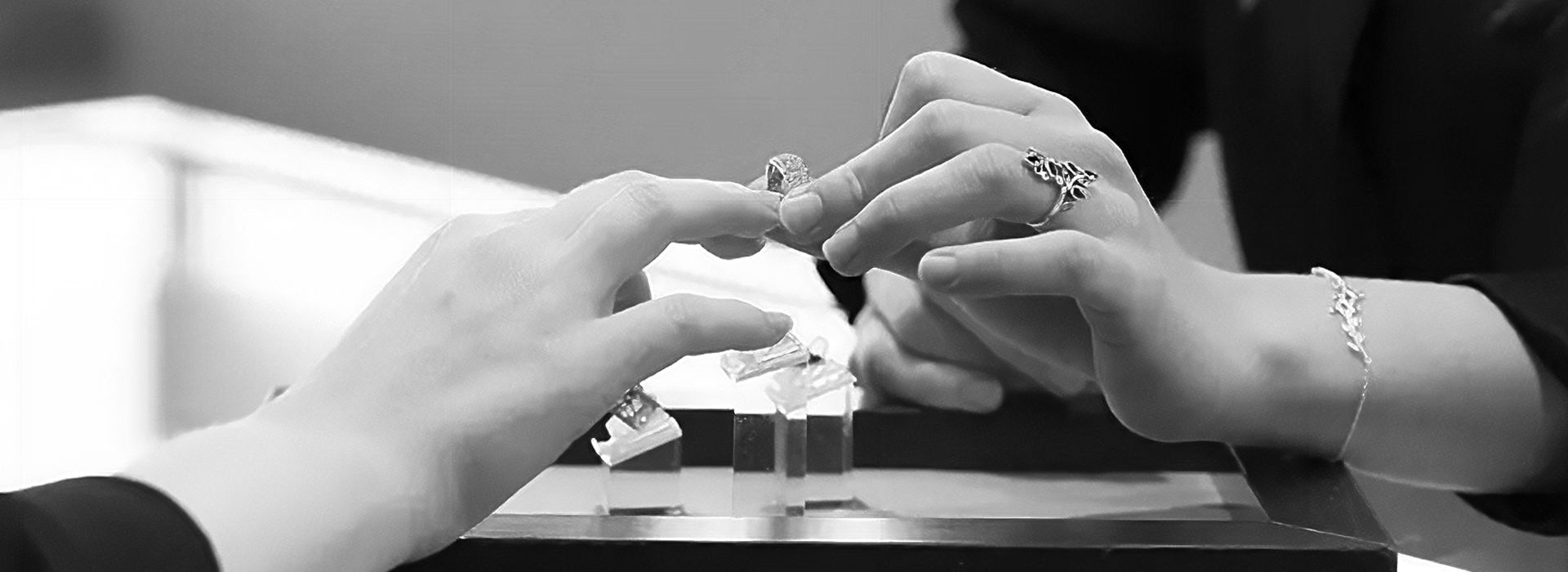
Did you receive a piece of jewelry that doesn't fit? Whether it was a mistake when buying it, a family heirloom passed down to you, a wedding band that's become too tight, or a necklace you received as a gift but find a little too short for your taste—there are many reasons why you might want to resize a piece of jewelry.
A ring can become too big or too tight and cause discomfort. A bracelet may be too loose, or a necklace too short to hang at the right height. Some gold rings can be easily resized by a jeweler, while others—particularly those made of ceramic, tungsten, or palladium—present more challenges, or may even be impossible to alter. The same applies to bracelets and necklaces: jewelry made of links can generally be shortened or lengthened without difficulty, while rigid designs require more careful consideration.
At MATY, every request for a size adjustment is accompanied by a free professional assessment to evaluate the feasibility of the work, ensure the jewelry’s structural integrity, and preserve its aesthetic appeal. This guide provides an overview of the possible solutions for resizing a ring, bracelet, or necklace, broken down by material and specific situation.
CONTACT MATY TO SUBMIT A REQUEST >
Contents
- When and why should you resize a piece of jewelry?
- Should you have a piece of jewelry altered right away?
- What types of jewelry can be resized?
- How do you make a ring that's too big smaller?
- How can I make a ring that's too small bigger?
- Changing the Size of a Wedding Ring
- Adjusting the Size of a Bracelet or Necklace
- FAQ: Everything You Need to Know About Resizing Jewelry
Key Points
| Location | Possible solution | Recommended Diagnosis |
|---|---|---|
| Ring is too big | Size reduction or temporary reduction | Yes |
| Ring is too small | Magnification by material | Yes |
| Alliance Too Tight | Resize if the template allows it | Yes |
| Bracelet is too big | Removing links or adjusting the clasp | Yes |
| Bracelet is too small | Adding links or extending | Yes |
| Necklace is too short | Extension chain or extension | Yes |
| Set jewelry | Conditional Intervention | Essential |
| Engraved jewelry | Preliminary study required | Essential |
| Antique jewelry | Recommended Expertise | Essential |
| Ceramic or tungsten jewelry | Changes are often impossible | Yes |
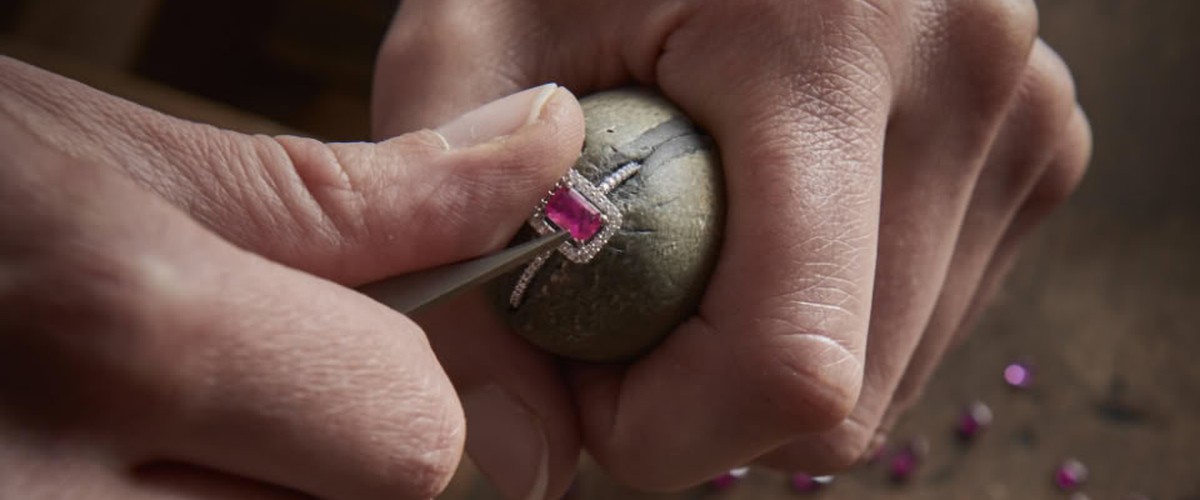
When and why should you resize a piece of jewelry?
The size of a piece of jewelry is crucial for comfort, safety, and aesthetics. A ring that’s too big may slip off your finger, while one that’s too tight can cause pain or even become difficult to remove. The same goes for a bracelet that extends too far down your hand or a necklace that isn’t the length you want.
In many cases, it is possible to adjust the size of a piece of jewelry, but you first need to determine whether resizing is necessary or if a temporary solution will suffice. Depending on the type of jewelry, professional resizing, an extension, or a temporary solution may be considered.
The telltale signs
A ring is too big if:
- It keeps spinning around the finger, and the stone ends up under the hand
- It slips when you lower your hand, or falls when your hands are cold
- you're worried about losing it during your daily activities (washing your hands, swimming)
A ring is too small if:
- It's hard to remove and squeezes the finger.
- it causes discomfort or pain after several hours
- It's even more uncomfortable when your fingers swell
A bracelet is the wrong size if:
- too big: it slides down onto the hand, wraps around the wrist, and bumps into things
- too small: it leaves marks, feels tight when the wrist swells, and restricts movement
A necklace is the wrong size if:
- Too short: it's tight around the neck, rides up, and doesn't fall to the desired length
- Too long: it gets tangled, slips under your clothes, and no longer shows off the pendant
Fingers do not maintain the same size throughout the day: they are often slimmer in the morning and in the winter, and swell slightly when exposed to heat, after exercise, or during pregnancy. A properly fitting ring should offer slight resistance as it slides over the knuckle, without ever causing pain.
The main causes of ill-fitting jewelry
| Location | Consequence | Is it possible to resize it? |
|---|---|---|
| A gift bought in the wrong size | Jewelry that's impossible to wear | Yes, in many cases |
| Error during checkout | Incorrect size | Yes |
| Weight Loss | Spinning Ring | Yes |
| Weight Gain | Ring Too Tight | Yes, depending on the model |
| Pregnancy | Temporary changes in the fingers | Postpone if possible |
| Water Retention | Fluctuating size | Wait for the situation to stabilize |
| Heirloom Jewelry | Size is rarely a good fit | Yes, after the assessment |
| Bracelet is too long | Poor posture | Yes |
| Necklace is too short | Unattractive position | Yes |
Should you have a piece of jewelry altered right away?
Not always. Before considering a permanent resizing, it’s best to ask yourself three questions: Is the discomfort permanent, or is it only related to a period of extreme heat or pregnancy? Is the weight change recent, or has it been stable for several weeks? Is there a temporary solution (ring stretcher, extension chain) that can meet your needs without permanently altering the piece of jewelry?
Quick Decision Chart
| Your Situation | Recommended Solution | Priority |
|---|---|---|
| My ring keeps spinning | Sizing or trimming | ⭐⭐⭐ |
| My ring slips off easily | Pruning | ⭐⭐⭐ |
| I only wear my ring in the summer | Wait a few weeks | ⭐ |
| My wedding ring has become too tight | Diagnostics in the Jewelry Industry | ⭐⭐⭐ |
| My bracelet slips off my hand | Removal of links | ⭐⭐ |
| My bracelet is hard to fasten | Adding links | ⭐⭐ |
| My necklace is too short | Extension chain or extension | ⭐⭐ |
| My necklace is too long | Shortening | ⭐⭐ |
Resizing isn't always the best solution. In some cases, a reversible solution allows you to preserve the jewelry in its original condition while improving its comfort; this is especially true for antique jewelry, heirlooms, or pieces with great sentimental value.
At MATY, this assessment is free and non-binding: it lets you know in just a few minutes whether your piece of jewelry can be enlarged or made smaller, or if a temporary adjustment would be a better option.
What types of jewelry can be resized?
Not all pieces of jewelry can be resized. Whether a piece of jewelry can be resized depends on several technical factors: its material, design, thickness, the presence of gemstones or engravings, and its overall condition.
Before performing any work, a jeweler therefore examines the piece to determine whether resizing is feasible, which technique to use, whether the procedure poses any risks, and whether an alternative solution would be preferable. Two pieces of jewelry that look identical may require very different approaches depending on how they were made or the type of metal used; an assessment is therefore essential before any decision is made.
Metal: The Primary Feasibility Criterion
Gold, silver, and platinum remain the metals best suited for resizing. Rings made of 375 or 750 gold can often be made larger or smaller, provided their design allows it: depending on the extent of the change, the jeweler slightly reduces the ring’s diameter, removes material, or adds material when the ring needs to be significantly enlarged. The three shades of gold (yellow, white, and rose) are worked in the same way, although the rhodium plating on white gold sometimes needs to be restored after the adjustment. Silver, which is more malleable, also lends itself well to this process. Platinum, on the other hand, offers excellent durability but requires more specialized expertise and equipment.
Conversely, palladium, titanium, tungsten, and ceramic present greater challenges: their hardness or composition makes stretching or soldering them very difficult, or even impossible, depending on the design. Stainless steel and gold-plated items fall somewhere in between: modifications are sometimes possible, but this depends on the jewelry’s design, and plating damaged during the process may require refinishing.
| Material | Enlarge | Shrink | Recommended Diagnosis |
|---|---|---|---|
| 750 gold | ✅ | ✅ | Yes |
| Gold 375 | ✅ | ✅ | Yes |
| Silver | ✅ | ✅ | Yes |
| Turntable | ✅ | ✅ | Yes |
| Steel | Depending on the model | Depending on the model | Yes |
| Gold-plated | Depending on the model | Depending on the model | Yes |
| Palladium | Very limited | Very limited | Essential |
| Titanium | ❌ Generally not | ❌ Generally not | Essential |
| Tungsten | ❌ | ❌ | Essential |
| Ceramics | ❌ | ❌ | Essential |
The structure, extent of the change, and other criteria
The metal isn't the only factor. A classic wedding band is generally easier to resize than a ring with openwork, twisted, or intricate designs. The extent of the resizing also matters: enlarging a ring by half a size is very different from enlarging it by two or three sizes, which may require adding more metal. Finally, the condition of the jewelry is a factor: an antique piece—one that has already been repaired or is fragile—requires more care than a newer piece.
Stones and Engravings: Cases That Require Expertise
The presence of precious or semi-precious stones requires extra precautions: the jeweler checks the setting, the stability of the stones, and ensures the setting is not fragile, and an inspection is usually performed after the work is completed. The greater the number of stones, the more technically challenging the resizing process becomes: pavé rings—and, even more so, wedding bands set all the way around the band—are among the most complex cases. Changing the ring’s diameter can affect the alignment of the stones and compromise the setting, often making the procedure impossible or very limited.
An internal engraving can generally be preserved, partially relocated, or redone after a procedure, depending on its location, the technique used, and the extent of the modification.
Antique or heirloom jewelry can often be resized, but its great sentimental value (and sometimes wear and tear or previous repairs) calls for a particularly cautious approach and a preliminary appraisal.
MATY Tip: Whether a ring can be resized can never be determined based solely on the material or a photo. Two rings made of the same metal may require different procedures depending on their design, setting, or repair history. That is why having a jeweler examine the ring remains the most reliable solution.
Summary Table: Which pieces of jewelry can be resized?
| Jewel type | Shrinkage | Enlargement | Difficulty Level |
|---|---|---|---|
| Simple gold wedding band | Yes | Yes | Low |
| Silver Ring | Yes | Yes | Low |
| Ring with a center stone | Yes | Yes | Medium |
| Paved Ring | Subject to certain conditions | Subject to certain conditions | High |
| All-around set engagement ring | Often impossible | Often impossible | Very high |
| Link bracelet | Yes | Yes | Low |
| Gourmette | Yes | Yes | Low |
| Rigid reed | Depending on the model | Depending on the model | Medium to high |
| Link Necklace | Yes | Yes | Low |
| Rigid Necklace | Depending on the model | Depending on the model | High |
In short, resizing a ring remains, in the vast majority of cases, a routine procedure at MATY, whether it involves enlarging a ring that has become too small or making a ring that is too large smaller.
How do you make a ring that's too big smaller?
A ring that is too large can often be resized by a jeweler if its design and material allow it (see the materials chart above). There are also temporary solutions, such as a ring reducer or an adjustment ring, which improve the fit without permanently altering the jewelry. The decision between permanently resizing the ring or opting for a temporary solution depends on the ring’s design, its value, and the cause of the problem.
A ring that is too large is not only less comfortable—it also poses a risk to the jewelry itself: loss, constant rotation, misalignment of the stone, repeated impacts, and uneven wear on the band. These issues are particularly common with engagement rings, wedding bands, and gem-set jewelry, where the center stone is designed to remain visible on top of the finger.
Solutions, from the least invasive to the most definitive
- The ring sizer: an accessory that attaches discreetly under the ring, on the palm side, to reduce the gap between the ring and the finger. It comes in various shapes (tubes, spiral clips, springs, rods) and materials (gold, silver, silicone). It is particularly useful during pregnancy, after recent weight loss, or to test the fit before having the ring resized permanently. Advantages: affordable, reversible, quick to install, requires no modification to the ring. Limitations: slightly visible depending on the model, slightly less comfortable than a resized ring.
- Wear a thin band in front of the ring: it acts as a stop and limits movement. Often used with engagement rings, wedding bands, or certain pieces of antique jewelry.
- Try a different finger: Depending on the style of the ring, temporarily wearing it on a different finger may solve the problem.
- Resizing by a jeweler: the most permanent solution when a ring is consistently too large; it involves reducing the diameter of the band so that it fits the finger more snugly. The technique varies depending on the material, thickness, presence of stones, and the number of sizes to be removed.
Comparison Table of Solutions
| Solution | Reversible | Comfort | Aesthetics | Estimated cost | What is it for? |
|---|---|---|---|---|---|
| Ring Reducer | Yes | ⭐⭐⭐ | ⭐⭐⭐ | Low | Temporary adjustment |
| Thin Ring | Yes | ⭐⭐⭐⭐ | ⭐⭐⭐⭐ | Low to moderate | A little game |
| Changing Fingers | Yes | ⭐⭐ | ⭐⭐⭐⭐⭐ | No | Part-time |
| Pruning | No | ⭐⭐⭐⭐⭐ | ⭐⭐⭐⭐⭐ | Varies depending on the piece of jewelry | Sustainable Adjustment |
The cost depends, among other things, on the material, the ring's design, whether it has gemstones, and the extent of the modification. A quote will help you assess the cost of the work.
Mistakes to Avoid
- Trying to tighten a ring yourself
- Using the wrong tools
- Glue materials directly onto the ring
- Postponing a procedure when there is a risk that the ring might fall out
- Choosing a size that's too tight "just to be safe"
MATY Expert Recommendation: A ring that rotates slightly isn’t necessarily too big—finger size naturally fluctuates throughout the day and depending on the temperature. We recommend observing how the ring fits over several days before having it resized permanently. If it slips off regularly or is at risk of being lost, a jeweler can assess the situation and determine the most appropriate solution.
How can I make a ring that's too small bigger?
A ring that is too small can often be resized if its material and design allow it. The resizing process varies depending on how many sizes the ring needs to be enlarged, whether it has gemstones, engravings, and the type of metal used (see the tables on materials and gemstones/engravings above). A professional assessment by a jeweler is essential to determine the most appropriate technique.
Before considering resizing, make sure the discomfort is persistent and not due to a temporary change: fingers can swell up to half a size in a single day. Always try on your ring at different times of the day before concluding that it has become too small. If you can no longer remove it normally, it’s best to consult a professional right away rather than forcing it off.
Enlargement Techniques
For adjustments limited to a single size, professionals most often use a stretching tool—a cone-shaped device on which the ring is gently stretched to the desired size. This technique generally does not involve adding material and preserves the jewelry’s original appearance.
To enlarge a ring by more than one size, adding material is essential: the ring must be cut, followed by the addition of an extra piece of the same metal, and then the finishing touches must be reapplied to ensure a uniform appearance. The more complex the ring (gemstones, engraving, significant width), the more time the jeweler’s work takes: the cost of resizing a simple gold wedding band will therefore not be the same as that of resizing a ring set with diamonds.
A ring can generally be resized up to 2 or 3 sizes; beyond that, the ring's structural integrity may be compromised. However, it all depends on the material, the width of the ring, its design, whether it has gemstones, and its overall condition.
| Criterion | Why He Matters |
|---|---|
| Material | Some are easier to work with |
| Number of sizes to add | Affects the technique used |
| Ring width | May limit certain procedures |
| Presence of stones | Request a crimp inspection |
| Engraving | May require rework |
| General Overview | Antique jewelry requires extra care |
Should a ring be resized right away?
Not always: it’s sometimes better to wait, especially if the weight gain is recent, if you’re pregnant, if your finger is temporarily swollen, or if you suspect fluid retention. Ideally, a permanent adjustment should be made once your size has stabilized.
Mild or significant enlargement: What's the difference?
| Location | A procedure that is generally considered | Recommended Diagnosis |
|---|---|---|
| Mild discomfort | Limited adjustment if the model allows it | Yes |
| One more size | Feasibility Study | Yes |
| Various sizes | A more complex procedure | Essential |
| Set Ring | Crimping Inspection | Essential |
| Engraved Wedding Band | Verifying the engraving | Essential |
| Antique Ring | Preliminary Assessment | Essential |
Mistakes to Avoid
- Forcing on a ring that's too tight
- Use tools to try to widen it yourself
- Heating Metal at Home
- Postpone treatment if the ring becomes painful to wear
- Choosing a size that's too big for fear that it will be too tight again
MATY Tip: A ring that has become too tight doesn’t necessarily need to be resized. Before taking any action, the jeweler will determine the cause of the discomfort, assess the stability of the current size, and examine the characteristics of the piece in order to recommend the best solution without diminishing its value and while preserving its longevity.
When should you consult a jeweler?
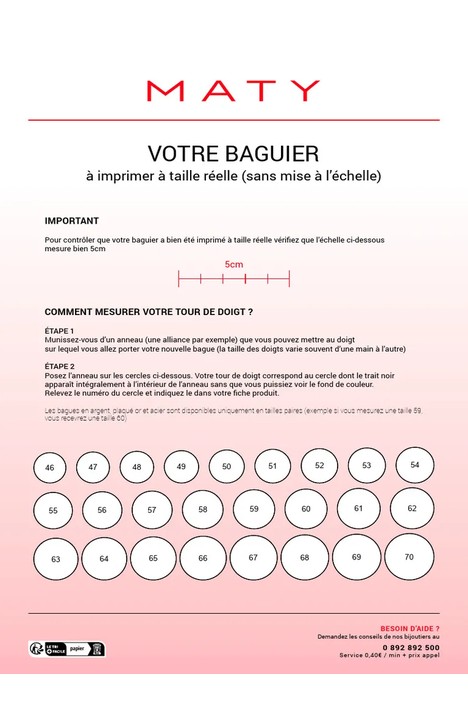
Make an appointment if you’re having trouble removing your ring (or wedding band), if removing it is painful, if you’d like to make a permanent alteration, if it’s set with gemstones, if it’s engraved, or if it’s a vintage piece. An assessment will help you determine whether resizing is feasible and guide you toward the most appropriate solution. For future purchases, be sure to use the MATY ring sizer, available in-store, so you can leave with the right size right away and avoid this inconvenience.
Changing the Size of a Wedding Ring
Yes, a wedding band can often be resized—either enlarged or reduced—when it is made of a precious metal such as gold, silver, or platinum (see the materials table above). However, whether resizing is possible depends on specific characteristics of the ring: its width, the presence of engravings, diamonds, or a full-band setting. An assessment by a jeweler is essential before any work is done.
A wedding ring is undoubtedly the piece of jewelry we wear the longest throughout our lives. Worn every day, it becomes a powerful symbol of a couple’s commitment, so it’s only natural to want to keep wearing it even if your finger size changes over time.
Why does a wedding ring stop fitting?
It’s not the wedding ring that changes shape when resized, but rather the finger that changes over the years. When planning a wedding, the ring size is sometimes measured a few months before the ceremony; however, in the meantime, weight loss, muscle gain, stress, or simple seasonal changes can slightly alter the circumference of the finger.
Some wedding rings are also passed down from one generation to the next. They hold immense sentimental value, but their size rarely matches that of the new owner; resizing allows the wearer to continue wearing this piece of jewelry steeped in history.
How can you tell if a wedding ring is the right size?
A properly fitting ring meets three criteria: it should not rotate constantly (a slight rotation is normal, but a full rotation several times a day indicates that it is probably too large); it should move over the knuckle with slight resistance, without causing pain or slipping on its own; and it should remain comfortable all day long, without squeezing the finger or leaving a deep indentation. Discomfort experienced only in hot weather does not necessarily warrant resizing.
Can all wedding rings be resized?
No, certain designs make the process more challenging. Classic, simple wedding bands are the easiest to resize. Wide wedding bands require a specific assessment to ensure they remain comfortable after resizing. An engraving on the inside does not necessarily prevent resizing, but may require additional adjustments depending on its location. Wedding rings set with diamonds require an assessment of the stability of the stones and the setting; rings that are entirely set with diamonds are among the most complex cases.
| Type of alliance | Enlargement | Shrinkage | Difficulty Level |
|---|---|---|---|
| Classic Gold Wedding Band | ✅ | ✅ | Low |
| Classic Silver Wedding Band | ✅ | ✅ | Low |
| Platinum Wedding Ring | ✅ | ✅ | Medium |
| Engraved Wedding Band | Subject to certain conditions | Subject to certain conditions | Medium |
| Wedding Ring with a Center Diamond | Subject to certain conditions | Subject to certain conditions | Medium |
| Paved wedding band | Depending on the model | Depending on the model | High |
| All-around set engagement ring | Often impossible | Often impossible | Very high |
Performed in a workshop, such as at Maty, resizing is designed to preserve the wedding band’s durability, comfort, and symmetry; several checks may be conducted after the procedure to ensure this. In most cases, a resizing done according to best practices does not diminish the sentimental value of the piece either. For an antique, signed, or fine jewelry piece, however, a preliminary assessment helps determine the most appropriate course of action.
| Your Situation | Best Solution |
|---|---|
| My wedding ring is spinning | Assessment for a Possible Reduction |
| My wedding ring is too tight | Evaluate the possibility of an expansion |
| I just lost some weight | Wait for the situation to stabilize if the loss is recent |
| I'm pregnant | Postpone final pruning if possible |
| My wedding ring is engraved | Check the impact on the engraving |
| My wedding ring has diamonds in it | Check the crimp before performing any work |
As with any ring, resizing a wedding band at MATY always begins with a free in-store assessment—the only way to ensure a successful resizing.
Adjusting the Size of a Bracelet or Necklace
Rings and wedding bands aren’t the only pieces of jewelry that can be resized: a bracelet that’s too loose or a necklace that’s too short can also be adjusted at a jewelry store, using techniques that are quite different from those used for a ring. Here, too, it all depends on the jewelry’s design: whether it has hinged links or is a single, rigid piece.
Enlarge or shrink mesh jewelry
Making a link bracelet or necklace shorter or longer is, in theory, the simplest task for a jeweler. For a piece of jewelry that is too long, cutting it to remove the excess links—along with repositioning the clasp—is usually sufficient. It is also possible to add an intermediate clasp, which allows the piece to be worn at different lengths as desired.
Similarly, to make a necklace or bracelet that’s too tight a better fit, you can add links or use extension chains—available at MATY—which add a few extra centimeters without permanently altering the piece of jewelry.
Modifying a One-Piece Piece of Jewelry
If your bracelet or necklace is a single-piece piece of jewelry, such as a bangle, resizing is still possible but requires more work. As with a ring, the jeweler will assess whether resizing is feasible to determine the cost of the alteration. Good to know: While most jewelers offer ring resizing—whether making them larger or smaller—not all of them resize necklaces or bracelets, so it’s best to check this beforehand.
To choose the right length for your new necklace and avoid having to have it adjusted later, be sure to check out the chain length simulator available on the MATY Necklaces product pages: it shows exactly where the necklace will sit on your neck or décolleté based on the length of the chain you choose.
Visit one of your MATY jewelry stores for a personalized assessment on resizing your rings, bracelets, and necklaces. Our expert jewelers will evaluate each piece of jewelry and guide you toward the most suitable solution, whether temporary or permanent. Whether you need a simple ring resizing or a complete necklace adjustment, MATY is here to assist you with the best possible service.
FAQ: Everything You Need to Know About Resizing Jewelry
Are you still unsure whether to have your ring, bracelet, or necklace resized? Here are the answers to the most frequently asked questions.
How much does it cost to resize a ring, and how long does it take?
There is no set price: the cost depends on the type of jewelry, the metal, the extent of the alteration, and whether it includes gemstones or engravings. A personalized quote provides a price tailored to each piece of jewelry. The turnaround time varies depending on the complexity of the work: after an assessment at the jewelry store, the piece is typically sent to the workshop to be adjusted, inspected, and then returned.
Why do my fingers change size?
Finger size naturally varies depending on temperature, time of day, season, physical activity, hormonal changes, or weight gain or loss—by as much as half a size in a single day.
Is resizing permanent, and does it weaken the piece of jewelry?
Yes, in most cases: unlike temporary solutions such as a ring reducer, resizing permanently alters the structure of the piece of jewelry. When performed by a qualified jeweler, however, the process is designed to preserve the jewelry’s strength and appearance, and an inspection is usually conducted after the work is completed. A ring can, in fact, be resized multiple times, depending on its design and condition.
How can you avoid choosing the wrong ring size?
Measure your finger circumference using a ring sizer, avoiding times of extreme heat or cold, when your fingers may swell or shrink. MATY’s size guides are a valuable resource, and the ring sizer available in MATY stores ensures you’ll leave with the right size right away.
Can I have multiple pieces of jewelry altered at the same time, or a piece of jewelry purchased elsewhere?
Yes. If you have several rings, bracelets, or necklaces that need adjusting, it’s entirely possible to have them all examined during a single appointment: the jeweler will assess each piece individually and, if necessary, provide a quote for each repair. Jewelry purchased from another jeweler can also be serviced, depending on the model and its condition.
Can a bracelet or necklace that's too big or too small be adjusted?
Yes. A bracelet can be shortened by removing links or repositioning the clasp. It can also be lengthened by adding links or an extension chain. A necklace that is too short can often be lengthened with an extension chain, and a necklace that is too long can be shortened by removing part of the chain or repositioning the clasp.

925 silver diamond ring
89€

Elastic bracelet MIYUKI Japanese beads in orange, white and gold enamelled glass
19,10 45€ (58)

925 silver rectangular signet ring with diamonds
145€

925 silver zirconia ring with flower motif
23,40 39€ (40)

Gold necklace 375 yellow medal 42 cm
399€

Square gold-plated signet ring with diamond escutcheon
99€

925 silver bracelet triple horse chain 18 cm
45€

925 silver ring with green synthetic stone and zirconias
49,50 99€ (50)

Necklace silver 925 and zirconias 45cm
40,30 95€ (58)

925 silver ring with blue synthetic stone and zirconias
34,50 69€ (50)

Yellow gold-plated ring with hammered zirconia
23,40 39€ (40)

925 sterling silver ring with Chinese pearl and London Blue treated topazes
23,30 55€ (58)

Gold-plated steel bracelet with amethysts 20 cm
49€

Chevalière gold 375 2 tons coeur diamant 1 initial
305€

925 silver filigree ring
45€

