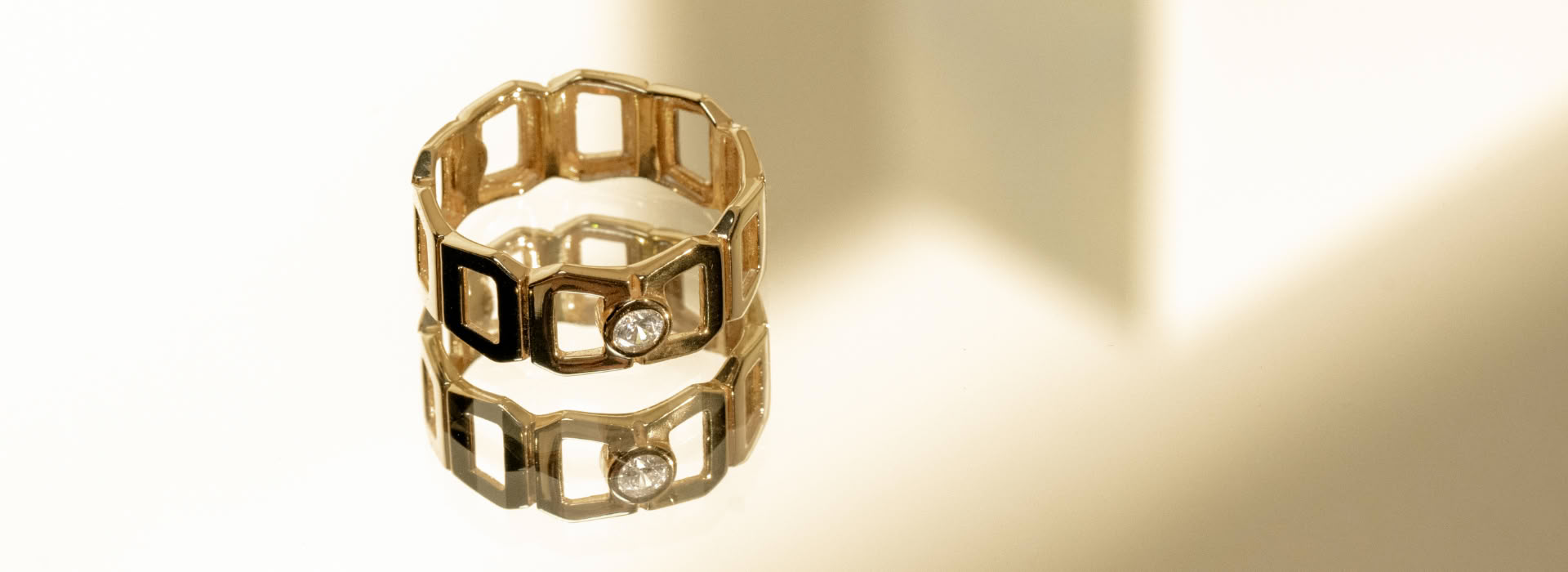
In an environmentally-friendly approach, MATY pioneered the use of synthetic diamonds to complement natural diamonds.
In keeping with this commitment, MATY prioritizes recycled gold: today, 75% of its collection is made from recycled gold, with the ambitious goal of reaching 100% by the end of 2025. Just as precious as mined gold, recycled gold is an ideal eco-friendly alternative to enhance your most beautiful jewelry. Discover its many benefits here.
Precious by nature, gold also has the unique quality of being able to be melted down, refined, and reused to create new pieces of jewelry. An antique ring, scraps from a workshop, or other gold-containing objects can thus begin a new chapter as a necklace, bracelet, or wedding band.
Once properly refined and then processed into the same alloy, recycled gold possesses the same qualities, strength, and luster as gold from recent mining operations. Using it helps make the most of an existing material and reduces the need to tap into new mineral resources.
In a nutshell: What is recycled gold?
-
Recycled gold is gold that has already been mined and used during a previous life cycle.
-
In particular, it can come from old jewelry, broken pieces, or manufacturing scraps.
-
It is collected, sorted, melted down, and refined before being reused.
-
Once refined and processed into an equivalent alloy, it offers the same qualities as newly mined gold.
-
It can be used to create all types of gold jewelry.
-
Its recycled origin alone is not enough to guarantee traceability throughout the entire supply chain: the information provided by the stakeholders and any certifications remain important.
What is recycled gold?
Recycled gold is a precious metal that has already been mined, refined, and used before being recovered to begin a new life cycle. It can come from antique jewelry, an object containing gold, or even scrap generated during the production of a new piece.
The Responsible Jewellery Council’s standards define recyclable materials as materials that have already been processed or used and are then reintroduced into the supply chain to begin a new cycle. This includes, in particular, end-of-life products and manufacturing scraps.
Unlike some materials, which may lose some of their properties when recycled, gold can be melted down and refined repeatedly. Once purified, it can be alloyed with other metals to achieve the desired fineness and color: 375 gold, 750 gold, yellow gold, white gold, or rose gold.
Therefore, recycled gold should not be thought of as a lower-quality material. Its history may change, but its value remains the same.
Where does the recycled gold used in jewelry come from?
Recyclable gold can come from several sources. Not all of these sources necessarily correspond to the supply chains used by each jeweler: the exact source must be specified by the brand or its suppliers when it is documented.
Antique Jewelry
Jewelry that is no longer worn can be resold, passed on, sold on the secondhand market, or dismantled to recover the precious metals.
When a piece of jewelry cannot be reused as is, its gold can be separated from the stones and other components and then sent to a refinery. The metal can then be used to create a new piece.
Jewelry that is broken or can no longer be worn
A broken chain, a severely distorted ring, or a single earring retains the value of its metal. Even when the piece of jewelry can no longer be repaired, the gold it contains can be recovered.
This possibility illustrates just how unique this material is: a piece of jewelry may lose its original form, while its gold continues its story.
Scrap from the workshops
The creation and alteration of jewelry generate small amounts of material: scraps, filings, polishing residue, or parts removed during repairs.
These fragments, some of which are tiny, are valuable. They can be collected in workshops, sorted, and then sent to a specialized facility so that the gold can be recovered and reused.
Items and components containing gold
At the industry level, recyclable gold can also come from certain electronic components or industrial applications. These sources require specialized processes to separate the precious metal from other materials.
|
Possible source |
Examples |
General Treatment |
|
Antique Jewelry |
Rings, necklaces, bracelets, or pendants |
Dismantling, Sorting, Smelting, and Refining |
|
Broken Jewelry |
Broken chains, deformed rings |
Metal Recovery and Refining |
|
Workshop Waste |
Scrap, metal shavings, manufacturing residues |
Specialized Collection and Recycling |
|
Items containing gold |
Certain components or industrial applications |
Material Separation and Refining |
How is gold recycled?
Gold recycling involves several steps that allow the metal to be recovered, its composition to be analyzed, and it to be prepared for reuse.
1. Collection
Old jewelry, items containing gold, and manufacturing waste are collected by specialized companies or directly at the workshops.
The various materials are stored and sorted so they can be directed to the appropriate recycling stream.
2. Sorting and Analysis
The collected materials are sorted according to their type and composition. Analyses are conducted to determine the amount of gold present and to identify the other metals that make up the alloy.
This step is essential because gold jewelry is generally not made of pure gold. For example, 750 gold contains 750 thousandths of gold, while 375 gold contains 375 thousandths.
3. Casting
Materials containing gold are melted down so they can be consolidated and prepared for refining.
This transformation erases the metal’s previous form: as a result, several pieces of jewelry or scraps can be combined into a single material to be processed.
4. Refining
Refining separates gold from other metals and any impurities. The goal is to obtain a highly pure material that can then be used to make new alloys.
5. The Creation of a New Alloy
Pure gold is naturally malleable. To create jewelry that is strong enough, it is mixed with other metals in precise proportions.
The alloy's composition determines, in particular, the gold's fineness, its color, and some of its properties.
6. Making a New Piece of Jewelry
The resulting alloy can then be crafted by jewelry workshops. It is then transformed into a ring, a wedding band, a pendant, or any other piece designed to accompany new moments in life.
Suggested cycle for the future visual:
Collection of existing gold → Sorting and analysis → Melting → Refining → Alloy creation → Manufacturing of a new piece of jewelry
Is recycled gold of the same quality as mined gold?
Yes. Once gold has been properly refined and then processed into an alloy of the same fineness, its origin does not affect its quality or appearance.
A piece of jewelry made from recycled gold can have the same color, luster, and durability as a piece made from newly mined gold. The methods used for manufacturing, polishing, and setting are also the same.
The final quality depends primarily on:
-
the gold content;
-
the alloy's composition;
-
the design of the jewelry;
-
the precision of its manufacturing;
-
the quality of its finishes;
-
the nature and setting of its stones;
-
on the maintenance it will receive.
|
Criterion |
Recycled gold |
Newly mined gold |
|
Metal Quality |
Equivalent after refining and the creation of an identical alloy |
It also depends on the refining process and the alloy |
|
Color and Shine |
Identical in terms of title and comparable finish |
Identical in terms of title and comparable finish |
|
Resistance |
The same applies to the same alloy |
The same applies to the same alloy |
|
Possible Designs |
Rings, wedding bands, necklaces, bracelets, earrings, or jewelry with gemstones |
The same categories of jewelry |
|
The Origin of Matter |
Gold is already present in the circuit |
Gold from mining operations |
|
Traceability |
Depends on the program and the available documents |
It also depends on the field of study and the available materials |
|
Price of the jewelry |
Depends on the weight, fineness, design, gemstones, craftsmanship, and the price of gold |
Depends on the same criteria |
The fact that the gold is recycled does not necessarily mean that the jewelry will be less expensive. Its price depends on many factors, including the amount of gold used, its purity, the craftsmanship involved, and whether it features gemstones.
What are the benefits of recycled gold?
Choosing a piece of jewelry made from recycled gold is, above all, a way to give new life to a precious material that is already available.
Making the Most of an Existing Resource
Recycling gold allows us to reintroduce into the cycle a material that might otherwise have gone unused. Old jewelry and manufacturing scraps thus become a resource for new creations.
This approach is particularly well suited to the nature of gold, which can be melted down and reworked without losing the qualities that give it its value.
Limit the use of new mineral resources
Using gold that has already been mined reduces the need to source raw materials to make the jewelry in question.
It thus helps limit, within the scope of this project, the need for operations required to extract new gold.
Preserving the Quality and Durability of Jewelry
A responsible approach requires no compromise on aesthetics or durability. Properly refined recycled gold can be worked just like any other gold and will serve its owner for many years to come.
Choosing sustainable jewelry—which we care for, repair, and pass down—naturally complements this approach.
Giving a precious material a new life
A piece of jewelry made from recycled gold holds special symbolic meaning: the material had a life of its own before being transformed. It returns in a new form, ready to celebrate a meeting, an anniversary, or a commitment.
The history of gold is generally no longer traceable after refining, but its new cycle allows it to continue through time.
What are the limitations of recycled gold?
Recycled gold is a promising avenue for reducing reliance on newly mined material, but it does not, on its own, address all the challenges facing the industry.
The term “recycled” indicates that the gold has already undergone a cycle of processing or use. It does not automatically provide information about all the conditions under which it was collected, refined, or transferred among the various parties involved.
Traceability and supplier verification therefore remain essential. The Responsible Jewellery Council’s chain-of-custody standards are specifically designed to ensure a documented flow of precious metals and responsible sourcing.
Furthermore, the use of recycled gold does not directly affect the working conditions of those who continue to earn a living from mining. Other initiatives seek to improve practices in these industries rather than replace them.
Recycled gold should therefore be viewed as one of the key drivers of a more responsible jewelry industry, alongside traceability, transparency, the sustainability of designs, and improved sourcing practices.
Recycled gold, ethical gold, responsible gold, and Fairmined gold: What are the differences?
These terms are sometimes used together, even though they do not refer to exactly the same concepts.
Recycled Gold
Recycled gold is gold that has already been mined, processed, or used, and is then recovered to begin a new life cycle.
This term primarily describes the secondary origin of the material.
Ethical Gold
The term “ethical gold” generally refers to gold that is mined or sourced in a manner that takes social and environmental standards into account.
It is not necessarily a single label. The brand must therefore explain the criteria, inspections, or standards to which it refers.
Responsible Gold
Responsible gold is a broader concept. It can encompass risk management in the supply chain, traceability, respect for human rights, mitigation of environmental impacts, and working conditions.
Once again, it is important to examine the specific commitments associated with this term.
Fairmined-Certified Gold
Fairmined is a certification label for gold sourced from artisanal and small-scale mining organizations that meet requirements regarding responsible practices, social development, environmental protection, and traceability. It is therefore mined gold, not recycled gold.
|
Name |
What it primarily refers to |
|
Recycled gold |
A material that has already been extracted and reintroduced into a new cycle |
|
Ethical Gold |
Gold that meets specific social and environmental standards |
|
Gold Manager |
A Comprehensive Approach to Managing Impacts and Risks |
|
Fairmined Gold |
Gold mined by certified artisanal mining organizations |
|
Traceable gold |
Gold whose journey is documented according to a defined process |
These approaches can complement one another. Ethical jewelry cannot be summed up in a single word: it is based on clearly explained commitments and, when available, on verifiable evidence.
How can you tell if a piece of jewelry is made from recycled gold?
It is not possible to visually distinguish jewelry made from recycled gold from jewelry made from newly mined gold. After refining, both materials look the same when they have the same fineness and finish.
To determine whether a piece of jewelry is made from recycled gold, you must rely on the information provided by the brand.
There are several factors you can consider:
-
an explicit mention of recycled gold on the jewelry description page;
-
information about the origin of matter;
-
documents submitted by suppliers;
-
a description of traceability procedures;
-
any standards or certifications that may be used;
-
the accuracy of the percentage of recycled gold when the jewelry does not consist exclusively of recycled gold;
-
consistency between the brand's messaging and the products featured.
In particular, the Responsible Jewellery Council offers a chain-of-custody standard designed to ensure documented traceability of precious metals from responsible sources. This certification is voluntary and distinct from general membership in the RJC.
Clear communication should make it possible to understand exactly what the term “recycled gold” means in relation to the selected piece of jewelry.
Why does MATY prioritize recycled gold?
For more than 70 years, MATY has been designing jewelry to celebrate emotions, commitments, and the moments that matter. Giving gold a new lease on life is part of this commitment to creating precious pieces designed to last.
By 2026, nearly the entire MATY collection will be made from recycled gold.
To make this commitment more concrete, MATY may also specify:
-
the exact scope of the collection in question;
-
the proportion of recycled gold used in the identified jewelry;
-
the criteria required of suppliers;
-
the related documents or certifications;
-
the steps that still need to be taken;
-
the date the information was last updated.
MATY's product listings and selections already make it possible to identify many rings, wedding bands, earrings, bracelets, and necklaces labeled "Recycled Gold."
What kinds of jewelry can be made from recycled gold?
Recycled gold offers the same creative possibilities as gold from recent mining. It can be used to craft delicate or statement pieces, simple designs or those set with gemstones.
In particular, it allows you to create:
Rings and Solitaires
A ring made of recycled gold can take the form of a delicate band, a contemporary design, or a solitaire ring meant to celebrate a marriage proposal.
Alliances
A symbol of a commitment meant to last, the wedding ring is naturally suited to a material capable of beginning a new life.
Recycled gold can be crafted into yellow, white, or rose gold, or into a design that combines several shades.
Necklaces, chains, and pendants
A delicate chain, a gemstone-set necklace, or a locket can be made from recycled gold with no visible difference in color or luster.
Bracelets
Whether rigid, flexible, or made of a delicate chain, the recycled gold bracelet is perfect for both everyday wear and special occasions.
Earrings
Studs, hoop earrings, dormeuse earrings, or dangling styles: all of these designs can be crafted from recycled gold and, depending on the design, can be paired with diamonds or colored gemstones.
Jewelry with gemstones
Recycled gold can be set in the same way as any other gold. It can therefore be paired with natural or synthetic diamonds, precious stones, semi-precious stones, or pearls.
How do you care for recycled gold jewelry?
Recycled gold jewelry should be cared for in the same way as any other gold jewelry of equivalent purity, color, and finish.
To keep it looking its best:
-
Store it separately to minimize scratches;
-
Remove it before exercising, doing housework, or using chemicals;
-
Avoid direct contact with perfumes and cosmetics;
-
Gently wipe it down with a soft cloth after wearing it;
-
If the jewelry allows it, clean it with warm water and mild soap;
-
Always adapt the method to the stones and the setting;
-
Have your valuable jewelry or jewelry that you wear every day inspected regularly.
A piece of white gold jewelry may need to be rhodium-plated again when its finish begins to fade. Similarly, a piece with gemstones or an antique piece should be taken to a jeweler if a stone is loose, if a prong appears weakened, or if the metal has deep scratches.
Taking care of your jewelry helps extend its history and preserve a piece that you, in turn, can pass on or have redesigned.
Our recycled gold jewelry
Discover a selection of MATY designs crafted from recycled gold: rings, wedding bands, necklaces, bracelets, and earrings designed to complement every style and every moment in life.
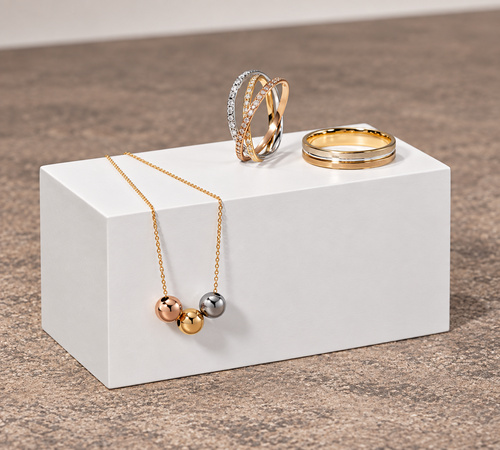
DISCOVER OUR JEWELRY: RINGS, NECKLACES, AND BRACELETS MADE FROM RECYCLED GOLD >
FAQ: Everything You Need to Know About Recycled Gold
What is recycled gold?
Recycled gold is gold that has already been mined and used, then recovered, melted down, and refined to begin a new life cycle. It can come from old jewelry or manufacturing scraps, among other sources.
Where does the recycled gold used in jewelry come from?
It may come from antique or broken jewelry, scrap from workshops, and—more broadly within the industry—from certain objects or components containing gold. The exact source depends on the suppliers and the supply chains used by each brand.
Is recycled gold of lower quality?
No. Once properly refined and then processed into an alloy of the same fineness, recycled gold has the same qualities, color, and strength as newly mined gold.
Is recycled gold worth the same as mined gold?
Given the same weight and fineness, the gold contained in the jewelry remains a precious metal. The final price also depends on the design, craftsmanship, finishes, gemstones, and the price of gold—not just on whether the material is recycled or mined.
How is jewelry made from recycled gold?
Existing gold is collected, sorted, analyzed, melted down, and then refined. It is then mixed with other metals to form the desired alloy before being crafted into a new piece of jewelry.
What is the difference between recycled gold and ethical gold?
Recycled gold refers to gold that has already been mined and is being reused. The term “ethical gold” refers more to the social and environmental conditions under which the gold is mined or sourced. The two concepts are therefore not synonymous.
How can you tell if a piece of jewelry is made of recycled gold?
The recycled origin cannot be identified with the naked eye. You must refer to the information provided by the brand, the product specifications, and any traceability documents or certifications.
Does recycled gold jewelry require the same care as traditional gold jewelry?
Yes. The precautions you should take depend mainly on the karat, the color of the gold, the finish, and any gemstones. Gentle cleaning and storing the piece separately will help preserve its luster.
Why Choose Recycled Gold Jewelry?
Choosing a piece of jewelry made from recycled gold allows you to make the most of an existing precious material and reduce the need for newly mined gold in the creation of that piece, without compromising on quality or aesthetics.

Solitaire ring gold 750 white diamond 0.70 ct
2199€

Earrings gold 750 white synthetic diamonds 0.60 carat
1589€

Silver mesh bracelet 20cm
725€

Yellow Gold Necklace with Synthetic Diamonds, 42 cm, 0.25 carat
890€

750 yellow gold half-round wedding band with 1 carat of synthetic diamonds.
2090€

Wedding band 2 gold 750 synthetic diamonds 0.7 carat
2305€

Solitaire gold 750 white synthetic diamond 1 carat
2439€

Solitaire gold 750 white synthetic diamond 1 carat
2639€

Earrings white gold 750 synthetic diamonds
989€

Gold 750 2-tone synthetic diamond hoop earrings
€2,345 €4,690 (-50%)

Solitaire gold 750 yellow synthetic diamond 0,8 carat
2090€

Ring gold 750 white pear synthetic diamonds 0,31 carat
941,50 1345€ (30)

Earrings gold 750 yellow synthetic diamond 0.8 carat
1790€

Necklace white gold 750 synthetic diamonds 0.20 carat
1230€

18K yellow gold half-round wedding band with 0.15 ct synthetic diamonds.
650€

