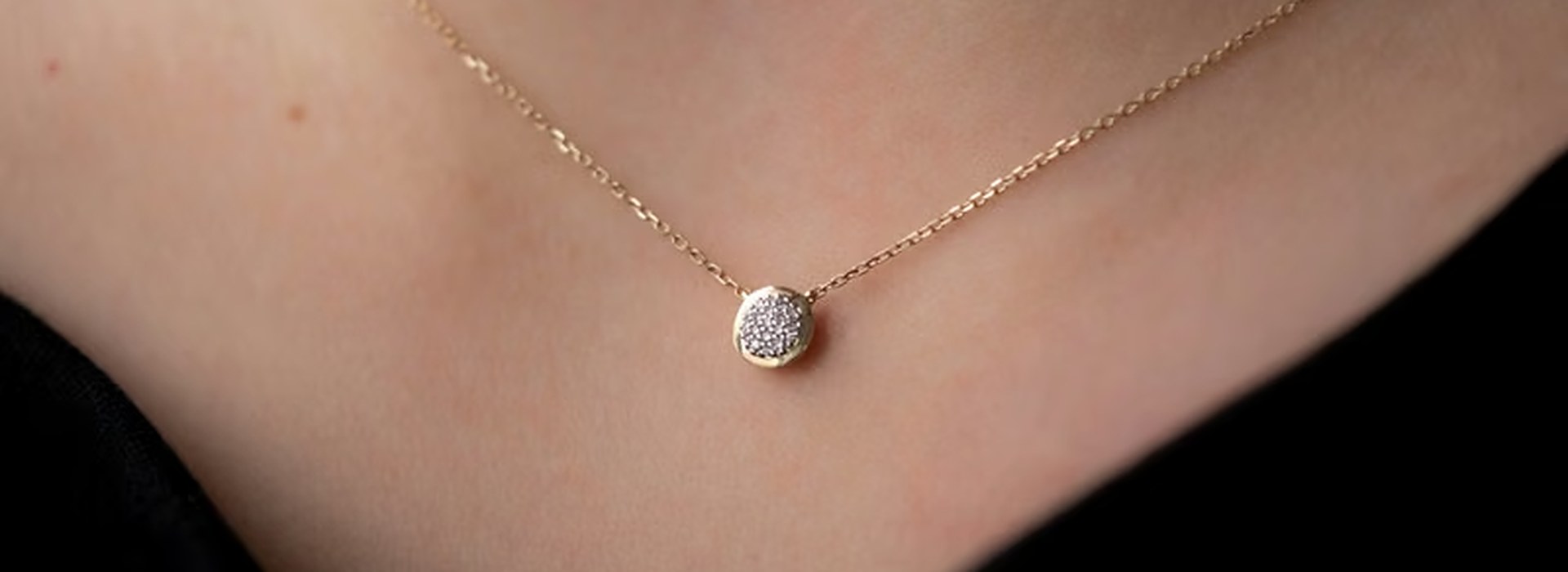
A good gold necklace is chosen based on four criteria, in this order: the karat weight (18 karats for durability and luster, 9 karats for a more affordable option and worry-free everyday wear), the color (yellow, rose, or white, depending on skin tone and other jewelry already worn), length (40 to 45 cm for women, 50 to 60 cm for men in general), and the chain style, which determines both durability and style. Next come the pendant and any gemstones, if present.
At MATY, we’ve been selling gold necklaces since our first catalog in 1951, designed in Besançon by Gérard Mantion, a watchmaker by trade. Seventy-five years later, the questions customers ask haven’t changed much: What length is right for my neck? Is 9-karat gold really gold? My white gold has turned yellow—is that normal? This guide addresses these questions one by one, with answers provided by our advisors and our Besançon Design Studio.
You'll also find key statistics (names, lengths, stone hardness) to help you compare models without relying solely on photos.
Yellow gold, rose gold, white gold: three colors, one metal
Pure gold is yellow and too soft for jewelry worn every day. To make it strong, it is mixed with other metals: it is this mixture—the alloy—that gives it its color. An 18-karat rose gold necklace therefore contains exactly the same amount of fine gold as an 18-karat yellow gold necklace. Only the remaining 25% differs.
|
Color |
What causes it |
Rendering |
Who it looks good on |
Interview |
|---|---|---|---|---|
|
Yellow gold |
Gold, silver, and copper in roughly equal proportions |
Warm, bright, classic |
Those with olive, golden, or tanned skin; lovers of vintage jewelry |
Simple: a gentle cleaning is all it takes |
|
Pink gold |
Gold + more copper |
Rosé, sweet, with a slight coppery hue |
Almost all skin tones, especially fair and rosy ones |
Simple; the color may darken very slightly over time |
|
White gold |
Gold + palladium or other white metals, followed by a rhodium plating bath |
Bright white, similar to platinum |
Fair skin, cool undertones; brings out the beauty of diamonds |
Rhodium plating should be redone from time to time |
Yellow Gold Necklace
It’s the classic color—the one found on baptismal medals and necklaces passed down from mother to daughter. Yellow gold ages beautifully: a fine scratch blends into the patina, and a simple polish at the jeweler’s restores its original luster. It pairs particularly well with warm-toned gemstones (ruby, citrine, garnet) and pearls. If you’re unsure about which gold piece to choose as your first piece of jewelry, this is often the safest bet: it looks just as good with a wool sweater as it does with an evening gown.
Rose Gold Necklace
Rose gold owes its color to copper. The higher the copper content, the deeper the pink hue. It has enjoyed a real resurgence over the past fifteen years or so, driven by delicate jewelry and layered looks. It flatters fair skin without making it look harsh, and it adds a softer touch than pure yellow gold. The copper makes the alloy slightly harder than yellow gold of the same fineness. This is an advantage for delicate chains worn every day.
White Gold Necklace
White gold does not occur naturally. The resulting alloy has a slightly grayish or cream-colored hue; it is therefore coated with a thin layer of rhodium, a metal in the platinum group, to achieve that brilliant white color. Over time and with wear and tear, this rhodium plating wears off, especially on the back of the necklace and on the clasp: the original color reappears. This is not a manufacturing defect. A new rhodium plating, done in our workshop, is all it takes to restore the piece to its original appearance. White gold is the natural partner of the diamond: a white metal behind the stone does not tint its light.
Mixing Colors
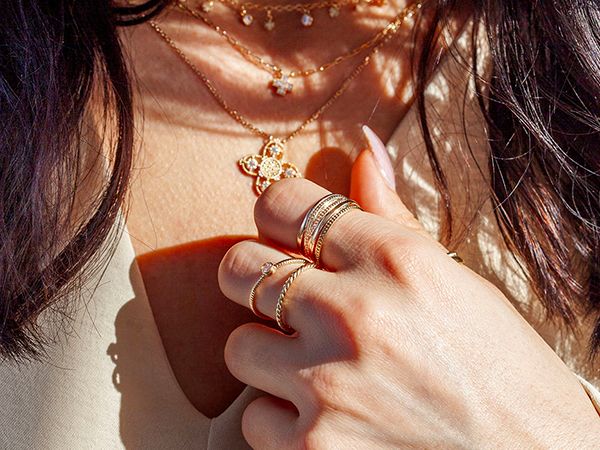
The rule that “you shouldn’t mix yellow gold and white gold” is a thing of the past. Layering a yellow gold chain with a rose gold chain creates a more vibrant look. There are also two-tone and three-tone necklaces, with links that alternate between the three shades; these allow you to coordinate the necklace with all your other pieces.
18-karat or 9-karat gold necklace: what the numbers really mean
The number of karats indicates the proportion of fine gold in the alloy, on a scale of 24. An 18-karat gold necklace contains 18/24 gold, or 75 percent. A 9-karat gold necklace contains 9/24 gold, or 37.5 percent. In France, gold purity is also expressed in parts per thousand: 750‰ for 18-karat gold and 375‰ for 9-karat gold.
|
Title |
Fine Gold Content |
French hallmark |
Color |
Scratch resistance |
Budget |
|---|---|---|---|---|---|
|
18 karats (750 ‰) |
75 % |
Eagle's Head |
Rich, deep |
Good |
Higher |
|
14 karats (585 ‰) |
58,5 % |
Scallop |
A little clearer |
Very good |
Intermediate |
|
9 karats (375 ‰) |
37,5 % |
Clover |
Lighter |
Excellent |
More accessible |
The 18-karat gold necklace
It is the gold standard in French jewelry and the standard for most heirloom pieces. Its high gold content gives it an intense color and makes it durable: it does not oxidize, does not tarnish, and is very gentle on the skin, even for those with sensitive skin. It also retains significant metal value, which is important if the piece is meant to be passed down or, one day, resold. The downside is that 18-karat gold is softer. A very fine chain worn day and night will show wear more quickly than a 9-karat one.
The 9-karat gold necklace
Yes, 9-karat gold is real gold. It is a legally recognized standard in France, tested and hallmarked just like other types of gold. It is very common in the United Kingdom and has gained popularity here as gold prices have risen: for the same weight, it contains half as much precious metal, so its price is significantly lower. With a higher proportion of alloy metals, it is also harder. For a delicate chain worn all the time—whether in the shower or while exercising—it’s a practical choice. Its color is slightly less vibrant, and on certain skin types or when exposed to chlorinated products, it may tarnish slightly: wiping it with a soft cloth is usually enough to restore its shine.
How do you check the authenticity of a necklace?
Look near the clasp or on the closing ring. There should be two markings there:
- the hallmark, affixed under government supervision, which indicates the fineness (eagle's head, scallop shell, or clover);
- the master's mark, which is diamond-shaped and identifies the French manufacturer; it is oval for imported jewelry.
Very small pieces of jewelry—weighing less than 3 grams for gold—may be exempt from the government hallmark; in such cases, the fineness is guaranteed by the seller and is listed on the invoice or certificate. Keep this document: you’ll need it for insurance, probate, or resale.
Types of gold necklaces: with or without a pendant, and what's in style right now
Before we talk about stones or links, we need to settle a simpler question: Do you want the necklace to be the piece of jewelry itself, or do you want it to serve as a backdrop for a design?
Gold necklace with a pendant
The pendant carries the message. An initial, a medal of the Virgin Mary, a heart, a zodiac sign, a birthstone—it’s the pendant that catches your eye and that you instinctively touch throughout the day. The chain, on the other hand, should be discreet and sturdy.
Three practical tips:
- Check the bail—the ring that connects the pendant to the chain. It must be wide enough to allow the clasp to fit through; otherwise, the pendant will never be able to be moved to a different chain.
- Match the weight: a heavy pendant on a chain that’s too thin will eventually bend or break it. For a medallion larger than 2 cm, choose a forçat or curb chain rather than a very thin snake chain.
- Keep the length in mind: on a 42-cm chain, the pendant falls just below the collarbones; on a 45-cm chain, it hangs down into the cleavage.
There are also necklaces with fixed pendants, where the design is soldered or integrated into the chain. They do not rotate or slide toward the clasp, but they do not come apart.
Gold necklace without a pendant
A chain on its own is anything but ordinary. It’s the link style that defines the look: a flat curb chain catches the light, a rope chain adds texture, and a snake chain flows like liquid across the skin. Necklaces without pendants have a major advantage: they’re easy to layer and go with any outfit. They’re also practical, since you can add a medallion or charm to them later.
Gold Necklace Trends
A few underlying trends are emerging in orders and among designers, beyond the fads of a single season:
- Layering: two or three chains of different lengths (for example, 40, 45, and 50 cm) made of contrasting stitches. The 4- to 5-cm gap between each row prevents them from getting tangled.
- Chunky chains and wide bracelets, worn on their own—even by women—in the spirit of the 1980s.
- Personalization: first names, initials, engraved dates, and GPS coordinates of a special place.
- Small colored gemstones —often a single stone set in a closed setting on a delicate chain.
- The Return of Vintage: Antique Medals, Family Heirlooms Brought Back into Style, and Buying Secondhand Jewelry.
The most useful advice, however, is still to choose a necklace that suits the person wearing it. A piece of gold jewelry can be kept for decades; it easily outlasts passing trends.
Gold necklace with gemstones: precious, semi-precious, natural, or synthetic
In France, the law recognizes only four precious stones: the diamond, the ruby, the sapphire, and the emerald. All other natural gemstones (amethyst, topaz, garnet, citrine, peridot, etc.) are classified as semi-precious stones. The term “semi-precious stones,” which is widely used in research, has not been permitted in commerce since a 2002 decree, as it implied that the stone was of lesser value. In fact, a beautiful tourmaline can cost more than a small sapphire.
The table below compares the most popular gemstones for gold necklaces. Hardness is rated on the Mohs scale (from 1 to 10): the higher the rating, the better the stone resists everyday scratches.
|
Pierre |
Category |
Hardness (Mohs) |
Color |
Recommended gold |
Point to Watch For |
|---|---|---|---|---|---|
|
Diamond |
Precious |
10 |
Clear (or decorative) |
White, yellow, or pink |
May chip upon direct impact |
|
Ruby |
Precious |
9 |
Red |
Yellow or pink |
Very durable |
|
Sapphire |
Precious |
9 |
Blue (and other shades) |
White or yellow |
Very durable |
|
Emerald |
Precious |
7.5 to 8 |
Green |
Yellow |
Fragile: inclusions, heat, ultrasound |
|
Amethyst |
Fine |
7 |
Violet |
Yellow or pink |
May fade with prolonged exposure to the sun |
|
Zirconium oxide |
Synthetic |
8 to 8.5 |
Colorless or colored |
All |
It loses its luster if it isn't cleaned |
Gold and Diamond Necklace
The diamond remains the gemstone of choice for special occasions: a birth, an engagement, a wedding anniversary, or a significant milestone you want to commemorate for years to come. It is also the hardest gemstone in existence (10 on the Mohs scale), which allows it to stand the test of time without losing its luster. On a necklace, it comes in three main styles. The solitaire showcases a single stone suspended from a delicate chain: it’s the most timeless design. The “rivière” style features a continuous line of diamonds all around the neck, for a more elegant look. Finally, the “pavé” style covers the surface of a pendant with small diamonds set close together, creating plenty of sparkle at a price that’s often more affordable than a single large stone.
For a necklace worn every day, a 0.05- to 0.15-carat diamond in a bezel setting is an excellent choice. The stone is protected from impacts, and the jewelry won’t snag on clothing or hair. The prong setting, which allows more light to pass beneath the stone, is better suited for a larger solitaire or a piece worn for special occasions.
Gold and Ruby Necklace
The ruby is a corundum, just like the sapphire: it is the chromium that gives it its red color, ranging from raspberry red to the deepest blood red, which is highly sought after. It is highly scratch-resistant and suitable for everyday wear without requiring any special care. It pairs naturally with yellow gold and rose gold, which enhance its warmth and give the jewelry a bold character. Set in white gold, it creates a more graphic and modern contrast. A small ruby pendant, whether on its own or surrounded by diamonds, is enough to add a bold pop of color to a simple outfit. It is the traditional gemstone for the 40th wedding anniversary (the ruby anniversary) and the birthstone for those born in July, making it a particularly symbolic gift idea. Long associated with passion and vitality, it remains one of the most popular gemstones given as a token of love.
Gold and Sapphire Necklace
We tend to think of it as blue, but sapphires come in almost every color: pink, yellow, orange, green, purple, or white. Only red corundum has a different name: ruby. Sapphires also share ruby’s hardness (9 on the Mohs scale), making them, too, a very durable stone for everyday jewelry. Deep blue pairs with white gold for a cool, luminous, and elegant look, often accented with small diamonds. With yellow gold, the contrast is more striking and warmer, with a distinctly vintage feel. Pink or yellow sapphires, with their softer hues, find a natural setting in rose gold or yellow gold.
Sapphire is associated with fidelity and wisdom, which explains why it has been used in engagement jewelry for centuries. It is also the birthstone for September and the stone commemorating 45 years of marriage.
Gold and Emerald Necklace
The emerald is the most delicate of the four precious stones and, above all, the most susceptible to impact. It almost always contains inclusions, which gemologists refer to as its “garden”: far from being a flaw, these inclusions are part of its identity and even help distinguish a natural stone. It is often treated with oil to reduce the visibility of these inclusions. This treatment requires some precautions: avoid hot water, ultrasonic cleaners, chemicals, and impacts. Yellow gold is its best setting: it warms the stone and brings out its intense green color. A closed-setting emerald pendant will offer better protection than a prong setting for everyday wear. It is the birthstone for May and the stone commemorating 55 years of marriage.
Gold and Amethyst Necklace
It is the best-known of the semi-precious stones and the violet variety of quartz. Its color ranges from pale lilac to deep violet, sometimes with highly sought-after reddish highlights. With a hardness of 7 on the Mohs scale, it withstands regular wear well, provided it is protected from direct impacts. Its greatest advantage is that it offers a beautiful cut at a reasonable price. This allows for more generous pendants—in teardrop, oval, or cushion shapes—that become the centerpiece of an outfit. Yellow gold accentuates its warmth, rose gold softens its violet hue, and white gold gives it a fresher luster. Prolonged exposure to strong sunlight or intense heat can lighten its color: store it away from light when you’re not wearing it. It is the birthstone for February.
Gold Necklace with Natural Stones
Beyond amethyst, gold enhances many natural gemstones. Among semi-precious stones: blue topaz with its crystal-clear blue, honey-toned citrine, dark red garnet, bright green peridot, multicolored tourmaline, pale blue aquamarine, and moonstone with its milky sheen. As for ornamental stones, which are softer and often opaque: mother-of-pearl, turquoise, and lapis lazuli, which add a more natural and colorful touch.
Each gemstone has its own vulnerabilities: topaz can crack upon impact; moonstone and turquoise are susceptible to scratches and certain chemicals; and mother-of-pearl is sensitive to perfume and water. Always ask about the stone’s hardness and any treatments it may have undergone (heating, oiling, irradiation) at the time of purchase, and store each necklace separately to prevent the harder stones from scratching the softer ones.
Gold and Zirconium Oxide Necklace
Zirconium oxide is hard (8 to 8.5 on the Mohs scale), highly lustrous, and perfectly colorless, making it very convincing to the naked eye. Set in gold, it allows for very sparkling designs (solitaires, band rings, pavé pendants) at an affordable price. It’s a great choice for a first piece of gold jewelry, a gift for a teenage girl, or a trendy piece you’ll be happy to wear every day. Their brilliance depends largely on how clean they are: lotions, perfume, and dust can quickly dull the stone. Regular cleaning with warm soapy water using a soft toothbrush, followed by drying with a soft cloth, will restore their full brilliance.
The Different Types of Gold Necklaces and the Right Lengths
Single-strand, double-strand, long necklace: the main categories
- The simple necklace: a chain, with or without a pendant. It's a staple of any jewelry box.
- The double-strand necklace: two chains of similar lengths, joined by a single clasp. It creates the look of layered necklaces without the risk of tangles.
- Multi-row: three or more rows, more formal, often with different stitches.
- The long necklace: a very long necklace that hangs below the chest. It can be worn on its own, wrapped twice around the neck, or tied.
- The river necklace: a short, continuous line of set stones, perfect for evening wear.
- The rigid necklace, or torque: a metal band that hugs the base of the neck. The flat, flexible omega link creates a similar look.
- The Y-shaped necklace (or “lariat”): a chain with one end hanging vertically down the neckline.
What length should I choose?
The length is measured including the clasp, with the necklace laid flat. The chart provides standard measurements for an average neck circumference; for a wider neck, add 2 to 5 cm.
|
Length |
Common Name |
Where It Falls |
For whom, for what |
|---|---|---|---|
|
35 to 40 cm |
Choker |
At the base of the neck |
Boat necklines or V-necklines, thin straps |
|
42 to 45 cm |
Princess |
On or under the collarbones |
The standard length for women, perfect for wearing with a pendant |
|
50 to 60 cm |
Mid-length, matinee |
Upper chest |
Men's standard; layered on the women's side |
|
70 to 90 cm |
Opera |
Middle of the chest |
High-necked tops, sweaters, simple dresses |
|
More than 90 cm |
Necklace |
Under the breast |
Can be worn doubled up or tied in a knot |
Short gold necklace, or choker
A choker is worn as close as possible to the base of the neck, typically between 35 and 42 cm. Worn high on the neck, it frames the face, accentuates the jawline, and highlights the décolletage. It’s particularly well-suited to slender, elongated necks, as well as wide necklines—such as boat necks, square necks, off-the-shoulder styles, or strapless tops—which give it plenty of room to shine. On a short neck, a choker that’s too tight tends to make it look even shorter. A length of 42 cm, which falls slightly onto the collarbones, will be more flattering. With a turtleneck or high neckline, opt for a longer length: a choker would be hidden or would rub against the fabric.
A choker with a pendant draws the eye upward and frames the face. That’s why it’s often chosen for a wedding, to be worn with a dress that has a low neckline: it remains visible in close-up portraits without overshadowing the outfit. In a delicate style, a small yellow or white gold chain can also be worn every day, either on its own or as the top layer in a layered look.
Mid-length gold necklace
Between 45 and 60 cm—this is the most versatile length. At 45 cm, the necklace falls just below the collarbones: this is the classic length for a pendant chain, a locket, or a solitaire. Between 50 and 60 cm, it falls toward the upper chest and looks just as good peeking out from the neckline of a shirt as it does over a T-shirt or a crew-neck sweater. This is also the ideal range for layering. For a harmonious look, pair two or three necklaces, spacing them about 5 cm apart (for example, 40, 45, and 50 cm), and vary the chain thicknesses or add a pendant to one of the layers so that each piece remains distinct. Mixing yellow gold, white gold, and rose gold works very well, as long as you maintain a consistent style.
It is also the best-selling length for men’s chains. Worn at 50 or 55 cm, a curb, chain-link, or rope chain can be slipped under a shirt collar or left visible over a T-shirt, with or without a pendant.
Long gold necklace
At lengths over 60 cm—and up to 90 cm or more for a long necklace—the necklace creates a vertical line that elongates the silhouette. It adds structure to a simple outfit: a little black dress, a lightweight sweater, a flowing blouse, or a sweater dress. It’s worn over clothing, making it a great choice for cooler seasons, when higher necklines hide shorter necklaces.
A long necklace can also be layered to create two strands of different lengths, or even tripled depending on its size. It’s like buying two necklaces in one: long and flowing one day, shorter and layered the next. On a petite figure, a long, delicate, and lightweight necklace keeps the overall look from feeling heavy; with a very simple outfit, a more elaborate design becomes the centerpiece.
A tip for measuring accurately
Take a piece of string or a flexible measuring tape, place it around your neck where you want the necklace to hang, in front of a mirror, and while wearing the type of clothing you’ll most often pair it with. Mark the length, then measure the string flat with a ruler. Keep in mind that a pendant will cause the chain to hang one or two centimeters lower due to its weight. If you already have a necklace whose length you like, measure it directly while it’s lying flat, including the clasp. Many chains also have an intermediate ring that allows you to shorten them by a few centimeters—a good way to adjust the length without any risk.
When choosing a gift, 42 or 45 cm is a safe bet for a woman: this length suits the widest range of body types and necklines. For a man, 50 or 55 cm provides enough slack so that the chain falls naturally without being too tight.
The Links of a Gold Necklace: Style, Durability, and Use
The weave refers to the way the links are formed and assembled. Two chains of the same weight and length can have very different appearances and strengths depending on their weave. It is also one of the primary factors affecting price: a complex weave requires more work.
|
Mesh |
Appearance |
Strength |
Can it hold a pendant? |
More for |
|---|---|---|---|---|
|
Forçat |
Oval or round links, flat or not |
Very good |
Yes, ideal |
Every day, women and men |
|
Jaseron |
Small, tightly spaced round links |
Good |
Yes, lightweight pendant |
Baptism Medals |
|
Gourmette |
Twisted, flattened links, laid flat |
Very good |
Yes |
Man, with a distinctive style |
|
Venetian |
Small Hinged Squares |
Good |
Yes |
Clean, modern design |
|
Rope (twisted) |
Spiral-wound links |
Very good |
Yes |
Relief, Light |
|
Snake |
Flexible, smooth tube |
Average: Prone to wrinkles |
Very lightweight pendant |
Evening wear, worn on its own |
|
Singapore |
Twisted and faceted, very brilliant |
Average |
Lightweight pendant |
Women's, thin chain |
|
Figaro |
Alternating short and long links |
Good |
Yes |
Italian style, for men or women |
|
Coffee beans |
Oval links with a slit in the center |
Good |
Yes |
Retro Style |
|
Palm tree |
Braided links in a herringbone pattern, very flexible |
Good |
Yes |
Delicate chain, women's |
The strongest stitches
For a necklace you never take off, the forçat link, the curb chain, and the rope chain are the most secure. They have numerous, independent links: if one opens, the jeweler can replace it without having to take apart the entire chain.
Stitches that require careful handling
Snake and omega chains are made of small interlocking links. A sharp kink—such as when the necklace is rolled up into a ball or wedged inside a bag—often causes a permanent break. Store them flat or hanging. Very fine links (less than 1 mm), regardless of shape, are elegant but fragile. If you sleep with your necklace on or if a young child tends to pull on it, aim for a width of at least 1.2 to 1.5 mm.
The clasp: the detail that makes all the difference
Most delicate chains feature a spring ring clasp; it is discreet but requires a bit of dexterity. The lobster clasp is sturdier and easier to use, especially for people who have difficulty with fine motor skills. On a valuable necklace, check to make sure the clasp is also made of solid gold and hallmarked.
The Price of a Gold Necklace: How It's Determined
The price of a gold necklace depends first on the amount of fine gold it contains, then on the craftsmanship involved, and finally on the gemstones. Understanding this process allows you to compare two necklaces that look similar in photos but are completely different in terms of materials.
The Five Factors
- The weight of the piece of jewelry, in grams. This is the most important piece of information, and it must be listed on the product page.
- The headline: By weight, an 18-karat necklace contains twice as much fine gold as a 9-karat one.
- The price of gold, which fluctuates daily on the markets, has risen sharply in recent years, which explains the general increase in jewelry prices.
- The process: production time, the complexity of the mesh, and the finishes (polishing, engraving, diamond-cutting).
- The stones: type, cut, quality, and number.
A concrete example
An 18-karat gold chain weighing 4 grams contains 3 grams of fine gold (4 × 0.75). The same chain in 9-karat gold contains only 1.5 grams (4 × 0.375). This is why the price difference between the two karat grades widens when the price of gold rises: the proportion of the metal accounts for an increasingly larger share of the final price, while the cost of craftsmanship remains roughly the same.
Guidelines by Collar Type
|
Collar type |
Standard weight |
Factors That Affect the Price |
|---|---|---|
|
Single thin chain (chain link, Venetian) |
1 to 3 g |
Title, length |
|
Necklace with a small pendant (initial, heart) |
1.5 to 4 g |
Title, engraving (if any) |
|
Medal + Chain |
3 to 8 g |
Diameter and thickness of the medal |
|
Necklace with a solitaire diamond |
1.5 to 4 g of metal |
Diamond Weight and Quality |
|
Men's Cuff Bracelet or Chunky Chain |
10 to 40 g or more |
Gold weight, first of all |
Solid gold, gold-plated, vermeil: don't confuse them
A necklace sold as “gold” is made of solid gold: the alloy is the same throughout its entire thickness. Gold-plated jewelry consists of a base metal covered with a layer of gold; in France, it bears a square hallmark. Vermeil is silver covered with gold. These materials are suitable for costume jewelry, but they lack the durability and resale value of solid gold jewelry. If in doubt, the product description, hallmark, and receipt should clearly indicate this.
The Right Calculation Over Time
A solid gold necklace never really goes out of style: it can be repaired, shortened, or redesigned, and it retains its value based on the metal itself. When you consider the number of years it will be worn, it often ends up being less expensive than a series of costume jewelry pieces replaced every two years.
Customize, Adjust, and Care for Your Gold Necklace
The Personalized Gold Necklace
A personalized necklace is often the one you keep the longest. There are many options:
- Engraving a first name, a date, initials, or a short message on the back of a medallion or plaque pendant. MATY has been offering personalized engraving for decades; expect about 15 characters on a small medallion, and more on a plaque.
- The name necklace, where the letters are cut out of gold and form the piece of jewelry itself.
- Initials or letters as pendants, which can be combined for a family (one letter per child, for example).
- The birthstone associated with a particular month, attached to a chain or placed next to a medallion.
- Custom Design: In Besançon, the MATY Design Studio helps bring one-of-a-kind pieces to life, whether based on a sketch, an idea, or a piece of jewelry you’d like to have transformed.
Before approving an engraving, proofread it letter by letter. Once the gold has been engraved, a mistake cannot be corrected without removing some of the material.
Resizing a gold necklace
A chain that's too long or too short isn't inevitable.
- Shortening: The jeweler removes a few links and reattaches the clasp. This is a simple process for a cable or curb chain, but more delicate for a snake or omega chain, which cannot be cut just anywhere.
- To lengthen: Add a gold extension chain of the same karat and color, or replace the chain with a longer one while keeping the pendant.
- Adding an extension link to the chain allows you to wear it at two different lengths, such as 40 and 45 cm.
How to Care for a Gold Necklace
Gold doesn't rust or oxidize, but it does get dirty: lotion, skin oils, perfume, and dust dull the surface and build up between the links.
- Routine cleaning: Soak the necklace for a few minutes in lukewarm water with a drop of mild soap or dish soap, gently brush it with a soft-bristled toothbrush, and rinse with clean water.
- Drying: Pat dry with a soft, lint-free cloth, then let it dry flat before storing. Moisture trapped in a fine knit will eventually leave marks.
- Shine: A special gold jewelry polishing cloth restores luster between cleanings. Avoid abrasive polishes, toothpaste, and baking soda, which can cause scratches.
- Things to avoid: chlorinated water from pools and hot tubs, seawater on delicate stones, household cleaning products, and perfume sprayed directly onto the jewelry. Put on your necklace last, after applying makeup and perfume, and take it off first.
- As for gemstones: diamonds, rubies, and sapphires can be cleaned in the same way as gold. Emeralds, pearls, opals, and turquoise should only be wiped with a damp cloth; never soak them or use an ultrasonic cleaner.
- For white gold: the rhodium plating wears off with wear. When the color takes on a pale yellow hue, a new rhodium plating at the workshop restores its white color.
- Storage: Store each necklace in its own compartment or pouch with the clasp closed to prevent tangles and scratches. Once a year, have a jeweler inspect the clasp and the prongs holding the stones; this is the best way to prevent loss.
The History, Symbolism, and Craftsmanship of the Gold Necklace
Five Thousand Years of Gold Necklaces
Gold was one of the first metals worked by humans, because it is found in its native state, without having to be smelted from ore. Goldsmiths in Mesopotamia and Egypt had already mastered gold wire, soldering, and granulation more than 4,000 years ago. The wide necklaces of Pharaonic Egypt, made of gold plates and colored gemstones, accompanied rulers even into their tombs. In Rome, free children wore a bulla, a small protective medallion hung around the neck. In the Middle Ages, the necklace became a sign of rank, and the large necklaces of chivalric orders signified membership in a circle of power. With the spread of Christianity, the cross and the religious medal took on a lasting significance, a tradition that France has preserved through the baptismal medal.
The 19th century saw the emergence of sentimental jewelry: lockets that opened to reveal a lock of hair or a portrait, and necklaces given as tokens of mourning or engagement. The 1920s embraced the long necklace, which complemented the straight silhouette of Art Deco dresses. The 1970s and 1980s popularized solid gold chains worn by men, thick curb chains, and layered jewelry.
What a Gold Necklace Symbolizes
Gold does not corrode: it does not rust or tarnish, and it endures through the centuries without changing its appearance. This is what makes it, in nearly every culture, the metal that symbolizes what is meant to last: commitment, loyalty, and memory. Its color also associates it with the sun and light. Worn around the neck, a necklace encircles an area associated with breath and speech, and rests close to the heart. It is likely no coincidence that it is so often the jewelry of choice for births, baptisms, and family bonds: it is received, worn, and passed down. The golden wedding anniversary, which celebrates fifty years of marriage, embodies the same idea of a bond that time cannot break.
How Is a Gold Necklace Made?
The process of making a gold chain involves several steps, whether it is done by hand or using specialized machinery:
- The alloy: fine gold is melted with alloy metals in precise proportions, depending on the desired fineness and color.
- Rolling and wire drawing: The resulting ingot is thinned and then drawn through progressively smaller dies until it reaches the desired wire diameter.
- Forming the links: The wire is wound, cut, and then each link is threaded through the previous one according to the stitch pattern.
- Welding: Each link is closed and welded to prevent it from opening under tension.
- Shaping: For certain link styles, such as the curb chain, the chain is twisted and then flattened, or faceted like a diamond to catch the light.
- Assembly: Add the end caps, the closing ring, and the clasp.
- Polishing and inspection: finishing, fineness testing, hallmarking.
Pendants are often made using the lost-wax casting process: a wax model is placed in a plaster mold, the wax is melted away, and liquid gold takes its place. Next comes the setting of the stones, which are held in place by prongs, a bezel setting, or a grain setting. Besançon has a long tradition of micromechanics and the fine jewelry crafts, inherited from the watchmaking industry. It was within this culture of precision craftsmanship that MATY was founded in 1951, and its Design Studio is still based in Besançon today.
Giving a Gold Necklace: Who to Give It To, When, and Which One to Choose
Occasions When a Gold Necklace Is Appropriate
|
Opportunity |
A popular choice of necklace |
The detail that makes all the difference |
|---|---|---|
|
Birth, Baptism |
Religious medal or angel medal on a jaseron chain |
Engraving of the first name and date on the back |
|
First Communion, age 18 |
Delicate chain with a cross, initial, or birthstone |
A leash long enough to keep up with an adult (42 or 45 cm) |
|
Degree, First Job |
A beautiful, fine-link chain on its own, or a simple pendant |
A piece of jewelry you can wear to the office |
|
Valentine's Day, Engagement |
Heart-shaped pendant with a solitaire diamond |
The gold color of the ring |
|
Birth of a Child (for the Mother) |
Necklace with first name, initial, and birthstone |
A room that can be customized for each child |
|
Mother's Day, Christmas |
Personalized pendant, double-strand necklace |
The Engraved Message |
|
Wedding Anniversary |
Necklace with a symbolic gemstone (ruby for the 40th anniversary, gold for the 50th anniversary) |
The wedding date |
|
Retirement, Succession |
18-karat gold medal or chain |
A premium product, built to last |
How to Choose Without Knowing Exactly What You Like
Take a look at their current jewelry: the color of metal they wear most often is a more reliable clue than any style advice. If they don’t wear any, yellow gold is the safest bet, and a 42- to 45-cm chain suits most women. For men, 50 to 55 cm is the most common length. Opt for a simple design over a very statement-making one: a discreet piece can be worn every day, while a showy piece stays in its box. And keep the receipt or invoice: if the length needs to be adjusted, exchanging the item or having it resized will be easier.
Women's Gold Necklace
The selection is the widest: delicate chains to layer, symbolic pendants, colored gemstones, rows of diamonds, and long necklaces. The right choice depends on how the necklace will be worn. For everyday wear, a fine yet sturdy chain (forçat, Venetian) in 42 or 45 cm, with a small pendant. For special occasions, a gemstone necklace, a choker, or a double-strand necklace. Women who work with their hands or wear their necklace day and night would do well to consider 9-karat gold.
Men's Gold Necklace
The men's gold necklace has made a comeback, worn on its own or with a medallion. Here are a few tips:
- Length: 50 to 60 cm, so that the chain falls below the shirt collar.
- Width: 2 to 3 mm for a subtle chain, 4 to 6 mm for a noticeable bracelet, and wider for a bold style.
- Chain styles: link, flat, rope, and figaro are the most popular. They are sturdy and can easily support the weight of a medallion.
- Pendants: religious medallions, engraved plaques, zodiac signs, crosses.
Yellow gold remains the most popular choice among men, but white gold appeals to those who wear a stainless steel watch or a white gold wedding band. For a man who doesn't yet wear any jewelry, a 2-mm-wide, 55-cm-long cable chain is an easy first necklace to try.
FAQ: The Most Frequently Asked Questions About the Gold Necklace
Can you wear a gold necklace every day—and even sleep in it?
Yes, that’s one of the great advantages of solid gold: it doesn’t oxidize and isn’t affected by tap water. If you plan to wear it all the time, choose a sturdy chain (forçat, gourmette, or rope) that’s at least 1.2 mm thick and a clasp in good condition. Remove it when swimming in a pool or the ocean, and during contact sports.
Can a 9-karat gold necklace turn black?
It doesn't tarnish like silver, but it can become slightly dull when it comes into contact with chlorine-based products, certain cosmetics, or acidic sweat, because it contains more alloy metals. Cleaning it with soapy water and a soft cloth will restore its shine.
Why is my white gold necklace turning yellow?
White gold is coated with a thin layer of rhodium, which wears off with friction. The alloy’s slightly yellow or grayish color then reappears. A new rhodium plating at the workshop restores its white color; this is not a sign of poor quality.
Does a gold necklace cause allergies?
Gold itself is generally very well tolerated. Reactions usually stem from the metals in the alloy, particularly nickel, which is strictly regulated in Europe for jewelry that comes into contact with the skin. The higher the karat, the less alloy it contains: for those with very sensitive skin, 18-karat yellow gold is the safest choice.
How can you tell if a necklace is made of solid gold?
Look for the hallmark near the clasp: an eagle’s head for 18-karat gold, a scallop shell for 14-karat gold, and a clover for 9-karat gold, accompanied by the diamond-shaped maker’s mark. A square hallmark indicates gold-plated jewelry. For jewelry weighing less than 3 grams, the karat weight is guaranteed by the jeweler’s receipt.
What is the standard length of a gold necklace?
For women, 42 to 45 cm. For men, 50 to 55 cm. A choker measures 35 to 40 cm, and a long necklace is over 90 cm.
What thickness of chain should I use to wear a medallion?
For a baptismal medallion measuring 14 to 18 mm, a chain 1 to 1.5 mm wide is sufficient. For medallions larger than 20 mm or thicker medallions, choose a chain 1.5 to 2.5 mm wide, such as a forçat or gourmette chain.
Can a gold necklace be shortened or lengthened?
Yes. To shorten a chain, remove some links and reattach the clasp. To lengthen it, add a chain of the same gauge and color. Snake and omega chains are more difficult to adjust.
Does a gold necklace hold its value?
A solid gold necklace retains at least the value of its fine gold, which follows market prices. The craftsmanship, brand, and gemstones are not always reflected in the resale value. Keep the receipt and any certificates for the gemstones.
What kind of gold necklace should you give as a gift for a birth or a baptism?
The French tradition is a medallion engraved on a delicate 18-karat yellow gold chain. Choose a chain that’s 38 to 40 cm long to save for later, or give the medallion on its own to be worn when the child is older: a chain is not recommended for a baby’s neck.
Mixing gold and silver jewelry... How can you successfully accumulate jewelry?