
Collecting jewelry means being bold enough to mix and match multiple pieces—layering them rather than limiting yourself to a single piece. This trend, which has won over even purists who once swore by a single classic piece, allows you to create a personal look using a variety of pieces, by playing with layering, lengths, and materials. When done right, layering doesn’t require a massive investment in lots of new jewelry: it’s all about skillfully combining what you already own, while keeping a few principles of balance in mind. This guide explains, area by area and situation by situation, how to create a successful jewelry layering look.
To try your hand at layering jewelry: simply layer several pieces— rings, necklaces, bracelets, and earrings—while making sure to maintain a harmonious consistency in style, shape, and materials. Instead of just throwing everything together haphazardly, we recommend choosing one focal point to highlight: the neck, wrists, hands, or ears. For necklaces, alternate lengths to avoid a cluttered look. For rings, alternate between delicate designs and more statement pieces. When it comes to bracelets, mix textures while sticking to a common theme—whether it’s a metal, a color, or a pattern. Gold and silver can certainly be mixed, provided that the shapes, styles, or proportions remain consistent with one another. The ultimate goal isn’t to pile on jewelry just for the sake of it, but to create a personal and balanced look that remains comfortable for everyday wear.
Contents
Accumulation, stacking, layering: What are we talking about?
Simple Rules for Stylishly Layering Your Jewelry
Building Your Portfolio Zone by Zone
How can you wear multiple rings without making your hand look cluttered?
– Finger rings: a detail that makes all the difference
How can you wear multiple bracelets on the same wrist?
What length should you choose when layering necklaces?
How can you harmoniously combine gold, silver, and other metals?
What style of layered jewelry should you choose?
What outfit should you wear with layered jewelry?
How can you adjust your layering depending on the occasion?
What mistakes should you avoid?
How can you prevent jewelry from getting tangled or damaged?
How do you care for your jewelry once you've collected a lot of it?
FAQ: Everything You Need to Know About Collecting Jewelry
Accumulation, stacking, layering: What are we talking about?
Let's start by clarifying the terminology; in fact, several terms are often misused even though they convey different nuances.
-
Layering, in the broadest sense of the term, involves wearing several pieces of jewelry together rather than wearing a single piece on its own. It is a generic term that encompasses all other concepts.
-
"Stacking," an English term popularized by international fashion trends, is most often used to describe the layering of rings on a single finger or of thin bracelets around a single wrist. It evokes a dense, closely packed arrangement.
-
Layering, on the other hand, refers primarily to the arrangement of necklaces of different lengths in successive layers around the neck. It is the most appropriate term when discussing jewelry worn around the neck.
-
Finally, “mix and match” involves deliberately combining different styles, materials, or shapes in a way that’s more creative than systematic. For example, you can pair a thin gold chain with a silver pendant, or a minimalist ring with a more statement-making ring.
In any case, the goal remains the same: don't overdo it, but create a composition that makes visual sense without looking cluttered.
Simple Rules for Stylishly Layering Your Jewelry
Creating a successful layered look is based on a few principles that can be applied to any area of the body. These principles aren’t hard-and-fast rules, but rather guidelines for putting together a look that works visually. Some people prefer a dense, bold layered look across all areas at once, in a maximalist style; others opt for a single statement piece accompanied by subtle, complementary jewelry.
Choose a primary area for stacking
The first step is to choose one main area to highlight rather than layering jewelry all over the body at once. A heavily accessorized neck, combined with hands covered in rings and wrists piled high with bracelets, can quickly look overwhelming. It’s better to choose one focal point—such as the hands or the neck—and keep the rest more understated.
Vary the volumes
It’s also important to vary the sizes. A stack consisting solely of delicate pieces lacks depth, while a stack consisting solely of large pieces can quickly become overwhelming. Alternating between delicate jewelry and more statement pieces creates a pleasing visual rhythm.
Playing with Lengths
This is another key principle, especially for necklaces: necklaces of the same length tend to overlap and get tangled, whereas necklaces of varying lengths create a clear, cohesive look.
Follow a plan for building a jewelry collection
Maintaining a unifying theme ultimately brings the whole ensemble together. This theme could be a common metal, a recurring color, a gemstone that appears in several pieces, or even a shared graphic style. It’s often this detail that distinguishes a carefully curated collection from a haphazard assortment.
Building Your Portfolio Zone by Zone
Each area of the body lends itself to different types of jewelry and styling tips. This chart summarizes, for each area, the pieces to choose and the key points to keep in mind.
|
Zone |
Stackable Jewelry |
Association Council |
|
Neck |
Delicate necklaces, chains, pendants, long necklaces |
Vary the lengths to prevent knots |
|
Hands |
Delicate rings, solitaire rings, wide bands, knuckle rings |
Alternate between volumes and locations |
|
Wrists |
Rattles, necklaces, link bracelets, leather bracelets, pearl bracelets |
Combine textures without overdoing it |
|
Ears |
Stud earrings, hoop earrings, ear cuffs, single earrings |
Create a progressive composition |
|
Anchor |
Delicate chain, dangling charms, pearls |
Keep the look light and comfortable |
How can you wear multiple rings without making your hand look cluttered?
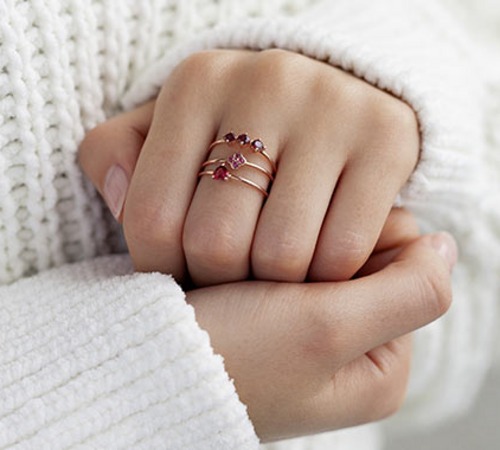
Stacking rings is probably the easiest way to get started, since it requires only a few pieces to create a noticeable effect. To get off to a good start, it's best to begin with just two or three rings, rather than trying to cover every finger right away.
Rotating Which Finger to Wear Rings On
Varying which fingers you wear rings on avoids the monotonous look of a hand where every finger has a similar ring. This way, you can alternate between the index, middle, and ring fingers, leaving some fingers bare to give the hand some visual breathing room.
Variations in the thickness of jewelry
Alternating between delicate rings and statement rings works particularly well: a more elaborate piece—adorned with a stone or featuring a bold design—serves as a focal point around which more understated rings are arranged. It’s best to avoid piling rings onto every finger in the same way, as this makes the overall look monotonous rather than harmonious.
Mix of Metals
Mixing metals is possible with rings, just as it is elsewhere, provided the overall look remains cohesive—for example, by using each metal at least twice. Finally, comfort during everyday activities remains an essential consideration: too many rings or rings that don’t fit properly can quickly become a nuisance when typing, cooking, or driving.
Finger rings: a detail that makes all the difference
Finger joint rings—which are thinner and lighter—add a contemporary, fashionable touch to a classic layered look. They allow you to vary the heights on a single finger and work particularly well when paired with other thin rings. It’s important that they remain comfortable, without slipping or feeling too tight. A knuckle ring can also be paired with a bolder piece worn lower down on the index, middle, or ring finger, creating a vertical layering effect on a single finger.
How can you wear multiple bracelets on the same wrist?
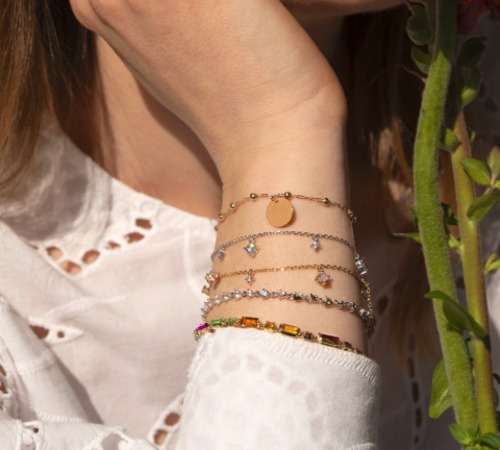
Bracelets lend themselves particularly well to layering in distinct styles, allowing everyone to create a look that reflects their own personal style.
Choose a style
Delicate layering involves stacking several delicate chain bracelets for a subtle and refined look. Bohemian layering, on the other hand, features beads, cords, and natural stones, with a more artisanal feel. Chic layering combines bangles, gold bracelets, and delicate pieces for a sophisticated look. The rock-inspired layered look, on the other hand, features leather, chain links, and wider bracelets, using bolder materials. Finally, the summer-inspired layered look often pairs several bracelets with an anklet for a vacation vibe.
Spread out the volume, avoid overloading
In any case, it's important to distribute the bracelets evenly around your wrist rather than concentrating them all on one side, and to avoid bracelets that get caught on each other or get in the way, especially if they have open links or charms.
It’s also possible to stack bracelets on both wrists rather than just one, by mixing and matching styles: for example, one wrist with a thinner, more understated bracelet, and the other with a bolder look featuring a cuff or a wide bracelet. This deliberate asymmetry is now one of the most popular ways to wear multiple bracelets without making one side look too cluttered.
What length should you choose when layering necklaces?
Layering necklaces is one of the most popular ways to create a layered look, as it effortlessly transforms a simple outfit.
Start with the shortest one when stacking
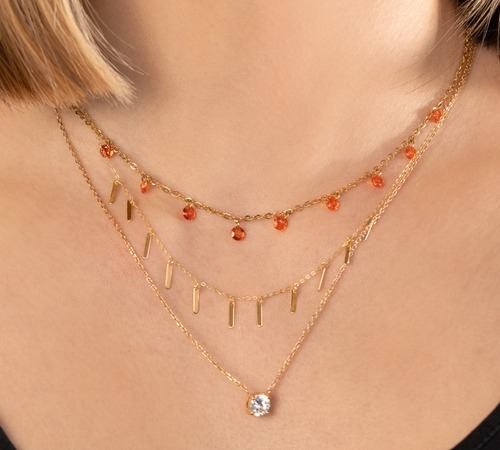
The most reliable method is to start with a short, choker-style necklace, then add an intermediate chain, and finish with a pendant or a longer necklace. This three-step process naturally prevents the necklaces from overlapping.
Vary the lengths to create layers
This is rule number one: necklaces of the same length tend to layer poorly and get tangled as you move. Pairing a simple chain with a pendant adds rhythm to the look without making it look too busy. It’s also a good idea to choose necklaces that flatter the neckline of your outfit, and to be careful with very thin chains, which are more likely to get tangled up with each other.
Identify the role of each collar
The number of necklaces worn layered depends mainly on the desired look: two necklaces are enough for a subtle effect that’s easy to wear every day, while three to four pieces allow for a more elaborate arrangement, best reserved for outfits that call for it. Beyond that, layering becomes harder to balance and requires special attention to the lengths chosen.
|
Length |
Role in accumulation |
|
Choker |
Short hem, close to the neck |
|
Short chain |
First visible line |
|
Intermediate Collar |
Balances the composition |
|
Pendant |
Creates a focal point |
|
Necklace |
Makes you look taller |
How do you stack earrings?
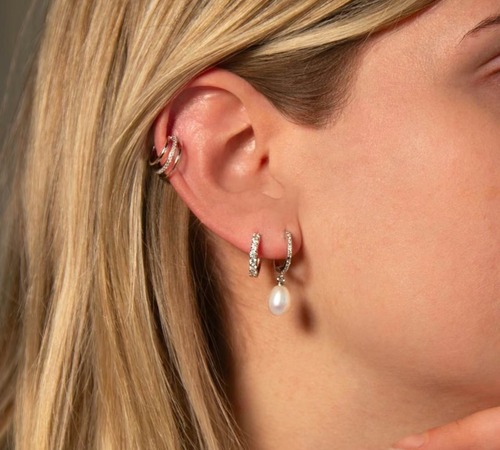
With the growing popularity of ear cuffs, single earrings, and asymmetrical arrangements, the ear has become a true "stacking" area in its own right, just like the neck or the hands.
Harmonious ear stacking from the earlobe to the cartilage
The method involves combining several types of earrings— studs, mini hoops, and ear cuffs — to create a progression from the earlobe toward the cartilage. Ideally, stick to a single type of metal or stone to tie the look together, and choose a more statement piece to serve as a focal point, surrounded by more subtle jewelry. The arrangement can, of course, be adapted based on the number of piercings, and an ear cuff is an excellent way to add volume without needing an additional piercing. It’s best to avoid wearing too many statement pieces on a single ear, as this can create an imbalance.
Testing Asymmetry
You can also play with the asymmetry between the two ears—a trend that’s becoming increasingly popular: one ear with more jewelry, featuring several pieces layered together, and the other with a more minimalist look, featuring just a single, understated piece. This approach makes it easy to refresh your look without buying more jewelry—simply by rearranging the pieces you already own.
How can you harmoniously combine gold, silver, and other metals?
Mixing gold and silver is no longer considered a fashion faux pas: it’s now a trend that’s all the rage—as long as you follow a few rules of balance.
We recommend starting with minimalist jewelry, which is easier to mix and match, before venturing into more intricate pieces. A two-tone piece—combining gold and silver in a single piece of jewelry—can serve as a visual transition between the two metals and make it easier to mix them. Maintaining a consistent style across the different pieces—for example, all minimalist or all more graphic—also helps tie the look together.
The balance between gold and silver is also important: a mix with too great a disparity in proportions can give the impression of a mistake rather than a deliberate choice. To avoid this, it’s helpful to include each metal at least once in the ensemble, which sends a clear signal that the combination is intentional. It’s also best to avoid using too many different finishes—matte, shiny, and textured—in a single stack, and to consider pairing metals based on your outfit or skin tone when appropriate. This principle applies beyond traditional gold and silver to gold-plated pieces, gold-toned steel, rose gold, and silver jewelry as well.
A concrete example: a stack of rings might combine two thin gold rings, a slightly wider silver ring, and then return to a touch of gold on another finger. This repetition, even if subtle, is enough to make the combination appear intentional rather than accidental.
What style of layered jewelry should you choose?
The choice of layering style depends primarily on the desired aesthetic. Here are a few guidelines to help you get started:
|
Desired Style |
Jewelry to Look For |
Tip |
|
Minimalist |
Thin rings, delicate chains, stud earrings |
Prioritizing discretion |
|
Bohemia |
Stones, pearls, charms, delicate bracelets |
Vary the textures |
|
Chic |
Gold, silver, pearls, cubic zirconia |
Maintain a balanced composition |
|
Rock |
Leather, knitwear, wide rings, ear cuffs |
Choosing a standout piece |
|
Romantic |
Hearts, flowers, gemstones |
Focus on the subtle details |
|
Solar |
Gold-plated, chains, pendants, colored stones |
Create a luminous rendering |
Of course, there’s nothing stopping you from mixing several styles as you please, as long as the overall concept—a focal point, a unifying theme, and varied proportions—is maintained. For example, you can start with a minimalist base for the week and add, just for an evening, a piece with a more bohemian or rock-and-roll vibe. It’s often by combining several styles in this way that you find your own balance—one that’s more personal than a collection of items strictly confined to a single category.
What outfit should you wear with layered jewelry?
When putting together a jewelry ensemble, it's best to consider the outfit you're wearing, since each type of clothing calls for a different combination.
A simple or solid-colored outfit allows for more noticeable layering, since the jewelry isn’t competing with patterns or colors. A black dress, for example, is ideal for showcasing layered necklaces. An open shirt works particularly well with layered necklaces, which add structure to the neckline. With a sweater or knit top, which covers more of the neck, it’s better to focus on rings and bracelets, which are more visible.
With a printed or colorful outfit, it’s best to opt for a more understated layering approach to avoid visual clutter: the fabric’s patterns and colors are already enough to catch the eye, so jewelry should simply complement them discreetly. For a plunging neckline, focus primarily on the length of the necklaces, making sure they harmonize with the garment’s shape. Finally, an evening outfit pairs well with a bold, statement piece, while a summer outfit allows for a more free-spirited layering style: bracelets, necklaces, and anklets can then be combined without restriction.
How can you adjust your layering depending on the occasion?
Beyond the outfit itself, the context in which jewelry is worn also influences the ideal combination.
For everyday wear, a subtle layered look that’s easy to wear all day remains the most practical choice. For work, opt for delicate, quiet, and comfortable jewelry that doesn’t interfere with your professional activities. In the evening, a more statement piece can take center stage, whether around the neck or on the ears. For a wedding or formal occasion, layered jewelry is best when it’s elegant and understated, featuring carefully selected pieces rather than a dense pile. On vacation, anklets, bracelets, and gemstones or pearls naturally take center stage. Finally, for a festival, layering can be freer, more colorful, and more expressive, in a fully embraced festive spirit. It’s often in this type of setting that the usual rules can be set aside: you can then allow yourself to layer more pieces, mix more styles or colors, as long as the overall look is worn with confidence.
What mistakes should you avoid?
Certain mistakes occur frequently and can turn a beautiful ensemble into one that’s too cluttered or lacks harmony. Most of these mistakes share one thing in common: they result from putting together an outfit piece by piece, without considering the big picture. Taking a few seconds to look in the mirror before heading out—and observing the overall balance between different areas—often allows you to immediately spot what’s throwing the composition off balance, whether it’s too much volume or a lack of a unifying theme.
Avoid Overloading
It’s best to avoid wearing too many necklaces, rings, bracelets, and earrings at once, as this scatters the eye rather than focusing it on a standout feature. Wearing several bold pieces without a balancing element (such as multiple statement rings or several large necklaces) also creates a cluttered look. Mixing too many styles without a common thread makes the overall look confusing rather than polished.
Choose necklaces of the same length
When it comes to necklaces, choosing necklaces of the same length is still the most common mistake, as is piling on uncomfortable or noisy bracelets, which get in the way of daily life.
Failing to maintain harmony in style and color
Mixing too many metal tones without enough repetition can make the look seem haphazard rather than stylishly curated. It's also important to keep the outfit balanced.
Wearing uncomfortable jewelry
Avoid jewelry that gets tangled or rubs excessively against other pieces, and be sure to clean it properly after wearing a stack of pieces.
How can you prevent jewelry from getting tangled or damaged?
Wearing multiple pieces of jewelry at once naturally increases the risk of friction, tangles, or scratches—a point that is often overlooked in advice on layering jewelry.
To minimize these inconveniences, it’s best to avoid necklaces that are too similar in length, as this makes them more likely to get tangled. Alternating delicate chains with more structured pieces also reduces this risk. It’s recommended to remove your jewelry before exercising or going to sleep—times when friction is most likely to occur—and to avoid stacking particularly fragile pieces together. Gemstones, pearls, and delicate elements require special care to prevent impact damage. It is advisable to store jewelry separately rather than all together in the same box to minimize wear and tear, and to regularly check the condition of clasps and links.
How do you care for your jewelry once you've collected a lot of it?
Special care is needed when wearing multiple pieces of jewelry together, as repeated friction accelerates wear and tear. Regular cleaning with a soft cloth helps preserve the pieces’ luster. Checking the condition of chains and clasps after each extended period of wear helps identify signs of wear before they worsen. Storing necklaces separately, rather than tangled together in the same compartment, prevents knots and scratches. It’s also helpful to avoid direct friction between gemstones and metals, especially for soft gemstones. Care should be tailored to the material: gold, silver, gold-plated items, steel, and pearls are not cleaned in the same way. Finally, removing your jewelry before showering, exercising, or going to bed remains the simplest way to extend its lifespan, depending on the sensitivity of the materials involved.
Another good habit is to establish a simple routine: a quick wipe with a soft cloth after each day you’ve worn several pieces of jewelry together, and a more thorough check once a month, paying special attention to clasps and fasteners. Doing this regularly helps you avoid dealing with tangled chains or tarnished pieces later on—problems that can be difficult to fix.
FAQ: Everything You Need to Know About Collecting Jewelry
How can you successfully layer jewelry?
Successful layering depends above all on balance. Start by choosing a focal point to highlight, such as the neck, hands, wrists, or ears. Then alternate between different sizes, lengths, and textures to create dimension without overwhelming your look. Finally, maintain a unifying theme—whether it’s a metal, a color, a gemstone, or a style—to achieve a harmonious look.
How do you layer multiple necklaces?
To create a beautiful layered necklace look, start by wearing a short necklace or choker, add a medium-length chain, and finish with a pendant or long necklace. Be sure to leave a few centimeters of space between each necklace to prevent them from getting tangled. You can also mix and match different types of links and pendants to create more dimension.
How many necklaces can you wear at once?
There are no hard-and-fast rules, but two to four necklaces are usually enough to create an elegant layered look. Three necklaces of different lengths often provide the best balance. Any more than that, and it becomes harder to maintain a clean, cohesive look, and the chains are more likely to get tangled.
How do you layer multiple rings?
For a harmonious stack, pair several delicate rings with one or two more statement pieces. Spread them out across different fingers rather than clustering them all in one place, and feel free to include a knuckle ring to add height to your stack. Alternating textures, gemstones, and shapes also helps create a more dynamic look.
How can you wear multiple bracelets without making your wrist look too cluttered?
Start by choosing a main bracelet, then complete your layered look with thinner styles. You can pair it with a bangle, a few chain bracelets, or a beaded bracelet, while maintaining a sense of cohesion in terms of materials or colors. Also, make sure the bracelets are comfortable and don’t get tangled with each other.
Can you mix gold and silver?
Yes. These days, mixing gold and silver is a trendy look. To achieve a harmonious look, choose a dominant metal, repeat each color at least twice in your layered look, and opt for pieces that share the same style or similar shapes. Two-tone jewelry also makes for an excellent transition between different metals.
How do you collect earrings?
A beautiful layered look with earrings involves creating a progression from the earlobe to the cartilage. For example, pair a hoop, a small ring, a stud, and then an ear cuff. If you only have one piercing, an ear cuff makes it easy to create a layered look without needing an additional piercing.
How can you keep necklaces from getting tangled?
To minimize tangles, choose necklaces of different lengths and alternate the types of links. Avoid layering several very thin chains of the same length, and store each necklace separately after use. Removing your necklaces before going to sleep also helps keep them in good condition.
What jewelry combination should you choose for a chic look?
For an elegant look, opt for jewelry with clean lines and carefully curated layering. A few delicate necklaces, dainty rings, a refined bangle, and a pair of understated hoop earrings are often enough to create a sophisticated look. It’s better to focus on the quality of your combinations than on the quantity of jewelry you wear.
What mistakes should you avoid when stacking?
The most common mistakes include piling on jewelry all over the body, wearing several very large pieces at once, choosing necklaces of the same length, or mixing styles without any cohesion. Successful layering depends above all on balance, comfort, and harmony between the jewelry, the outfit, and the occasion.

375 Rose Gold Ring with Flowers, Mother-of-Pearl, Pearls, and White Topaz
435€

