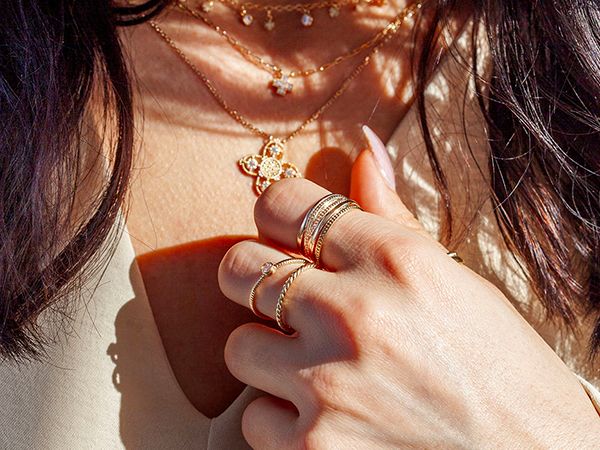
Vintage is enjoying incredible popularity... The fashion world throws this word at us at every turn! But what exactly is the vintage look? And most importantly, what vintage jewelry is all the rage right now? Clip-on earrings, brooches, pearl necklaces... MATY reveals the secrets to pulling off a vintage style with jewelry!
- Vintage jewelry draws inspiration from the styles of past decades—basically, from the 1920s to the 1980s.
- A vintage piece of jewelry was actually made in an earlier era; a retro piece of jewelry merely draws inspiration from that era.
- Art Nouveau (late 19th and early 20th centuries) is characterized by its curves, plant motifs, insects, and female figures.
- Art Deco (the 1920s and 1930s), on the other hand, emphasizes geometry, symmetry, and color contrasts.
- Cameos, brooches, pearl necklaces, antique rings, and secondhand jewelry are the easiest ways to get started with vintage style.
- To avoid looking like you're wearing a costume, pair a single vintage piece with a simple, modern outfit.
A cameo found in a grandmother’s jewelry box, a brooch unearthed at a flea market, a colored-stone ring bought secondhand: vintage jewelry has that rare power to tell a story even before you know it. It appeals to those who want to wear something other than the designs seen everywhere, and who love the idea that a piece has already lived a life of its own. But you still need to know your way around. Vintage, retro, antique, Art Nouveau, Art Deco: these terms are often used interchangeably, even though they refer to different styles. This guide will help you recognize each style, choose jewelry that suits you, and wear it today without looking like you’ve stepped out of a period film.
Contents
- What is vintage jewelry?
- How can you tell if a piece of jewelry is vintage?
- How can you tell if a piece of jewelry is Art Nouveau?
- Art Nouveau or Art Deco: How Can You Tell Them Apart?
- What jewelry should you choose for a great vintage look?
- How can you wear vintage jewelry without looking like you're in costume?
- Which vintage style should you choose based on your personality?
- Secondhand vintage jewelry to add a unique touch
- How Can You Best Buy Vintage or Secondhand Jewelry?
- How do you care for vintage jewelry?
- Mistakes to Avoid When Wearing Vintage Jewelry
- FAQ on Vintage and Art Nouveau Jewelry
What is vintage jewelry?
As we now know, fashion is cyclical! And while we may notice every year that old styles of clothing and accessories are coming back into fashion, that’s normal—and it will continue. The vintage trend works just as well for men as it does for women and draws inspiration from fashion hits from the 1920s through the 1980s.
The same goes for jewelry! In short, everything that was all the rage in previous decades has now become a coveted treasure!
Vintage, retro, antique: What are the differences?
A vintage piece of jewelry evokes a bygone decade; a retro piece imitates its style; an antique piece actually dates from that era. The distinction matters, especially when making a purchase: it affects the piece’s value, fragility, and care requirements.
In everyday language, these terms are often used interchangeably. In the jewelry industry, however, they are distinguished as follows:
|
Term |
Definition |
Example |
|---|---|---|
|
Vintage jewelry |
An item or style inspired by a past decade, most often from the 1920s to the 1980s |
A typical 1950s cocktail ring |
|
Retro Jewelry |
A recent creation that draws on traditional elements, without being period-specific |
A new pendant in the shape of an oval medallion |
|
Antique jewelry |
A piece of jewelry that was actually made in a bygone era; the term generally applies to pieces that are more than 50 years old |
A gold brooch from the 1930s |
|
Pre-owned jewelry |
Jewelry that has been worn and then resold, whether it is antique, vintage, or modern |
A refurbished wedding ring from the 2000s |
|
Art Nouveau |
An artistic movement of the late 19th and early 20th centuries, inspired by curves and nature |
An enameled dragonfly pendant |
|
Art Deco |
1920s and 1930s style, geometric and structured |
A ring featuring a diamond and onyx diamond-shaped pattern |
Why These Nuances Are Useful
An antique piece of jewelry isn’t necessarily “vintage” in the fashion sense of the term, and a vintage piece isn’t always antique. An authentic Art Deco ring from 1928 is an antique piece of jewelry. A new ring that replicates its geometric design is a retro piece inspired by Art Deco. Both can add the same charm to an outfit, but not at the same price, nor with the same care required. Finally, secondhand jewelry is a category unto itself: it’s defined by its history, not by its style. Yet it’s one of the best ways to find genuine vintage pieces with a story behind them.
How can you tell if a piece of jewelry is vintage?
Vintage jewelry is first and foremost recognized by its inspiration: its shapes, materials, and motifs evoke a specific era. Compared to today’s minimalist jewelry, it often appears more ornate, more intricately crafted, and more narrative.
The telltale signs
- A distinct era. The flowing lines of a 1900s pendant, the diamond shapes of a 1930s ring, or the generous proportions of a 1950s brooch immediately identify the piece of jewelry.
- Attention to detail. Chiseling, engraving, filigree, and ornate clasps: metal is not just a medium—it is part of the design.
- Distinctive materials. Pearls, mother-of-pearl, yellow gold, patinated silver, colored gemstones, coral, onyx, enamel.
- Traditional motifs. Cameo, medallion, bow, flower, foliage, snake, ornate chain, engraved monogram.
- Special finishes. Hammered, aged, or blackened metal in the recesses to highlight the texture.
- Clasps from days gone by. Clip-on or screw-on earrings, olive clasps on pearl necklaces, and long pins on brooches.
A vintage piece or a modern take?
To determine whether a piece of jewelry is truly antique or merely inspired by the past, there are a few clues to look for: natural wear on the metal (smoothed edges, partially faded hallmarks), an even patina, clasps of a style rarely used today, or stones cut in the old style, which are less brilliant than modern cuts. Hallmarks—small marks stamped into the metal—also provide information about the material and, sometimes, the era. These marks are merely indicators. For a valuable piece, only the opinion of a jeweler or an expert can confirm its age and authenticity.
How can you tell if a piece of jewelry is Art Nouveau?
Art Nouveau jewelry is recognizable by its curved lines, its motifs inspired by nature, and its sense of movement. It dates from the late 19th and early 20th centuries, with its golden age centered around the 1900 Paris World’s Fair.
A movement born out of a reaction
At the end of the 19th century, a generation of artists rejected industrial production and copies of ancient styles. They wanted a new art form—hence the name—that drew direct inspiration from nature. In jewelry, designers such as René Lalique, Georges Fouquet, and the Vever house challenged conventional wisdom: the value of a piece of jewelry was no longer determined solely by the weight of the gold or the size of the diamonds, but by its artistic composition. Precious stones were thus combined with more modest materials, such as horn, ivory, glass, or enamel.
How did the Art Nouveau movement influence jewelry design?
Art Nouveau jewelry is regarded more as works of art than as mere fashion accessories. It is therefore generally imposing and crafted from a variety of materials. It often features organic materials, semi-precious or precious stones, and delicate ornamentation. The mysterious world of Art Nouveau is a perpetual quest for beauty, a celebration of women and their graceful curves, as well as of nature in general.
A Checklist for Identifying Style
- Curved, flowing lines that evoke stems, waves, or strands of hair.
- Asymmetrical shapes, rarely rigid or perfectly regular.
- Floral motifs: iris, water lily, orchid, wisteria, poppy, foliage.
- Insects and animals: dragonfly, butterfly, beetle, bee, peacock, swan, bat.
- Female figures, often shown in profile, with long, wavy hair, depicted as fairies, nymphs, or intertwined with a flower.
- Draped fabrics and flowing silhouettes that seem to extend the pattern.
- Organic and luminous materials: mother-of-pearl, baroque pearls, translucent enamel, horn, and semi-precious stones such as opal, moonstone, and amethyst.
- A sense of movement, as if the flower or the wing were about to move.
- A piece of jewelry designed as a work of art, rather than simply as an accessory.
Inspired by women, flora, and fauna, Art Nouveau jewelry is easily recognizable. The use of certain materials is also characteristic of this movement in jewelry design: ivory, glass, horn, mother-of-pearl... As for the designs, they feature interlacing patterns of foliage, flowers, insects, birds, women, or figurative representations of sensuality.
Enamel: A Hallmark of Style
Pliqué-à-jour enamel is one of the techniques most closely associated with Art Nouveau. With no background, it allows light to pass through like a small stained-glass window, giving dragonfly wings or flower petals a translucent appearance. A piece that combines enamel, mother-of-pearl, and wavy lines is likely to belong to this movement or be inspired by it.
The exceptional quality of Art Nouveau jewelry continues to captivate many collectors, and if there’s one place where you can find authentic Art Nouveau jewelry, it’s in the secondhand market! For those who simply want to draw inspiration from this movement, there are plenty of pieces to delight you: jewelry made of pearls, mother-of-pearl, or featuring floral motifs.
Art Nouveau or Art Deco: How Can You Tell Them Apart?
Art Nouveau preceded Art Deco and contrasts with it almost in every respect: where the former uses curves, the latter employs straight lines. Both are often grouped under the “vintage” label, but they do not belong to the same era nor do they share the same stylistic codes.
Art Nouveau jewelry should therefore be distinguished from Art Deco jewelry. The Art Nouveau movement, which emerged in the late 1800s and early 20th century, found expression in all creative fields and highlighted the beauty of women, flowers, animals, and plants through its interplay of curves. What is known as Art Deco then flourished during the interwar period, in both architecture and jewelry, and is characterized by geometric shapes, in contrast to the Art Nouveau movement.
Art Nouveau dominated from around 1890 until the start of World War I. Art Deco took over after the war and flourished in the 1920s and 1930s; it takes its name from the International Exhibition of Decorative Arts held in Paris in 1925. In the intervening years, the world had changed: automobiles, airplanes, electricity, and skyscrapers had replaced nostalgia for nature with a fascination for modernity.
|
Criterion |
Art Nouveau |
Art Deco |
|---|---|---|
|
Period |
Late 19th century, early 20th century (circa 1890–1914) |
The 1920s and 1930s |
|
Lines |
Curved, supple, organic |
Straight, geometric, symmetrical |
|
Inspirations |
Nature, women, flowers, insects, animals |
Architecture, Machines, Speed, Distant Arts |
|
Common Reasons |
Dragonfly, butterfly, flower, foliage, female profile |
Diamond, fan, herringbone, parallel lines, rays |
|
Materials and Details |
Mother-of-pearl, enamel, pearls, horn, semi-precious stones |
Platinum, diamonds, onyx, rock crystal, calibrated stones |
|
Colors |
Soft, subtle shades |
Sharp contrasts: black and white, green and white, red and black |
|
Desired effect |
Poetic, natural, artistic |
Elegant, graphic, sophisticated |
Major Vintage Inspirations, Decade by Decade
Beyond these two movements, each period has left its mark on jewelry design. This distinction helps us avoid lumping everything together under a single term.
|
Period |
Main Codes |
Iconic Jewelry |
|---|---|---|
|
1890–1914: Art Nouveau |
Curves, nature, enamel, mother-of-pearl |
Dragonfly pendants, floral brooches, ornate combs |
|
1920–1930: Art Deco |
Geometry, platinum, black-and-white contrasts |
Rings with geometric patterns, long pearl necklaces, and bracelets |
|
1940s |
Voluminous rose or yellow gold, ribbon and drape effects |
"Tank" rings, large bow brooches, wide-link bracelets |
|
The 1950s |
Glamour, sparkling costume jewelry, pearls |
Cocktail rings, pearl necklaces, clip-on earrings |
|
1960s–1970s |
Free-form designs, colors, bohemian style |
Large rings with colored gemstones, long necklaces, ethnic pendants |
|
The 1980s |
Bold yellow gold, graphic shapes |
Statement clip-on earrings, thick chains, bangles |
Art Deco jewelry looks best with a clean, structured outfit; Art Nouveau jewelry pairs better with flowing fabrics. If you have a fondness for the Art Deco period, many gemstone pendants will suit you: sapphire, ruby, emerald... You’ll have a piece of jewelry that’s both fashionable and precious.
How to select jewelry for a successful vintage look?
When it comes to jewelry, there are no specific guidelines on what types to choose to create a vintage look: bracelets, watches, earrings, necklaces… Everything works with this trend! The only rule to follow is that the piece should be inspired by an iconic design from a different decade than our own. To start, a single well-chosen piece is all you need: a cameo pendant, a brooch, a pearl necklace, an antique ring, or a pair of retro-inspired earrings. Here are a few examples of jewelry that’s perfect for a “so vintage” style.
Vintage pendants
No matter what your favorite era is when it comes to fashion and trends, you’re sure to find the perfect pendant! Are you more of a fan of ancient Rome through the Renaissance? Go for a cameo! This piece of jewelry, engraved in bas-relief—usually in a seashell or a hard stone—typically features a woman’s profile against a background of a different color. Every cameo is unique. Having made a comeback in the early 20th century, it still has many good years ahead of it.
Medallions, which open to hold a photo or a lock of hair, hold deep sentimental value. Next come gemstone pendants (garnet, amethyst, citrine), floral designs, and figurative pendants, such as birds or butterflies. Worn on a delicate chain, these pieces are easy to wear every day: discover MATY’s pendants and medallions.
Vintage brooches
The brooch is making a big comeback among trendy jewelry and accessories! Pinned to a jacket, coat, or sweater, the brooch is minimalist in its use, but your style will feel its full impact. This true gem for your outfits—an icon of the 1950s—will quickly become a must-have. The bonus: you can collect brooches to your heart’s content (or almost). Group two or three of different sizes together in one spot for a coordinated look, or pin one onto a bag or hat. New and vintage brooches offer a selection of styles you won’t find anywhere else.
Vintage rings
If you’re looking for vintage rings to complete your look, you’ll be spoiled for choice! Just keep a few things in mind: blackened, hammered, or distressed metal will instantly give your ring a vintage look. Next, gemstones and semi-precious stones with a jewelry-like appearance are a perfect fit and will add a touch of retro-chic to your outfits! Finally, amber, due to its fossilized origin, naturally lends a vintage feel to your jewelry.
Generously sized cocktail rings from the 1950s, marquise rings or entourage rings, chiseled yellow gold rings, Art Deco-inspired designs with their geometric lines: rings are the easiest vintage pieces to wear every day. When buying a secondhand ring, be sure to check the size using the size guide and see if resizing is possible.
Pearl necklaces
The pearl necklace spans every vintage decade, from the long necklaces of the 1920s to the short strands of the 1950s. To give it a less prim look, wear it with jeans and a sweater, a white T-shirt, or a men’s shirt. Long necklaces can be wrapped twice around the neck or tied at the bottom; a short strand layered over a thin chain creates a very modern look. Check out MATY’s pearl necklaces.
Vintage earrings
Although often overlooked, they’re actually a great way to embrace the style. Clip-on earrings, which don’t require pierced ears, evoke the 1950s and 1980s. Stone pendants, teardrop pearls, floral designs, and engraved hoop earrings round out this collection. With your hair pulled back, a pair of clip-ons is all it takes to add character to a very simple outfit.
How can you wear vintage jewelry without looking like you're in costume?
The secret lies in one rule: one vintage piece, one contemporary outfit. It’s the contrast between the two that makes the jewelry look modern. A head-to-toe vintage look, on the other hand, quickly brings to mind a costume.
Tips for Modernizing Vintage Jewelry
- Choose a statement piece rather than a set. A dramatic brooch or a cocktail ring speaks for itself. Let the rest of the outfit breathe.
- Opt for understated clothing. Raw denim, a white shirt, a cashmere sweater, a well-tailored blazer, a little black dress: these basics highlight the details of vintage jewelry.
- Repurposing items. A brooch can be worn on a bag, a hat, a belt, or tucked into the neckline of a turtleneck. A cameo pendant can be strung on a velvet ribbon or a very fine chain.
- Limit retro references. A polka-dot dress, a tied scarf, a vintage bag, and antique jewelry all in the same outfit is too much. Stick to one or two nods to the past at most.
- Play with contrasts. Pearls with a sweatshirt, an Art Deco brooch on a trench coat, a cameo with a striped T-shirt: it’s the unexpected combination that makes it so charming.
- Mix and match with contemporary jewelry. An antique ring worn alongside two modern, delicate bands immediately looks more current.
The Table of Associations
|
Vintage jewelry |
Recommended Attire |
Desired effect |
|---|---|---|
|
Cameo |
White shirt, lightweight sweater, blazer |
Refined Retro Elegance |
|
Spindle |
Jacket, coat, simple dress |
A unique and refined detail |
|
Pearl necklace |
Jeans, knit, black dress |
A chic and modern contrast |
|
Antique Ring |
Minimalist outfit |
Showcased Highlight |
|
Clip-on earrings |
Hair pulled back, simple top |
A Bold Retro Look |
|
Art Nouveau Pendant |
Flowy dress, blouse, minimalist outfit |
A poetic and natural style |
|
Art Deco Jewelry |
Suit, shift dress, chic look |
Graphic Elegance |
What about men?
Men's vintage style is all about antique signet rings, cufflinks, tie pins, or vintage watches. The same rule applies: just one standout piece, worn with a modern outfit.
Which vintage style should you choose based on your personality?
Vintage fashion spans nearly a century of styles. Rather than trying everything, start with your own personal style and the clothes you already enjoy wearing.
|
Personality |
Jewelry to Look For |
Materials and Patterns |
|---|---|---|
|
Romantic |
Cameos, medallions, flower pendants |
Pearls, mother-of-pearl, rose gold, soft shapes |
|
Chic |
String of pearls, brooch, vintage ring |
Yellow gold, white pearls, classic gemstones |
|
Chart |
Art Deco Rings and Earrings |
Geometric lines, onyx, contrasting stones |
|
Poetics |
Art Nouveau Pendants and Brooches |
Plant motifs, birds, butterflies, enamel |
|
Bold |
Cocktail rings, large brooches, colorful jewelry |
Large stones, bold shapes, bright colors |
|
Discreet |
Small vintage pendant, delicate ring, retro earrings |
Fine yellow gold, small pearls, delicate gemstones |
A few tips for refining
If you mostly wear flowing outfits, floral dresses, and soft colors, Art Nouveau and romantic styles will suit you well. If your wardrobe consists of clean lines, black, white, and tailored suits, Art Deco will highlight that precision. Those who love color and mixing styles will gravitate toward the 1960s and 1970s, while those who prefer classic pieces—the kind you keep for a lifetime—will find joy in pearls and yellow gold.
There's nothing stopping you from switching between styles depending on the occasion. The key is to maintain consistency within a single outfit.
Secondhand vintage jewelry to add a unique touch to an outfit
A piece of secondhand jewelry offers something no new collection can promise: a piece that already has a history—and is often a design that is no longer in production. It’s also the most direct way to acquire authentic vintage jewelry.
To take it a step further and give your style real character, opt for vintage jewelry that actually dates back to the era when it was at the height of its popularity.
Jewelry, rings, brooches…Secondhand jewelry is steeped in history, which gives it a very special charm. It’s a real asset for a vintage look, since it draws on the aesthetic and stylistic elements of the past while remaining one-of-a-kind.
Good Reasons to Get Started
- A one-of-a-kind piece. Vintage jewelry was produced in small batches, sometimes as single pieces. You're unlikely to run into anyone else wearing the same piece.
- The charm of time-honored craftsmanship. Hand-chiseled designs, traditional stone-cutting techniques, and intricate settings: some of these details require a level of craftsmanship that few new pieces of jewelry can afford today.
- Pieces you won't find anywhere else. Figurative brooches, 1940s rings, Art Deco long necklaces, and vintage watches are now almost exclusively available on the secondhand market.
- A more responsible approach. Gold and silver can be recycled indefinitely. Choosing secondhand jewelry means extending the life of metals and gemstones that have already been mined.
- Good value for the money. For the same price, a secondhand 18-karat gold ring sometimes offers more metal or a more beautiful stone than a new one.
What Determines the Value of Pre-Owned Jewelry
Three factors are most important: overall condition (clasp, setting, wear on the metal), material (gold, silver, platinum, natural or synthetic stones), and authenticity, as attested by hallmarks or a certificate. A store that sells inspected and refurbished secondhand jewelry will help you avoid most unpleasant surprises.
Whether online or in-store, browse and discover our selection of pre-owned jewelry: rings, necklaces, earrings, yellow gold jewelry, and pre-owned watches.
How Can You Best Buy Vintage or Secondhand Jewelry?
Before buying vintage jewelry, check four things: the material, the condition, the dimensions, and the seller's reputation. These checks take just a few minutes and can save you a lot of disappointment.
The Pre-Purchase Checklist
- Check the material. In France, 18-karat gold is marked with an eagle’s head and silver with a head of Minerva—two hallmarks in use since 1838. A piece of jewelry without a hallmark isn’t necessarily fake, but it’s worth checking.
- Check the clasp. Open and close it several times. A worn-out spring or a bent ring can cause you to lose the piece of jewelry.
- Examine the stones and settings. The prongs should hold each stone securely, with no wiggle. Gently shake the piece near your ear: none of the stones should move.
- Check the dimensions. In a photo, a brooch or pendant may appear larger or smaller than it actually is. Read the measurements in millimeters.
- Check the size of a ring. Antique rings are often smaller than today's sizes. Ask if the ring can be resized: a plain band can be resized easily, but a ring set all the way around is much harder to resize.
- Accept some signs of wear. A slight patina is part of the charm of antique jewelry. A chipped pearl, cracked enamel, or chipped stone, on the other hand, are difficult or expensive to repair.
- Choose a reliable seller. A retailer that can provide you with information about the material, weight, type of gemstones, and condition of the jewelry offers you real peace of mind, as well as a warranty and after-sales service.
- Seek advice. When it comes to a valuable or antique piece, consulting a jeweler in person is still the best way to clear up any doubts.
Questions to Ask the Seller
What material is the jewelry made of? Are the stones natural? Has the jewelry been cleaned, restored, or repaired? Can it be resized? Is there a certificate or warranty? A reputable seller will answer these questions without hesitation.
How do you care for vintage jewelry?
Antique jewelry should be cleaned gently: use lukewarm water, mild soap, and a soft brush—and never use harsh chemicals. Certain materials, such as pearls, mother-of-pearl, or enamel, require even greater care.
The Basic Rules
- Clean gently. Give it a quick bath in lukewarm soapy water, brush it lightly with a soft-bristled toothbrush, rinse it, and then dry it thoroughly with a soft cloth.
- Avoid harsh products. Bleach, vinegar, toothpaste, baking soda, and ultrasonic cleaners can damage delicate gemstones, dull the enamel, or loosen the settings.
- Put on your jewelry last. Perfume, lotion, and hairspray can leave residue on the metal and gemstones. Wait until they have dried before putting on your jewelry.
- Store separately. Antique jewelry can scratch each other. A box with compartments or fabric pouches will prevent them from rubbing against each other.
- Have your jewelry checked regularly. Once a year, ask a jeweler to inspect the clasps and settings, especially on pieces you wear often.
Care Instructions by Material
|
Material |
How to Clean It |
Things to Avoid |
|---|---|---|
|
Gold |
Warm soapy water, soft brush |
Chlorinated products, repeated shocks |
|
Silver |
Special silver polishing cloth to restore shine |
Baths that are too long, which wash away the desired patina from the blackened reliefs |
|
Beads |
A soft, slightly damp cloth after each use |
Soapy water, perfume, an airtight bag: pearls need air |
|
Mother-of-pearl |
Soft, dry cloth |
Hot water, acidic products |
|
Enamel |
A dry cloth; do not rub too hard |
Shocks, sudden temperature changes |
|
Precious stones (diamond, sapphire, ruby) |
Warm soapy water, soft brush |
Impacts on the edges of stones |
|
Semi-precious stones (opal, turquoise, moonstone) |
Soft cloth; preferably dry |
Water, heat, prolonged sun exposure |
When it comes to pearls, be sure to have your necklace restrung every few years: the thread wears out and loosens over time. For repairs, a thorough cleaning, or restoration, bring your jewelry to MATY Jewelers and Watchmakers.
Mistakes to Avoid When Wearing Vintage Jewelry
Most mistakes stem from going overboard: too many pieces, too many styles, too much cleaning. Here are the most common ones.
- Wearing too many vintage pieces at once. A cameo, a brooch, pearls, and a cocktail ring all in the same outfit: the eye doesn't know where to look, and the whole look seems dated.
- Mix eras without a unifying theme. An Art Nouveau dragonfly, a geometric Art Deco ring, and a long necklace from the 1970s each tell a different story. Choose a dominant era, or tie them together with the color of the metal.
- Choosing delicate jewelry for heavy use. An opal or enamel ring cannot withstand the daily wear and tear. Save these pieces for special occasions and opt for a hard stone for a ring you wear every day.
- Do not clean with a harsh cleaner. Household cleaners or ultrasonic cleaners can permanently damage an antique piece.
- Neglecting clasps and settings. A loose stone or a worn-out clasp are the leading causes of loss.
- Pair a very retro outfit with lots of vintage accessories. The more vintage the outfit, the more understated the jewelry should be.
- Don't overlook the size of a secondhand ring. A ring that's too tight can't be worn, and a ring that's too loose will get lost. Check the size and resizing options before purchasing.
- Store pearls and mother-of-pearl with other jewelry. These delicate materials can get scratched when they come into contact with metal and hard stones. Store them separately in a fabric pouch.
FAQ on Vintage and Art Nouveau Jewelry
What is vintage jewelry?
It is a piece of jewelry from a bygone decade—or one that clearly echoes the style of that era—most often from the 1920s through the 1980s. It can be recognized by its shapes, materials, and motifs, which are characteristic of that era.
What's the difference between vintage, retro, and antique jewelry?
Antique jewelry was actually made in the past. Retro jewelry is a recent creation that imitates antique styles. The broader term “vintage” refers to both period pieces and the style inspired by them.
How can you tell if a piece of jewelry is Art Nouveau?
With its curved and often asymmetrical lines, its motifs drawn from nature (flowers, dragonflies, butterflies), its female figures with long hair, and materials such as mother-of-pearl, enamel, and pearls, it conveys a sense of movement.
What is the difference between Art Nouveau and Art Deco?
Art Nouveau, from the late 19th to the early 20th century, emphasizes curves and nature. Art Deco, which emerged after World War I and flourished in the 1920s and 1930s, favors straight lines, symmetry, and color contrasts.
What kind of jewelry should you choose for a vintage look?
The easiest pieces to incorporate are cameo pendants, brooches, pearl necklaces, vintage gemstone rings, and clip-on earrings. Start with a single piece and wear it with a simple outfit.
How do you wear a vintage brooch?
On the lapel of a jacket or coat, on the collar of a shirt, on a sweater, or—for a more creative touch—on a bag, belt, or hat. You can also group two or three of them together in the same spot.
How can you give a pearl necklace a modern twist?
Pair it with casual clothes: jeans, a white T-shirt, a sweatshirt, or a men's shirt. Layer it with a thin chain, or wrap a long necklace twice around your neck.
Why choose secondhand vintage jewelry?
To wear a unique piece, steeped in history, that’s often impossible to find in stores. It’s also a responsible choice and can sometimes offer good value for the money, provided you buy from a reliable seller.
How do you care for antique jewelry?
Use lukewarm water, mild soap, and a soft brush for gold and hard stones; use a simple soft cloth for pearls, mother-of-pearl, and enamel. Avoid harsh cleaning products and have clasps and settings checked once a year.
What vintage jewelry should you give as a gift?
A locket or cameo for a romantic person, a vintage gemstone ring for a special occasion, a brooch for a fashion lover, or a pearl necklace for a timeless gift. If you’re giving a ring, make sure you know the size or that it can be resized.
Vintage: It's All in the Eye of the Beholder
Embracing the vintage style isn’t about going back in time—it’s about choosing a piece from the past and making it part of your present. Once you’ve established your reference points, everything becomes simpler. Art Nouveau features flowing, undulating lines inspired by nature. Art Deco features clean, sharp lines. Each subsequent decade has left its own distinctive mark. Start with the piece of jewelry that appeals to you most—whether it’s a cameo, a brooch, a string of pearls, or an antique ring. Wear it with what you already have in your closet, without trying to recreate a specific era. Take the time to check its condition if you’re buying it secondhand, then care for it gently so it will last for a few more decades.
To find the perfect piece, browse MATY’s selection of pre-owned jewelry, brooches, pendants and medallions, pearl necklaces, and rings featuring semi-precious and precious stones. If you’re looking for a ring, check your size using the size guide.

Second hand gold ring 750 white china cultured pearl china cultured pearl diamond
€1,019 Estimated value:€2,038

Pre-owned 750 white gold brooch with diamonds and cultured pearls
€1,649 Estimated value:€3,298

Pre-owned 750 yellow gold bracelet with Tahitian pearls
€1,379 Estimated value:€2,758

Second-hand brooch in 2-tone 750 gold with diamonds and garnets
€790 Estimated value:€1,580

Silver necklace 925 Chinese pearls 45cm
63,20 79€ (20)

Second-hand brooch in 750 yellow gold with cultured pearl flower
€1,379 Estimated value:€2,758

375 yellow gold hoop earrings with Chinese cultured pearls
224,50 449€ (50)

Pre-owned 750 yellow gold ring with a cultured pearl and sapphire
€699 Estimated value:€1, 398

Pre-owned 750 yellow gold necklace with cultured pearls
€899 Estimated value:€1, 798

Pre-owned 750 yellow gold necklace with cultured pearl, 42 cm
€949 Estimated value:€1, 898

Silver necklace 925 Chinese pearl 45cm
32,50 65€ (50)

Gold necklace 375 yellow Chinese cultured pearls 42 cm
169,50 339€ (50)

Pink gold-plated cultured pearl ring
€27.96 €69.90 (-60%)

Second-hand gold ring 750 yellow cultured pearl
€449 Estimated value:€898

Silver earrings 925 cultured pearls china zirconias
22,50 45€ (50)

Rock jewelry: from biker rock'n roll to rock chic!

Bohemian chic jewelry: a matter of style