A piece of jewelry rarely wears out from being worn. It suffers far more damage in between, when it lies at the bottom of a drawer, mixed in with other pieces that scratch, snag, or tarnish it. The delicate chain found knotted around itself, the hoop earring whose pendant has gone missing, the ring whose stone has lost its luster: these minor mishaps almost always stem from the same cause—haphazard storage. Storing your jewelry properly, however, is neither an obsession nor a luxury. It’s a matter of a few simple principles, which can be adapted to the nature of each piece, its material, and the space you have available. This guide covers them one by one, from necklaces to watches, including travel jewelry and family heirlooms you wish to pass down.
Sorting your jewelry before storing it—by type, material, how often you wear it, or value—is essential. You should also make sure to store necklaces separately, either hanging or in compartments, to prevent them from getting tangled. Keeping earrings in pairs so you never lose one is also a good practice to follow. Also, be sure to keep gem-set rings and precious jewelry separate to protect them from scratches and impacts. Finally, choose a storage container suited to your needs—such as a compartmentalized box, jewelry case, display stand, or pouch—and keep your collection away from moisture, direct light, loose items, and friction.
Contents
- Why is it important to store your jewelry properly?
- Which storage solution is best for which piece of jewelry?
- Sort Your Jewelry Before Storing It
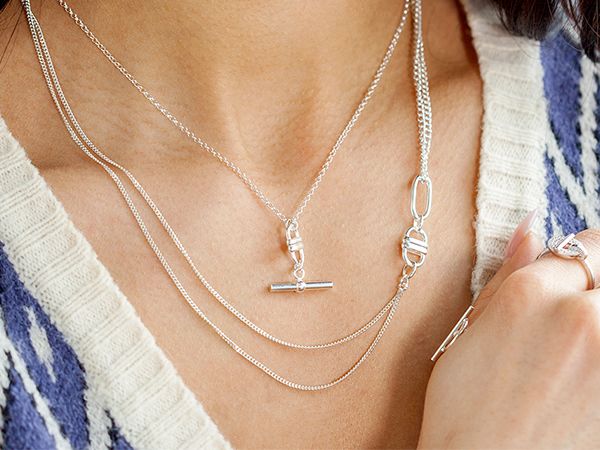
- How can you store your necklaces without them getting tangled?
- Storing Your Earrings: By Pair and by Shape
- Store your rings where they're protected from bumps and scratches
- How should you store your bracelets?
- Storing Your Watches: A Special Place in Your Collection
- How should you organize your jewelry based on the material it's made of?
- How can you protect your precious or sentimental jewelry?
- Traveling with Jewelry: How to Transport It Without Damaging It
- What kind of storage should you choose for a large collection or a small space?
- Mistakes to Avoid to Keep Your Jewelry in Good Condition
- FAQ: Your Questions About Jewelry Storage
- Storage that helps your jewelry last longer
Why is it important to store your jewelry properly?
Thoughtful storage protects the jewelry itself first and foremost. Each material reacts differently to air, humidity, light, and contact with other metals. Left on their own in a shared box, the pieces bump into and rub against one another, eventually leaving marks on each other.
The most common types of damage are well known to jewelers:
- the knots, which lurk in every chain, and even more so the fine links, which sometimes break when you try to untangle them;
- scratches caused by a hard stone coming into contact with a softer metal, or by two rings rubbing against each other;
- oxidation, to which silver is particularly susceptible: when exposed to the air, it gradually takes on a grayish tint, then turns black;
- the loss of a single earring, a clasp, or a push-button, which makes the pair unwearable;
- deformation, which affects bangles, hoop earrings, and watch bands that have been crushed under other objects.
Then there’s the convenience of everyday life. A well-organized collection is easy to scan at a glance, and in just a few seconds you can find the pair of hoop earrings that matches your outfit. You also rediscover forgotten pieces, which you begin to style in new ways. A piece of jewelry you see is a piece of jewelry you wear.
Finally, storing these items with care means respecting what they represent. A wedding band, a baptismal medal, or an heirloom ring all carry a story. Giving them a special case and a special place means ensuring that one day we can pass them on in the same condition in which we received them.
Which storage solution is best for which piece of jewelry?
Each type of jewelry has a primary risk, and therefore one type of container is more suitable than another. This table provides an overview; the following sections go into detail about each case.
|
Jewel type |
Recommended Storage |
Risk Avoided |
|---|---|---|
|
Necklaces and chains |
Hanging display rack, hooks, separate compartments |
Knots, twists, breakage |
|
Rings |
Jewelry box, slotted tray, ring holder |
Scratches, dents, loss |
|
Earrings |
Storage by pair, perforated rack, compartmentalized box |
Loose loop, friction |
|
Flexible bracelets |
Compartments or suspension |
Tangle |
|
Rigid bracelets |
Display stand or flat storage |
Warping, scratches |
|
Watches |
Cushion box, separate storage compartment |
Scratches, dents, bent band |
|
Precious Jewelry |
Individual case, lined pouch |
Impacts, oxidation, loss |
Sort Your Jewelry Before Storing It
Before choosing a box or display case, it’s best to know what you have. Lay out all your jewelry on a light-colored surface, such as a towel or a tray, and take the time to go through it. This is a good opportunity to set aside a stray earring, a clasp that needs repairing, or a chain that needs cleaning.
There are several different ways to organize your jewelry. None is better than the others—it all depends on your collection and how you choose your jewelry in the morning.
- By type: rings together, necklaces together, bracelets together. This is the most intuitive way to organize items, and the one that makes it easiest to choose a container.
- By material: yellow gold, white gold, silver, steel, gold-plated, and costume jewelry. This sorting method has a practical advantage, as it prevents metals of different hardnesses from scratching each other.
- By color: This is especially useful if you like colored gemstones, pearls, or costume jewelry, which are easier to coordinate with an outfit when grouped by shade.
- By how often they're worn: everyday items within easy reach, and special-occasion items stored away in a closed container.
- Whether based on value or fragility: precious jewelry, costume jewelry, and sentimental jewelry require different levels of care and are best stored separately.
- By occasion: work attire, evening wear, formal wear, vacation wear. A small selection of ready-to-go items saves precious time when packing your suitcase.
In practice, two criteria are often combined: the type of item, which determines its general classification, and how often it is worn, which helps decide what stays on display and what goes into a jewelry box.
How can you store your necklaces without them getting tangled?
Necklaces are the first casualties of haphazard storage. A chain laid flat in a box will sooner or later end up tangled around another, and the slightest movement of the drawer tightens the knots. The basic rule can be summed up in one word: separate. Each necklace should have its own space, whether it’s hung up or laid flat in a compartment.
Hanging storage remains the safest option for a medium-sized collection. A necklace holder, a jewelry tree, or a simple row of hooks attached to the inside of a closet door allows the chains to hang at their full length, without touching one another. The necklaces remain visible, making it easier to choose one.
Some cases require a little more attention:
- Delicate chains—whether in forçat or Venetian link styles—tend to tangle at the slightest breeze. Always close the clasp before hanging them up or putting them away: this simple precaution is enough to prevent most tangles. For the most delicate chains, it’s best to store them in individual pouches.
- Long necklaces and chokers need a stand that’s tall enough so they don’t drag on the ground, or an elongated compartment where they can be placed without having to be folded over on themselves.
- Ties, which are shorter and often stiffer, fit neatly flat in a compartmentalized box.
- Pendant necklaces look best when the pendant is suspended from the clasp so that it hangs freely and does not bump into the adjacent chains.
- Necklaces worn every day can be kept on a small display stand near the mirror, as long as they are kept away from the bathroom.
- Travel necklaces can be slipped—with the clasp closed—into a pouch or a jewelry box with snaps.
An old trick still works very well for transporting a thin chain: thread it through a straw cut to the right length, then close the clasp on the outside. It arrives at its destination perfectly straight.
Storing Your Earrings: By Pair and by Shape
A single earring isn't much use anymore. The key rule to always keep in mind is to store each pair together—in the same compartment or on the same holder—and to put the backs back on the posts as soon as you take them out. Most jewelry boxes, in fact, have narrow compartments or slots designed to hold two earrings side by side.
Now it’s a matter of choosing between two approaches. The display—whether a perforated card, grid, or looped rack—showcases the pairs and lets you choose them at a glance. The box—closed and lined—hides the jewelry but protects it better from dust, light, and impacts. Many collections combine the two: the display stand for the pieces worn every week, and the box for the rest.
The shape of the earrings also influences the choice:
- Ear studs and posts are easy to lose. They can be stored in small compartments or on a slotted cushion that holds the pair in place.
- Hoop earrings are best kept in a separate compartment. If placed on top of other jewelry, they can get scratched or scratch the pieces next to them, especially when the metals are different.
- Hanging items require a vertical support or a box deep enough to prevent the fasteners from bending.
- The clips have a delicate mechanism. Store them open and separately to protect the spring.
- Earrings adorned with pearls or gemstones should be stored in an individual jewelry box or a soft pouch to prevent any contact with metal.
And if you like to wear mismatched earrings, there's nothing stopping you from storing these combinations together, just as you would a classic pair: you'll be able to find your favorite combinations without having to put them back together.
Store your rings where they're protected from bumps and scratches
One unique feature of rings is that they often feature the hardest stones in the collection. A diamond can scratch gold, a sapphire can scratch silver, and two gem-set rings that touch each other will eventually damage one another. Therefore, they need to be placed where they remain stationary, without coming into contact with their neighbors.
The original jewelry box, provided when you purchased the ring at the jewelry store, remains the ideal way to protect it: it’s custom-fitted for the ring, lined, and has a secure closure. Keep it—at least for your most precious pieces. However, it becomes bulky as your collection grows, and you eventually lose track of which box contains what. For a larger collection, a slotted tray lined with velvet or suede is the best solution. Each ring stands upright in its own slot, separate from the others, and the whole thing fits neatly into a drawer. Ring holders—whether cones or small decorative hands—are best suited for rings you wear often and like to keep in plain sight.
Depending on the type of ring, a few adjustments may be necessary:
- Set rings should always be stored separately, in a compartment or a jewelry box, and never in direct contact with other jewelry.
- Thin rings and stackable rings can become misshapen if they are crushed. They can be stored together on the same cone, as long as they are made of the same metal.
- Large rings and signet rings require wider slots or a dedicated compartment.
- Wedding bands and everyday rings deserve a small dish on the nightstand—rather than on the edge of the sink—so you can set them down at night without risking losing them.
- Precious or heirloom rings are returned to their original case, which is stored in a sealed container.
How should you store your bracelets?
Bracelets alone bring together two categories with opposing needs. Flexible styles get tangled like necklaces, while rigid styles get scratched and warped like rings. Treating them the same way is tantamount to compromising one or the other.
Flexible bracelets and chain bracelets should be hung on a horizontal bar or a bracelet holder with the clasp closed. If you don’t have many, they can share the same holder as your necklaces, as long as you leave one hook free between each piece. Otherwise, a box with narrow compartments works perfectly.
Bracelets and cuffs, on the other hand, should not be stacked under other items or allowed to knock against each other. A bracelet holder shaped like a bar or cylinder, onto which they are slipped side by side, helps them retain their shape. They can also be stored flat, each in its own compartment, in a lined drawer. An open cuff should never be forced closed or spread apart; it should be left in its natural position.
Some subjects require special attention:
- Bead or stone bracelets, which are often strung on elastic or silk thread, should be stored flat. If left hanging for too long, the thread will stretch.
- Leather or fabric bracelets should be kept away from moisture and direct light. Storing them in a closed box, away from metal objects, will prevent them from staining or drying out.
- Charm bracelets get caught on everything. A separate pouch keeps them from snagging on the links of the bracelets next to them.
Storing Your Watches: A Special Place in Your Collection
A watch is both a piece of jewelry and an instrument. Its crystal, polished case, and band are just as susceptible to scratches as rings; its movement, on the other hand, does not fare well when exposed to moisture, temperature fluctuations, or magnetic fields. Storing it properly helps preserve both its appearance and its accuracy.
The safest approach is to never mix it with other jewelry. If placed at the bottom of a shared jewelry box, it takes the brunt of bumps from rings and chains, and its crystal will show the marks. A watch box, equipped with individual compartments and cushions that cradle the bracelet, keeps it in its natural position. The bracelet doesn’t get twisted, and the dial remains facing upward, protected.
It is helpful to distinguish between two uses:
- Your everyday watch can be placed on a small cushion or tray next to your side table, away from the bathroom and any nearby electronic devices, such as a phone or a speaker.
- More valuable watches—or those that are rarely worn—are best kept in their original case or in a closed compartment of a watch box. For an automatic watch that is rarely worn, a watch winder eliminates the need to set the time each time you put it on.
Also keep in mind the watchband: a leather band should be stored flat or rolled up—without being folded—and away from light, to prevent it from cracking or fading. A metal band should be fastened before being set aside, so that its links do not rub against the case.
MATY offers watch storage boxes designed for these purposes, as well as a watch repair service for maintenance, battery replacement, or servicing of your timepieces.
How should you organize your jewelry based on the material it's made of?
The type of jewelry determines the shape of the storage container; the material, in turn, determines the conditions under which it should be stored. A silver necklace and a yellow gold necklace are not susceptible to the same damage, even though they are hung in the same way.
Silver Jewelry
Silver tarnishes when it comes into contact with sulfur compounds in the air, and humidity accelerates this process. To slow it down, store your silver jewelry in a sealed container: a lined box, a fabric pouch treated to prevent tarnishing, or a small resealable bag from which you’ve removed the air. Placing an anti-tarnish strip inside the box further prolongs this effect. Avoid leaving your jewelry exposed to the air on a display stand for weeks at a time if you’re not wearing it.
Gold Jewelry
Gold hardly oxidizes at all, but it is a soft metal. Therefore, you should be careful to avoid scratches, especially when it comes into contact with hard stones or textured, engraved, or diamond-cut pieces. Separate your gold jewelry from gem-set rings and store them in lined compartments. Rhodium-plated white gold requires the same care: its thin layer of rhodium wears away more quickly if it rubs against other metals.
Gold-plated and steel
Gold-plated jewelry gets its luster from a layer of gold deposited onto another metal. Repeated friction and moisture gradually wear it down. Store it in a safe place, in a closed, dry box, and keep it separate from harder jewelry. Stainless steel is more durable; however, it can scratch softer metals, which is why it’s important to keep it separate from gold and silver.
Fashion Jewelry
Costume jewelry often combines base metals, adhesives, and rhinestones. Water, moisture, and perfume can quickly damage it. A dry, sealed container with separate compartments is all it takes to preserve its shine and prevent the rhinestones from falling off.
Beads
Pearls are organic materials, softer than any stone. They scratch at the slightest touch and are sensitive to both dryness and moisture. Store them flat, in a soft fabric pouch or a jewelry box—never in an airtight plastic bag for an extended period. A pearl necklace should not be hung up; the string would eventually stretch out.
Jewelry set with gemstones
Not all gemstones have the same hardness. A diamond can scratch a sapphire, which can scratch an emerald, which in turn can scratch an opal or a turquoise. The simplest approach is to avoid any direct contact between pieces of set jewelry: each piece should be stored in its own compartment, slot, or pouch. Light-sensitive gemstones, such as amethyst or kunzite, should preferably be stored in a closed container.
How can you protect your precious or sentimental jewelry?
Some pieces cannot be replaced. Their value sometimes lies in the gold and gemstones, sometimes in the memories they hold, and often in both. They require more careful storage than the rest of the collection.
- Keep the original jewelry boxes. Designed specifically for the jewelry they hold, they keep it secure and protect it better than any other container. They also make it easier to resell the jewelry or have it appraised.
- Keep the most delicate pieces separate. An antique ring with worn prongs, a pearl necklace, or an enamel brooch should never be stored alongside other jewelry.
- Opt for closed storage. Open displays are suitable for everyday jewelry, but not for pieces you only take out twice a year. A box that closes—or even locks—protects them from dust, light, and prying eyes.
- Take photos of your valuable jewelry, both from the front and in profile, and keep these images along with the certificates and receipts. In the event of loss or theft, these documents will greatly simplify the process of filing a claim with your insurer.
- Consider a secure storage solution for high-value items: a home safe, or a bank safe deposit box for items you rarely wear.
- Have them checked regularly. A jeweler can check the tightness of the prongs and the condition of the clasps in just a few minutes. A loose stone is much more likely to get lost in a drawer than on your finger.
Traveling with Jewelry: How to Transport It Without Damaging It
A suitcase is undoubtedly where jewelry is most at risk. It gets jostled around for hours, squeezed between clothes, and sometimes forgotten at the bottom of a pocket. However, just a few simple habits are all it takes to ensure it travels safely.
- Pack lighter. Put together a small selection in advance that goes with all your outfits: a pair of stud earrings, a pair of hoop earrings, a necklace, and one or two rings. Leave your most valuable pieces at home, unless there’s a specific occasion.
- Choose a dedicated container. A travel jewelry pouch, a small hard case, or a compact box with compartments provides much better protection than a single pouch where everything gets jumbled together.
- Separate each piece. Chains on one side, clasps on the other, and rings in their slots. Nothing should be able to touch anything else.
- Close all the clasps and slip the thin chains into a straw or an individual pouch to prevent them from getting tangled.
- Keep your jewelry with you. Whether you're traveling by plane or train, it should go in your carry-on luggage, never in checked luggage.
- Once you arrive, assign them a specific spot. In a hotel room, choose a single spot—preferably the safe—and stick to it. That's the best way to make sure you don't leave anything behind when you check out.
For a short trip, a simple pouch made of soft fabric for each piece of jewelry, all stored together in a case, works perfectly.
What kind of storage should you choose for a large collection or a small space?
Choosing the right container depends as much on the number of pieces of jewelry as on the amount of space you have available. A handful of pieces will fit in a standard jewelry box; a collection of several dozen pieces requires a more structured organization system.
For a large collection
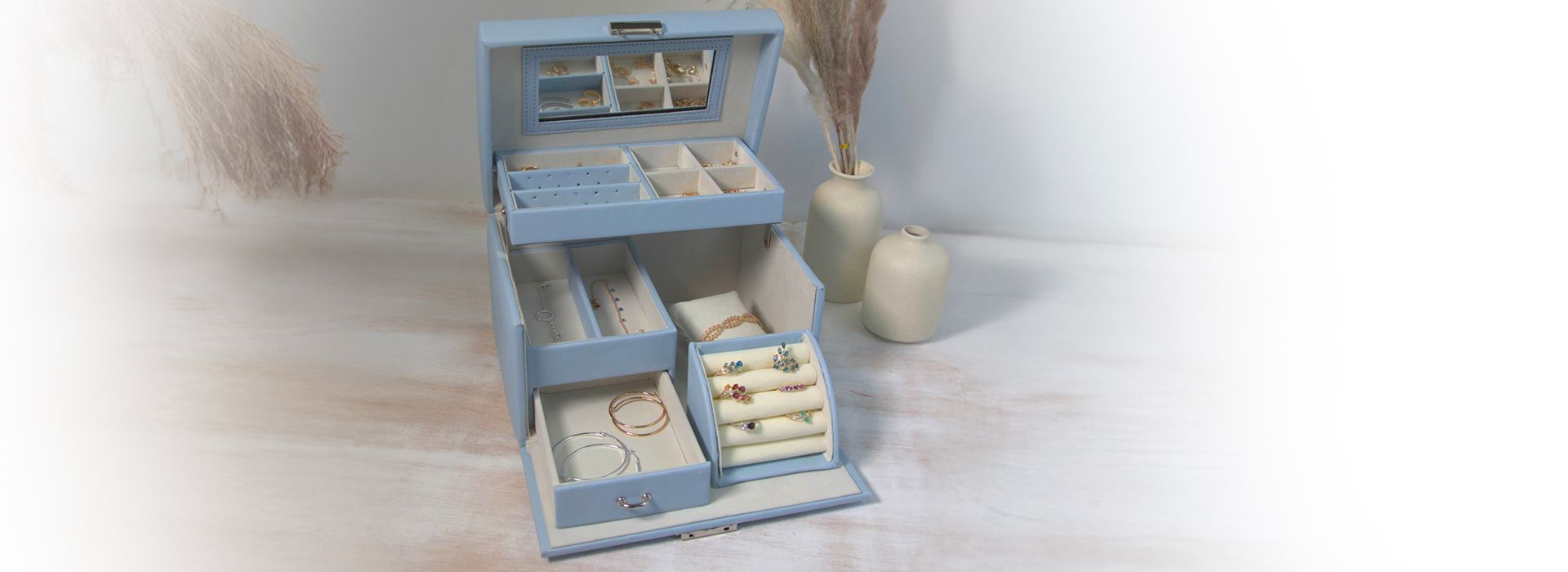
Large jewelry boxes with stacked drawers offer a complete solution: a slotted tray for rings, narrow compartments for earrings, a deeper shelf for bracelets, and a vertical compartment for necklaces. You can also transform a dresser drawer into a full-fledged jewelry organizer using modular trays lined with velvet that you can arrange to suit your collection. This solution has the advantage of keeping everything in one place without cluttering the surface of a vanity.
A good practice is to set aside a “holding” space: a small dish where you can place the jewelry you’ve worn during the day, before putting it back in its place once it’s dry and clean.
For a small space
When space is limited, think vertically. Hooks attached to the inside of a cabinet door, an organizer with clear pockets hung on a hanger, or a small wall-mounted display free up space on the dresser while keeping jewelry visible. Stackable boxes, on the other hand, fit perfectly on a narrow shelf.
Homemade Solutions
You don’t need to invest in specialized organizers to get started. A coat hanger with clips or hooks can hold necklaces and bracelets; a cardboard tube covered with fabric can become a bracelet holder; a clean egg carton or ice cube tray can be turned into a compartmentalized box; and a coat hook or wall-mounted key holder can serve as a display for necklaces. A piece of tulle or lace stretched across a picture frame makes a very pretty display for dangling earrings.
These tips are suitable for costume jewelry and everyday pieces. Precious jewelry, on the other hand, deserves a lined case that truly protects it.
Mistakes to Avoid to Keep Your Jewelry in Good Condition
Most damage to jewelry isn't caused by accidents, but by storage habits that we think are harmless. Here are the ones you should stop doing:
- Stuff everything loosely into a single box or pouch, where each item rubs against the others.
- Leaving your jewelry in the bathroom. Steam and temperature fluctuations speed up the oxidation of silver and cause gold plating to tarnish. The sink is also where people lose the most rings.
- Do not mix thin chains, even in a designated compartment: two chains are enough to form a knot.
- Do not let the set rings touch each other, as this may scratch both the stones and the metals.
- Do not put away jewelry while it is still wet after a shower, a workout, or cleaning. Dry it thoroughly with a soft cloth before putting it away.
- Forgetting to close the clasps on necklaces and bracelets before putting them away.
- Exposing your jewelry to direct sunlight or dust on a display stand that hasn't been used for months.
- Using a container that is too hard or unlined—made of rigid plastic or uncoated metal—which scratches the surfaces every time it is opened.
- Put away your jewelry right after applying perfume or lotion. Put on your jewelry last thing in the morning and take it off first thing at night, before applying skincare products.
Checking these few points is often enough to explain why a piece of jewelry has lost its luster.
FAQ: Your Questions About Jewelry Storage
How can you store your jewelry without damaging it?
Avoid any contact between the pieces. Each piece of jewelry should have its own place—in a compartment, a slot, or on a hook—inside a lined container that is dry and protected from direct light.
How can you store your necklaces to prevent them from getting tangled?
Close the clasp, then hang each necklace separately on a necklace holder or hooks. For very thin chains, an individual pouch or a straw that you thread the chain through will prevent them from getting tangled.
How do you store your earrings in pairs?
Use a box with small compartments or a slotted holder that holds two buckles side by side. Always put the pushers back on the pins: a complete pair is a pair you won't lose.
How should you store your rings to prevent scratches?
In a slotted tray lined with velvet or in their original case. Set rings should never come into contact with other jewelry, as their stones can scratch softer metals.
How should you store your silver jewelry?
In a sealed, dry container—ideally an anti-tarnish pouch or an airtight bag. The less the silver is exposed to air and moisture, the longer it will retain its whiteness.
Is it okay to store jewelry in the bathroom?
It's best to avoid it. Humidity and temperature fluctuations there promote oxidation and cause costume jewelry and gold-plated items to lose their luster. A bedroom or walk-in closet is still the best place.
How should you store your jewelry when traveling?
Limit the number of pieces you bring, store each item separately in a pouch or small travel case, fasten all clasps, and keep your jewelry in your carry-on luggage.
What kind of storage should you choose for a large jewelry collection?
A multi-tiered jewelry box or modular trays that slide into a drawer. These solutions allow you to assign a suitable space to each type of jewelry while keeping everything in one place.
How should you store your watches along with your jewelry?
Separately. A watch should be stored in a padded case or its own box, with the strap fastened, and kept away from rings or chains that could scratch its glass and case.
Storage that helps your jewelry last longer
Storing your jewelry properly ultimately means giving it the same care and attention you put into choosing it. A quick sort, a container suited to each piece, and a few precautions based on the material—that’s all it takes to avoid tangles, scratches, and mismatched pairs. The rest is a matter of habit. Putting each piece back in its place at night, drying it before storing it, and closing a clasp: these simple steps take just a few seconds and save you from many repairs. This way, your jewelry retains its original luster, and the pieces that matter most can one day be passed from one hand to another, intact. To create a storage solution tailored to your collection, discover MATY’s jewelry boxes and watch cases, and don’t hesitate to entrust your most precious pieces to our jewelers for inspection or cleaning.

Beige jewelry box
49€

Metallic grey jewelry box
62,50 125€ (50)

Almond green jewelry box
€45.54 €75.90 (-40%)

Light blue jewelry box
79€

Pale pink synthetic jewelry box
79€
How do you clean gold jewelry without damaging it?
How do you clean earrings?