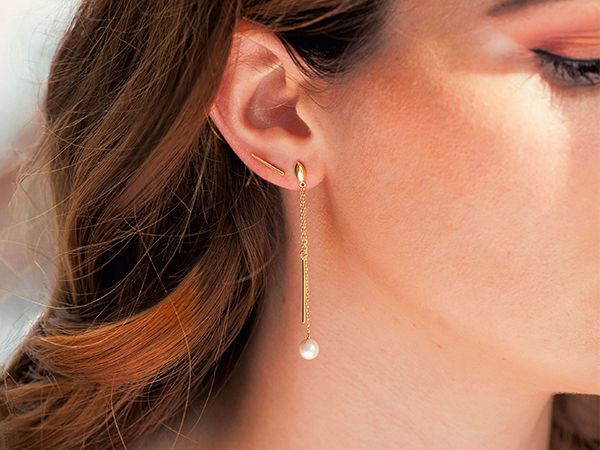
Whether understated, eye-catching, graphic, or deliberately bold, the ear cuff adorns the earlobe and easily transforms an earring ensemble. Also known as an ear ring, this piece of jewelry typically creates a pierced look without the need for a piercing.
But how do you put on an ear cuff correctly? Where should you place it so it stays in place? Which style should you choose based on your personal style, hairstyle, or the occasion? Discover all our tips for wearing this ear jewelry and incorporating it seamlessly into your looks.
In summary
-
An ear cuff is a piece of jewelry that is usually worn on the ear cartilage and does not require a piercing.
-
It can be worn on its own or paired with studs, hoop earrings, and other types of earrings.
-
It must be properly adjusted so that it stays in place without pinching.
-
Slim styles are perfect for everyday wear, while bolder cuffs help create a bold look.
-
The choice depends on the desired style, the shape of the ear, the hairstyle, and the occasion.
What is an ear cuff?
An ear cuff is a piece of jewelry designed to be worn on the outer edge of the ear. Unlike a traditional earring, it generally does not require a pierced ear: it is slipped onto the thinnest part of the cartilage and then slid into the desired position.
It can take the form of a thin ring, a multi-row piece of jewelry, a wrap-around cuff, or a design adorned with a chain, zirconias, or a pattern. Depending on its shape, it is worn on the upper part of the ear, at the helix, lower down on the cartilage, or around the concha.
Easy to pair with other jewelry, the ear cuff lets you personalize your ear without getting more piercings. It can add a subtle touch to an everyday outfit or become the centerpiece of a bolder look.
Ear cuffs, ear rings, and ear cuffs: What are the differences?
Several terms are used to refer to these pieces of jewelry, but they do not always refer to exactly the same style:
-
"Ear cuff" is the most commonly used English term for a piece of jewelry worn on the ear cartilage.
-
"Earring" is the standard French translation.
-
The term "ear cuff" often refers to a wider or more enveloping style.
-
A fake piercing refers to the visual effect achieved without actually piercing the skin.
-
An "ear climber" is a piece of jewelry that winds its way up the ear, but generally requires a pierced lobe.
-
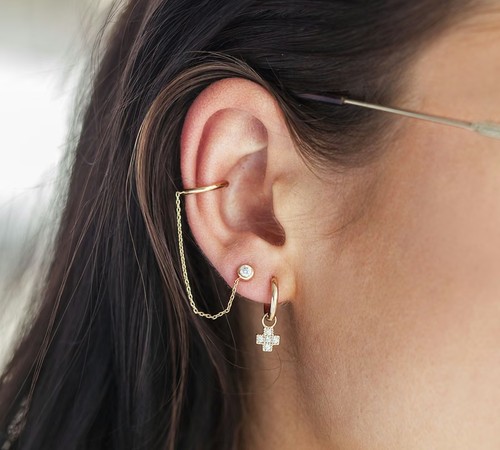
An ear chain can connect an ear cuff to a classic hoop worn on a pierced ear.
These different shapes allow you to play with volumes and heights to create a composition suited to every style.
Can you wear an ear cuff without having your ears pierced?
Yes, most ear cuffs are specifically designed to be worn without pierced ears. The jewelry wraps around part of the cartilage and stays in place thanks to its shape and fit.
This allows you to try out an helix or cartilage piercing without getting a permanent piercing. It is also suitable for people who do not want to get pierced or who want to change their jewelry setup as they please.
A piercing-free ear cuff can be worn on its own—even on an unpierced ear—or paired with traditional earrings on a pierced ear.
Ear cuffs with or without a piercing: How can you tell them apart?
Not all jewelry that goes through the cartilage works the same way:
-
The classic ear cuff attaches directly to the cartilage and does not require a piercing;
-
The climbing loop is usually inserted into a hole in the earlobe before being pulled up along the ear;
-
The earring chain can combine a piercing-free ear cuff with a classic earring;
-
The fake cartilage piercing works like a small clip-on ring;
-
A true helix, conch, or tragus piercing requires the proper piercing technique.
Before choosing a model, be sure to check its fastening system and how it should be worn.
How do you put on an ear cuff correctly?
Putting on an earring is easy when you use the right technique. The first few times you do this, stand in front of a mirror and proceed gently.
-
Locate the thinnest part of the cartilage. It is usually found on the upper or central part of the edge of the ear.
-
Gently slide the opening of the ear cuff around that area, without forcing it.
-
Drag the piece of jewelry up or down to the desired location.
-
Check its orientation. Part of the earring should be in front of the ear and part behind it.
-
Adjust it slightly only if the design and material allow it.
-
Check how it fits. The ear cuff should stay in place when you move your head, without squeezing or pinching the cartilage.
A properly fitted piece of jewelry should be comfortable. A slight feeling of pressure may be normal, but pain or a pronounced mark usually indicates that the jewelry is too tight or not positioned correctly.
Where should you wear an ear cuff on your ear?
The placement depends on the shape of the jewelry and the shape of your ear:
-
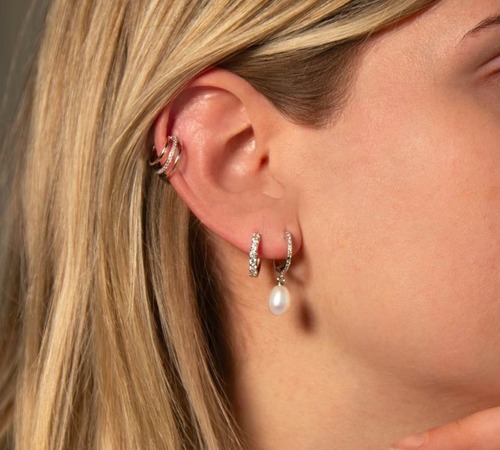
on the helix, the upper outer edge of the ear, for a subtle and discreet look;
-
in the middle of the cartilage to complete a buildup;
-
around the conch, using a pattern that is wide enough or form-fitting;
-
near the earlobe to create a seamless look with a stud or a small hoop earring;
-
on a higher part of the garment with a statement cuff to immediately catch the eye.
There is no single "correct" position. The key is to choose a stable spot where the jewelry won't slip and will remain comfortable to wear.
How do you take off an ear cuff without hurting yourself?
To remove an ear cuff, avoid pulling directly on it. Instead, slide it in the opposite direction from the one you used to put it on.
-
Stand in front of a mirror.
-
Gently hold the piece of jewelry between two fingers.
-
Slide it toward the thinnest part of the cartilage.
-
Gently remove it once the opening is properly positioned.
-
If the piece of jewelry seems stuck, adjust its angle slightly instead of forcing it.
Some pieces may be loosened very slightly, provided their design and material allow it. However, avoid opening and closing them every time you wear them: repeated handling could distort or weaken the jewelry.
How can you keep an ear cuff from falling off?
The fear of losing a piece of jewelry is common, especially the first few times you wear it. However, there are a few precautions you can take to minimize this risk:
-
Choose a size that fits the shape of your ear;
-
Place the jewelry on a sufficiently stable area of the cartilage;
-
Make sure it doesn't slip when you gently move your head;
-
Adjust it carefully without crushing the cartilage;
-
Avoid styles that are too open or too wide;
-
Be careful of hair, scarves, helmets, and headphones that could get caught on it;
-
Choose a lightweight, comfortable model for extended use.
After putting on your ear cuff, pull it very gently outward. It should stay in place without you having to tighten it too much.
What are the different types of ear cuffs?
Ear cuffs come in a wide variety of shapes, materials, and finishes. Each style creates a different look on the ear.
|
Type of ear cuff |
Desired effect |
Style Tip |
|
Delicate ear cuff |
Discreet and easy to wear |
Perfect on its own or with a little one for everyday use |
|
Double-row or multi-row ear cuff |
Layering effect without multiple piercings |
Pair with a simple loop to maintain balance |
|
Ear cuff with chain |
Graphic, rock, or contemporary look |
Best shown off with an open hairstyle |
|
Ear cuff with a stone or cubic zirconia |
Backlit Key |
Perfect for an evening out or paired with jewelry featuring matching details |
|
Helix ear cuff |
A subtle detail at the top of the ear |
Pair with a hoop earring or a single-hoop earring |
|
Conch Ear Cuff |
More noticeable bulge in the center of the ear |
Can be worn on its own as a statement piece |
|
Statement Cuff |
A bold and sophisticated look |
Keep other jewelry minimal to avoid overloading the outfit |
|
Ear cuff with symbol |
Personal and Expressive Style |
Choose a design that fits your style |
You'll also find designs inspired by flowers, stars, moons, hearts, and snakes, as well as jewelry with wavy or geometric lines.
Ear cuffs are available in gold, 925 silver, gold-plated, or stainless steel. Some styles are also embellished with gemstones, pearls, or cubic zirconia to add extra sparkle.
Which ear cuff should you choose based on your style?
The right style is, above all, one that matches your personality and the jewelry you already wear.
For a minimalist style
Choose a thin ring, a smooth metal piece, or a design with clean lines. A discreet ear cuff can easily be worn every day and pairs well with a small stud or a thin hoop.
For a rock style
Opt for chains, snake motifs, graphic shapes, or silver-tone finishes. You can complete the look with a single hoop or structured hoop earrings.
For a bohemian look
Organic shapes, flowers, pendants, and colorful stones blend naturally into a bohemian look. Mix and match jewelry of different sizes while sticking to a common material or color.
For a chic look
A gold ear cuff, set with zirconia stones or featuring delicate lines, adds an elegant touch without overwhelming your outfit. Pair it with delicate earrings to create a harmonious look.
For a glamorous look
Go for a statement ear cuff, a multi-row design, or a sparkly piece. The ear cuff can then become the focal point of your look.
For a simple or mixed-style look
A silver or steel piece, or one with geometric lines, can be worn with many different styles. Simple, graphic shapes work particularly well in a minimalist look.
Which ear cuff should you wear for different occasions?
|
Opportunity |
Recommended Model |
Tip |
|
In everyday life |
Delicate or subtle ear cuff |
Choose a lightweight and comfortable model |
|
At work |
Minimalist Earring |
Choose a simple, versatile style |
|
In the evening |
Style with stones or volume |
Pull the hair back to reveal the jewelry |
|
At a festival or on vacation |
Sun motif, chain, flower, or tassel |
Pair it with several pieces of lightweight jewelry |
|
For a wedding or a ceremony |
Gold, pearl, or glow-in-the-dark design |
Maintain an elegant and consistent layout |
|
With a rock-and-roll look |
Chain, snake, or silver-colored metal |
Pair it with statement jewelry |
The same ear cuff can, of course, be worn in a variety of settings. Often, all it takes is changing your other earrings or your hairstyle to achieve a more understated or sophisticated look.
How do you wear an ear cuff with earrings?
An ear cuff can complement the earrings you're already wearing and add dimension to your entire ear. In particular, you can pair it with:
-
an earring stud, for a delicate, comfortable design;
-
a small creole earring, to play with the heights;
-
a dangling earring, while keeping the ear cuff discreet enough;
-
a single loop, to emphasize the asymmetry;
-
several loops distributed across different holes;
-
a more discreet loop on the opposite ear.
To maintain a sense of harmony, choose a unifying theme: the same metal, a common color, a gemstone, a pattern, or a similar style.
You can also wear an ear cuff on each ear. Identical designs will create a symmetrical look, while different pieces will allow you to create a more free-spirited and personal style. The key is to maintain a balance between shapes and proportions.
How do you create an ear look with an ear cuff?
An ear stack, sometimes called an “ear stack,” involves combining several pieces of jewelry on the earlobe and cartilage. The ear cuff is particularly well-suited for this look, as it adds height without requiring a new piercing.
To create a harmonious composition:
-
Start by choosing the main room;
-
Place a stud or hoop earring in your earlobe;
-
Place the ear cuff higher up on the cartilage;
-
Vary the sizes and shapes slightly;
-
Maintain consistency in metal or color;
-
Space out the jewelry so that each piece remains visible;
-
Limit very large earrings to one per ear.
You can also play around with asymmetry: wear a more elaborate arrangement on one side and a simple loop on the other. This approach lets you personalize the look without overdoing it.
To learn more: [check out our tips for successfully layering jewelry] and [how to wear asymmetrical earrings].
How should you wear an ear cuff depending on your hairstyle?
Your hairstyle directly affects how visible your jewelry is.
-
With short hair: your ears are naturally exposed. You can choose a slim style or go for a bolder, more voluminous design.
-
If you have long, loose hair: wear the ear cuff on the side with the most hair, and choose a style that stands out.
-
Whether you wear your hair in a ponytail or a bun: take advantage of having your ears exposed to wear a sparkly or statement piece.
-
If you have a side part: it's best to wear the earring on the ear that's less covered.
-
If you have curly or voluminous hair: choose a sturdy, eye-catching ear cuff that won't get lost visually in your hair.
Also be aware of the risk of snagging when you tuck your hair behind your ear or when you're styling your hair.
See also: [Which earrings should you choose based on your hairstyle?].
What mistakes should you avoid when wearing an ear cuff?
To ensure you can enjoy your jewelry comfortably and minimize the risk of losing it, avoid:
-
choosing a model that is too large for your cartilage;
-
squeeze the jewelry until it hurts;
-
pull it sharply to remove it;
-
wear a heavy pair all day if you have sensitive ears;
-
hide it completely under your hair;
-
combine several very large pieces without balancing them;
-
mixing too many colors, metals, or styles without a unifying theme;
-
sleeping with a model that is uncomfortable or is likely to lose its shape;
-
frequently adjust a piece of jewelry made of a material that is not designed to be bent;
-
Continue wearing it if you experience persistent pain or irritation.
Comfort should remain your top priority. A properly chosen and positioned ear cuff should neither fall off easily nor press too tightly against the ear.
How do you care for and store an ear cuff?
Like other jewelry, an ear cuff should be cared for according to its material. Clean it gently using a method suitable for gold, silver, gold-plated, or steel, without using harsh chemicals.
To stay in shape and reduce the risk of losing it:
-
Put it in a designated compartment;
-
Avoid leaving it loose with other jewelry;
-
Check regularly to make sure it is not warped;
-
Handle models decorated with stones or chains with care;
-
Remove it before exercising, showering, or sleeping if the model is not suitable for these activities;
-
Avoid repeated contact with perfume, cosmetics, and household products.
Since ear cuffs are often sold individually, a jewelry box with compartments makes it easier to find them and protects them from scratches.
For more information: [How to store your jewelry in style?] and [How to clean silver jewelry?].
FAQ About Ear Cuffs
Can you wear an ear cuff without pierced ears?
Yes. Most ear cuffs attach directly to the cartilage and do not require any piercings. However, be sure to check the attachment method for the model you choose.
How do you put on an ear cuff?
Insert it into the thinnest part of the cartilage, then slide it into the desired position. Make sure it stays in place without pinching.
How do you take off an ear cuff without hurting yourself?
Gently slide it toward the narrowest part of the ear. Don't pull it abruptly, and adjust its angle slightly if it seems stuck.
How can you keep an ear cuff from falling off?
Choose the right size, place it on a stable surface, and check that it stays in place by gently moving your head. It should fit snugly, but never be too tight.
Where should you wear an ear cuff?
It can be placed on the upper or middle part of the cartilage, near the lobe, or around the concha, depending on the shape of the model and the ear's anatomy.
Can you wear an ear cuff with earrings?
Yes. It pairs easily with a stud, a hoop, a single earring, or a set of multiple pieces.
Which ear cuff should you choose for a subtle look?
Choose a thin ring, a plain design, or a small ear ring made of the same metal as your other jewelry.
Can you wear an ear cuff every day?
Yes, as long as you choose a lightweight, well-fitting, and comfortable model. Take it off if it causes pain or irritation.
Can you sleep while wearing an ear cuff?
It is best to remove it when it gets in the way, might get caught on something, or could become misshapen while you sleep.
How do you care for an ear cuff?
Clean it according to its material, avoid harsh cleaning products, and store it separately to preserve its shape and finish.
Find the ear cuff that matches your style
Delicate and minimalist, gold, silver, set with zirconia, adorned with a chain, or inspired by a symbolic motif: the ear cuff offers countless possibilities for personalizing an earring ensemble.
Wear it on its own to subtly draw attention, or pair it with your favorite earrings to create a look that's all you.
[Discover MATY's selection of ear cuffs]

Yellow gold-plated earcuff, chain style sold individually.
25€ €59 (-58%)

925 sterling silver earcuff sold individually
66,50 95€ (30)

Earcuffs silver 925 zirconias
42€ €99 (-58%)

925 silver snake motif ear clip sold individually
49,50 99€ (50)

Earcuff silver 925 chain style sold individually
34,30 49€ (30)

Earcuff silver 925 wavy effect sold individually
49,50 99€ (50)

Earcuff silver 925 chain style sold individually
19,50 39€ (50)

Yellow gold-plated earcuff, snake motif sold individually
33,50 79€ (58)
Why choose stainless steel earrings?