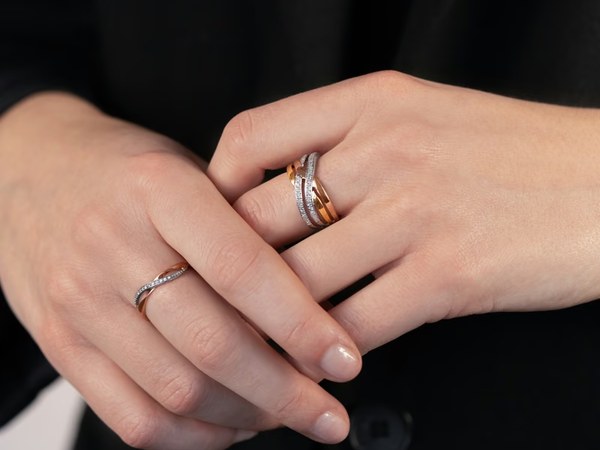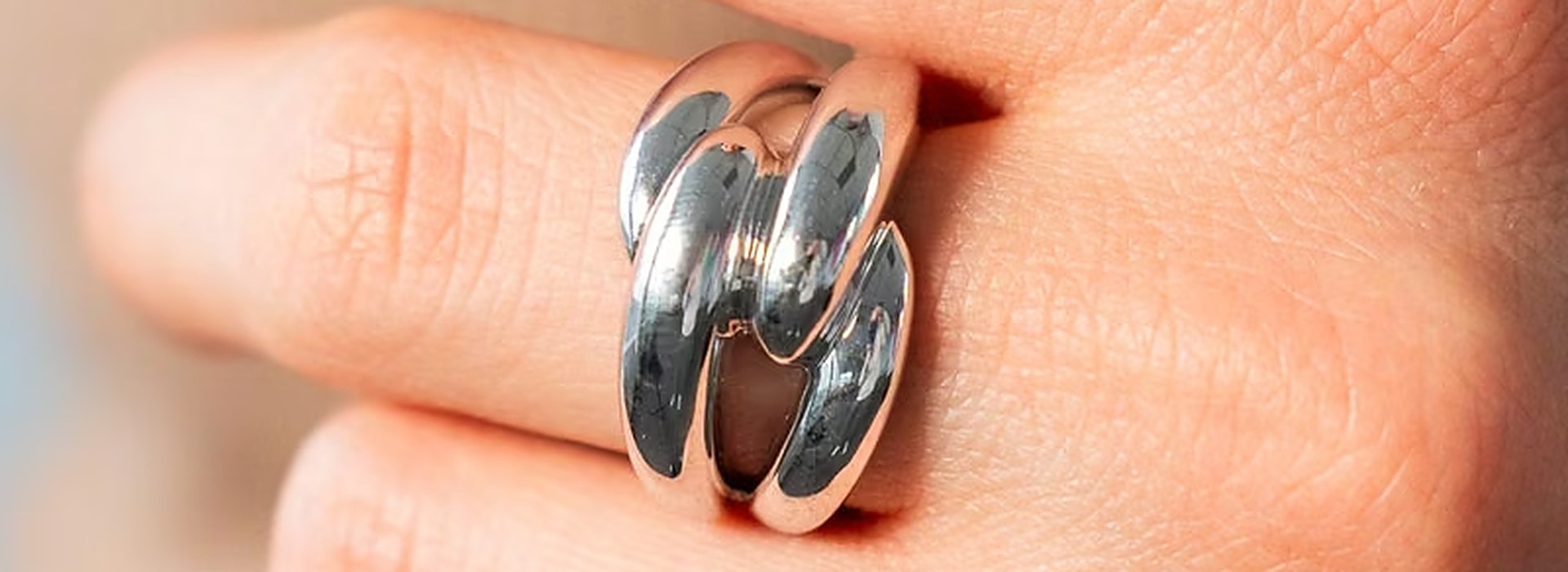
Purity and clarity: In the collective imagination, silver evokes a celestial body—the moon (unlike gold, which is associated with the sun)—and conjures up in the unconscious notions of gentleness, intuition, and sensitivity. A silver ring also alludes to protection; indeed, in many (folk) traditions, this metal is considered protective and purifying. In contrast to the more flashy gold, silver symbolizes simplicity, authenticity, and discretion. Choosing a silver ring reflects a minimalist, no-frills style.
In short: a silver ring is a ring made from a solid silver alloy, most often 925 silver (known as “sterling”), which contains 92.5% pure silver and 7.5% other metals, usually copper. In France, it can be identified by its Minerva head hallmark. More affordable than gold, it stands out for its bright white hue, its wide range of design possibilities, and its unique care requirements, since silver naturally tarnishes when exposed to air. Maty, a jeweler based in Besançon, shares here the essentials for choosing a silver ring, giving it as a gift, verifying its authenticity, and keeping it looking its best.
Contents
- Understanding the Metal in a Ring: Alloys, Finishes, and Hallmarks
- The 925 silver ring
- The rhodium-plated silver ring
- Sterling silver, silver-plated, gold-plated silver: What Sets Them Apart
- The Symbolism and History of the Silver Ring
- The Steps Involved in Making a Silver Ring
- Designs and styles: women's, men's, with gemstones
- Price of a silver ring
- Choosing a Silver Ring: Criteria, Size, and Occasion
- Authenticity, Strengths, Limitations, and Allergies
- Maintenance, Blackening, and Trimming
- Silver Ring Market and Trends
- Frequently asked questions
- Why Choose Maty
Understanding the Metal in a Ring: Alloys, Finishes, and Hallmarks
The silver used to make a ring is almost never pure. In its native state, this metal is so soft that a ring would lose its shape after just a few weeks of wear. Silversmiths therefore combine it with a small amount of copper, which gives it the necessary rigidity. The proportion of pure silver in this alloy is known as the fineness, expressed in parts per thousand.
Silver fineness in thousandths
|
Name |
Title |
Pure silver |
Landmark in France |
Use as a ring |
|---|---|---|---|---|
|
Fine silver |
999 |
99,9 % |
Rarely hallmarked in jewelry |
Too flexible for a ring worn every day |
|
950 Silver |
950 |
95 % |
Former French No. 1 |
Designer pieces, antique silverware |
|
925 silver (sterling) |
925 |
92,5 % |
Head of Minerva, Figure 1 |
The Leading Name in Silver Jewelry |
|
800 Silver |
800 |
80 % |
Head of Minerva, Figure 2 |
Antique jewelry, gold and silverware |
The higher the fineness, the whiter the silver, the softer it feels to the touch, and the easier it is to work with. But it also becomes more flexible and prone to scratches. 925 silver offers the best balance: rich enough to be classified as sterling silver, yet firm enough to withstand everyday wear and tear. In fact, this is the fineness of the vast majority of rings sold today.
Silver Finishes
Unlike gold, which comes in various colors depending on its alloy, silver has a unique natural hue. Its character therefore comes from the finish applied to its surface. As a result, two 925 silver rings of the same weight can look completely different.
|
Finish |
Method |
Rendering |
|---|---|---|
|
Polished silver |
Polishing to a mirror finish |
White Gloss, the most classic look |
|
Rhodium-plated silver |
A thin layer of rhodium deposited by electrolysis |
A cooler, brighter sheen that protects against darkening |
|
Oxidized or blackened silver |
Intentional sulfur patina in the recesses |
Striking contrasts, vintage or ethnic look |
|
Brushed or satin-finished silver |
Surface treated by brushing or sandblasting |
A soft, matte finish with a very contemporary look |
|
Hammered silver |
Hammer-Forged Facets |
Unpredictable plays of light, artisanal spirit |
|
Gold-plated silver |
Gold Plating on Silver |
The appearance of gold with a silver base (vermeil if the thickness is sufficient) |
Each finish tells a story: a polished finish evokes purity and clarity; a blackened finish evokes character and authenticity; and a brushed finish evokes modern simplicity.
Hallmarks: What the Law Says
In France, a solid silver ring offered for sale typically bears two marks. The maker’s mark—which is diamond-shaped for manufacturers based in France—allows one to trace the jewelry back to the person who made or imported it. The fineness mark guarantees the silver content: the head of Minerva, accompanied by the number 1 for 925 silver and the number 2 for 800 silver. Since 2001, this fineness mark has been optional for silver items weighing less than 30 grams—which covers most rings—so only the maker’s mark is required. Abroad, 925 silver is often marked simply with “925” or “Sterling.” A square hallmark, on the other hand, indicates that the item is plated, not solid silver.
The 925 silver ring
The 925 silver ring is made from an alloy containing 925 parts pure silver out of 1,000, with the remaining 75 parts consisting of another metal, almost always copper. Known worldwide as sterling silver, this composition has become the standard for solid silver jewelry.
Composition and Reference Points
- Pure silver: 92.5%, or 925 grams of silver in one kilogram of alloy.
- Alloy metal: 7.5%, most often copper, sometimes zinc, germanium, or silicon to limit oxidation.
- Markings: the head of Minerva in France; the markings “925,” “Sterling,” or “STG” on many pieces of foreign jewelry.
- Color: a bright, slightly warm white that develops a gray and then black patina if left unmaintained.
The Benefits of 925 Silver
- A true precious metal at an affordable price: the price of silver is nowhere near that of gold, making solid silver rings accessible to a wide range of people.
- Total creative freedom: 925 sterling silver is highly malleable, making it ideal for bold designs, intricate engravings, and sculptural forms—all without breaking the bank.
- A solid material, not a plating: the silver extends from the core to the surface; a scratch never reveals another metal.
- A metal that can be restored indefinitely: even when heavily tarnished, a 925 silver ring regains its original luster after being cleaned properly.
What You Need to Know Before Buying
- It turns black: the sulfur present in the air, sweat, or certain cosmetics forms a thin film of silver sulfide on the surface. This is a natural and reversible phenomenon.
- It scratches and gets marked: softer than 9-karat gold or steel, silver quickly develops small marks, especially on a wide, mirror-polished ring.
- Its resale value remains modest: the metal itself is worth very little per gram; it is the design and craftsmanship that account for most of the price.
- It may stain the skin: in some people, oxidation leaves a slight gray or greenish mark on the finger. This is not an allergy, but a harmless chemical reaction.
Who is it for, and what are your needs?
The 925 silver ring is particularly suitable for:
- stacking enthusiasts, who layer several thin rings on top of each other;
- chunky rings, signet rings, and statement pieces, which would be very expensive if made of gold;
- a first piece of jewelry made of precious metal, given to a teenager or as a reward for an achievement;
- a desire for fashion and change, to switch up styles as the seasons change;
- rings set with colored semi-precious stones, zirconium oxides, or decorative stones such as turquoise and onyx.
However, for a wedding band that is meant to be worn continuously for decades, it’s best to choose gold or platinum, which are more resistant to wear and tear.
The rhodium-plated silver ring
A rhodium-plated silver ring is a piece of 925 silver jewelry coated with a very thin layer of rhodium, a rare metal in the platinum group. This protective coating, about one-tenth of a micron thick, alters both the appearance of the jewelry and how it ages over time, without changing its nature: it is still solid silver.
Composition and Recognition
- Base material: 925 silver, hallmarked like all solid silver.
- Coating: rhodium deposited by electrolysis, sometimes over an intermediate layer.
- Color: a white that is cooler, brighter, and more reflective than polished silver, similar to that of white gold.
- Here's how to tell: the product description or invoice will say "rhodium-plated silver"; to the eye, the shine is more "mirror-like" and has a slight bluish tint.
The Benefits of Rhodium Plating
- Protection against tarnishing: as long as the coating remains intact, the silver is no longer exposed to the air and does not oxidize.
- A harder surface: rhodium is more resistant to micro-scratches than bare silver.
- Long-lasting luster: The jewelry retains its shine—just as it did when you first bought it—without needing regular polishing.
- A wedding band with white stones: the cool luster of rhodium enhances the beauty of zirconium oxides and diamonds.
Its limitations
- A layer that wears away: On a ring, friction eventually wears away the rhodium, especially underneath the band; at that point, you’ll need to have it rhodium-plated again by a jeweler.
- A more delicate cleaning process: abrasive products and pre-soaked silver-cleaning cloths can damage the finish.
- A more demanding resizing process: after soldering, the ring must be rhodium-plated again to restore a uniform color.
- A less warm glow: some people prefer the slightly creamy softness of polished silver.
Who is it for, and what is it used for?
Rhodium plating is a wise choice for:
- people who don't want to maintain their jewelry on a regular basis;
- rings set with zirconium oxides or white gemstones;
- daily wear, especially when in contact with water or cosmetics;
- skin types that tend to cause silver to turn black.
Unpolished 925 silver or rhodium-plated silver: which should you choose?
|
Criterion |
Raw 925 silver |
925 silver, rhodium-plated |
|---|---|---|
|
Type of metal |
Solid silver |
Solid silver with a rhodium plating |
|
Shade |
Mild, slightly warm white |
Cool white with a high gloss |
|
Darkening |
Yes, natural and reversible |
No, as long as the diaper stays on |
|
Scratch resistance |
Low |
Best on the surface |
|
Routine Maintenance |
Regular cleaning, silver polishing cloth |
Soapy water only |
|
Long-Term Maintenance |
Occasional polishing |
Re-rhodium plating every 1 to 3 years, depending on usage |
|
Patina and Aging |
Develops a distinctive patina |
Stays looking new, then wears out in patches |
|
Ideal for |
Oxidized, hammered, vintage, and ethnic rings |
Stone-set rings, everyday wear, minimalist style |
In a nutshell: unplated silver appeals to those who love a living metal that develops a patina; rhodium-plated silver is ideal for those who want dazzling jewelry that’s easy to wear every day.
Sterling silver, silver-plated, gold-plated silver: What Sets Them Apart
A solid silver ring is made entirely of silver, whereas a silver-plated ring has only a thin layer of silver applied to a base metal. This difference in construction affects the jewelry's durability, price, and how it ages.
|
Criterion |
Sterling silver (925) |
Silver-plated or silver-colored metal |
|---|---|---|
|
Structure |
Silver alloy that is homogeneous throughout its thickness |
A thin layer of silver on brass, copper, or zamak |
|
Changes Over Time |
The surface darkens, then cleans up and looks like new again |
The coating wears away, exposing the base metal |
|
Price |
Accessible |
Very low |
|
Resale Value |
Small but real, linked to the weight of silver |
Does not exist |
|
Repair |
Welding, trimming, and polishing are possible |
Limited repairs; wear and tear on the coating is permanent |
|
Recommended Use |
A piece of jewelry to wear often and keep |
Fashion accessory, worn on special occasions |
Variations on the Theme of Money
The terminology used in the silver section can be confusing. Here's how to make sense of the main terms.
|
Name |
Base metal |
Coating |
Key Takeaways |
|---|---|---|---|
|
925 sterling silver |
Silver 925 |
None or rhodium |
The benchmark—precious metal through and through |
|
Vermeil |
Silver 925 |
Gold of at least 5 microns in France |
The look of gold on a precious metal base |
|
Gold-plated silver |
Silver 925 |
Gold finer than vermeil |
A golden effect that eventually fades |
|
Silver-plated |
Brass or copper |
Silver deposited by electrolysis |
Affordable, but the base becomes visible over time |
|
Silver-plated metal |
Brass, zamak, or white metal |
Plain silver finish, with no guarantee of thickness |
Fashion jewelry |
|
Silver-colored steel |
Stainless steel |
None: the color is that of steel |
It doesn't tarnish, but it's not a precious metal |
Some useful details:
- Vermeil is the only one of these categories to be governed by French regulations: it must consist of sterling silver with a layer of gold of a minimum thickness.
- Gold-plated silver is still a solid silver ring; only the surface color changes, and it gradually returns to white as you wear it.
- Silver-plated items may look the part at first, but a ring that’s constantly rubbed will quickly reveal the brass or copper underneath.
- Stainless steel is often mistakenly presented as an alternative to silver: it is durable, but it lacks the softness, luster, and value of a precious metal.
Because a ring is subjected to impacts and friction every day, solid silver is always a better choice than a plated ring, even on a tight budget.
Silver or Silver-Plated Rings: How Can You Tell the Difference?
It all comes down to the thickness of the precious metal. In a solid silver ring, the 925 alloy is the same at the center of the band as it is on the surface: you can file it, polish it, or re-solder it, and it will always be silver. That’s what allows it to regain its luster after years of wear.
A silver-plated ring works in the opposite way to a coat of varnish. Its body is made of a base metal, onto which a few microns of silver have been applied through electrolysis. This layer is so thin that friction against the palm of your hand, doorknobs, or a keyboard eventually wears it away. This reveals yellowish or pinkish areas: this is the brass or copper coming back to the surface, and no amount of cleaning will remove it.
The Symbolism and History of the Silver Ring
Silver has played a key role in the history of jewelry since ancient times; this metal was already being worked in Mesopotamia and Egypt, though less valuable than gold, which was reserved for the elite. It was during the Roman Empire that the wearing of silver rings became widespread, worn by ordinary citizens as well as serving as a symbol of status or official office. In the Middle Ages, silver became the metal of choice for signet rings and chevalières, used to authenticate documents before they were signed by hand. The discovery of massive silver deposits in South America in the 16th century—particularly in Peru and Bolivia—upended the global economy and made the metal more accessible in Europe, introducing its use in popular jewelry. At the turn of the 20th century, it experienced a new surge in popularity with the Art Nouveau and Art Deco movements, which took advantage of its malleability to create organic shapes and chiseled finishes. Today, the silver ring has established itself as a timeless and accessible classic, prized for both everyday wear and more sophisticated designs, straddling the line between tradition and modernity.
While gold is associated with the sun, silver has always been the metal of the moon. Its white, reflective light evokes gentleness, intuition, clarity, and protection. In many traditions, it was believed to ward off evil influences and purify whatever it touched: it was said to possess protective powers, and its very real antibacterial properties have long fueled this reputation. Wearing a silver ring also means choosing a piece of jewelry that is intimate rather than ostentatious. Its understated luster speaks of sincerity and simplicity. The circle of the ring, meanwhile, retains its universal meaning: that of a bond with no beginning and no end. It is no coincidence that the silver wedding anniversary is celebrated after twenty-five years of marriage, a milestone that marks a strong and enduring union.
Where the ring is worn on the hand
|
Finger |
What Jewelry Conveys |
|---|---|
|
Thumb |
Freedom, willpower, an independent spirit—the silver thumb ring is a bohemian classic |
|
Index |
Confidence, ambition, a taste for leadership |
|
Major |
Balance and pure aesthetic choice, without any particular message |
|
Left ring finger |
A promise, an engagement, or a union—a silver ring often serves as a promise ring in these situations. |
|
Right ring finger |
A wedding band in countries where the wedding ring is worn on the right hand, or a simple heart-shaped ring |
|
Little Finger |
Family heirloom, symbol of belonging, signet ring |
The left ring finger is said to have a vein that connects directly to the heart, which the Romans called the *vena amoris*: a belief with no anatomical basis, but one that has shaped our traditions.
Money Through the Centuries
|
Period |
The Silver Ring in Its Time |
|---|---|
|
Egypt During the Early Dynasties |
Silver, which was rarer than gold in the Nile Valley, was the most precious metal at that time; it was used to adorn jewelry and amulets |
|
Greek and Roman Antiquity |
Silver is used for coins and seals; silver rings are becoming widespread among the wealthy classes |
|
Middle Ages |
Silver rings symbolize promises and devotion; in England, the sterling standard was established and regulated as early as the turn of the 14th century |
|
16th century |
The influx of money from South American mines, such as Potosí, makes the metal more accessible in Europe |
|
19th century |
The Industrialization of Silversmithing; Silver Rings Become More Widely Available and Find Their Way into Modest Households |
|
Early 20th century |
Art Nouveau and, later, Art Deco established silver as a creative medium in its own right |
|
1960s–1970s |
Bohemian Chic: Chiseled silver rings, turquoise, and handcrafted pieces from around the world |
|
Since 1950 |
Maty, who was born in Besançon, makes precious metal jewelry accessible through online sales |
|
Today |
Metal for stacking, mixed-style signet rings, and mixing and matching with gold |
The Steps Involved in Making a Silver Ring
The crafting of a silver ring follows a well-defined process that ensures its quality and durability. It all begins with the creation of the design, which is either hand-sketched or modeled in 3D, before being reproduced in wax or printed to serve as the basis for casting. The silver used is almost always 925 silver, an alloy composed of 92.5% pure silver and 7.5% copper; this balance gives the jewelry the strength that pure silver—which is too soft—could not provide on its own. Once the piece has been cast and removed from the mold, the ring undergoes various stages of sanding and polishing to enhance its luster and, if applicable, the stones are meticulously set. Many silver rings are then rhodium-plated—a thin layer of rhodium that enhances the shine and delays the metal’s natural tarnishing. Finally, each piece is inspected and hallmarked: the 925 hallmark, visible on the jewelry, officially certifies the purity of the silver used and is the first quality indicator to check before making a purchase.
Here are the steps, in order:
- The alloy: a mixture of fine silver and copper, which is then cast into ingots, sheets, or wires.
- Shaping: There are two possible methods. The lost-wax casting process involves sculpting or molding a wax model, encasing it in plaster, and then replacing the melted wax with liquid metal. Handcrafting, on the other hand, begins with a strand or sheet of silver that the artisan saws, bends, hammers, and solders.
- Setting: The artisan crafts prongs, settings, or rails to hold the stones in place, then sets them one by one. A poorly set stone is the leading cause of returns to the workshop.
- Deburring and polishing: files, increasingly fine abrasives, and then polishing compounds give the metal its shine—or its brushed appearance, if that is the desired effect.
- Surface finish: depending on the model, rhodium plating, gold plating, controlled oxidation of recesses, or decorative hammering.
- Inspection and marking: verification of the strength of the settings, the size, and the appearance, followed by the application of the master’s mark and, if applicable, the fineness mark.
Every step affects the final quality. The lost-wax casting process allows for the faithful reproduction of complex shapes and mass production, while handwork at the workbench yields unique pieces with a more distinctive character. Silver, which is more malleable than gold, is more forgiving during shaping but requires careful polishing, as it reveals even the slightest irregularity.
Models and styles: women's, men's
Silver is a designer's favorite medium: its moderate price allows for generous shapes and bold designs. Silver rings are classified according to their construction (band, bangle, open), their purpose (engagement, signet), and their aesthetic.
The Main Categories of Silver Rings
Classic and Timeless Silver Rings
These designs transcend trends and never go out of style. They form the foundation of any jewelry collection and are often the first piece of silver people buy, whether for themselves or as a gift. Their appeal lies in their ability to complement any outfit without ever looking dated.
The silver wedding band, a symbol of understated elegance
The silver wedding band appeals for its absolute simplicity: a slender band, free of any design or gemstones—a simple piece of jewelry whose strength lies in the purity of its lines. This simplicity makes it a timeless piece, equally at home on the hand of a twenty-year-old as on that of a sixty-year-old. Worn alone, it exudes minimalist elegance. Its best feature? This type of ring is less expensive than a gold ring; it’s more affordable without compromising on aesthetics.
The Solitaire: The Star of Silver Engagement Rings
The solitaire is the engagement ring style everyone is clamoring for, and its silver version is making a symbol once reserved for gold or platinum more accessible. A single stone—whether zirconium, topaz, or a semiprecious stone—is showcased on a minimalist band so as not to distract from the gem. The choice of setting makes all the difference: the prong setting, which holds the stone in place with fine metal prongs, allows light to circulate beneath the gem and enhances its brilliance—though it leaves the stone more vulnerable to impact. The bezel setting completely encases the stone’s outline in metal, offering superior protection for everyday wear.
The silver bangle ring: unapologetic minimalism
The bangle ring—a wide, plain band without any ornamentation or embellishments—has been a staple of the “quiet luxury” trend for several seasons now. This understated luxury emphasizes the quality of the material and the purity of the design rather than an abundance of details. Its width gives it a strong visual identity without being excessive.
The Silver Signet Ring: A Blend of Tradition and Modernity
Historically worn by men as a symbol of status or lineage, engraved with a coat of arms or initials, the silver signet ring has undergone a contemporary and largely unisex reinterpretation in recent years. Its flat face—engraved with a monogram or personal symbol, or left plain—offers a surface for personalization that few other ring styles provide so naturally. Today’s versions often move away from the chunky design in favor of slimmer, more discreet signet rings, worn on the index or ring finger rather than the little finger.
The twisted silver ring, or "twist ring"
The twisted silver ring embodies movement and fluidity: its band, sculpted into a spiral or twist, catches the light differently depending on the viewing angle, creating a rounded effect that is impossible to achieve with a straight shape. This graphic design, which has been particularly trendy since 2025, lends itself well to a rhodium-plated finish: the rhodium coating enhances the reflections on the curves of the twist while delaying the tarnishing typical of silver.
The Ethnic Silver Ring and Its Powerful Symbols
Geometric patterns, the protective eye against evil spells, a crescent moon, a feather: ethnic rings are often paired with natural stones such as turquoise, labradorite, or tiger’s eye rather than faceted gemstones. This aesthetic appeals to customers seeking more than just an accessory: an object that conveys meaning, offers protection, or symbolizes cultural identity. Silver, with its more matte and earthy hue compared to the cold brilliance of white gold, naturally complements this aesthetic and the often warm or natural colors of the stones that accompany it.
The Geometric Silver Ring
Angular lines, triangular, hexagonal, or trapezoidal shapes: the geometric ring deliberately breaks away from the traditional curves of classic jewelry to embrace a more architectural aesthetic. This aesthetic, which is highly popular among a young, urban clientele attuned to the codes of contemporary design, pairs particularly well with matte or brushed finishes that emphasize the piece’s structural character rather than its shine.
The Asymmetrical Silver Ring
With its irregular shape, off-center setting, variable-width band, and stone set off-center,the asymmetrical ring appeals to customers seeking unique, almost handcrafted pieces—even when they are mass-produced. This style reflects a broader shift in the jewelry market toward individual expression rather than conformity to rigid aesthetic standards.
Wide Silver Ring
The smooth, domed band: a thick band with clean lines. It’s the most timeless choice, whether worn alone or as a statement piece on a finger. With its irregular finish that catches the light differently depending on the angle, the textured or hammered ring is unquestionably a handcrafted piece with a distinctive character. The wide signet ring is no exception: flat or slightly domed, with or without engraving, it remains a safe bet. For a more creative design: the wide twisted or sculptural ring stands out with its spiral shapes, knots, or sculpted waves.
Delicate silver ring: The minimalist plain ring
The most sought-after style: a slim band ranging from 1 to 2 mm in width, without any embellishments. It’s a simple piece that can be worn on its own or stacked with other rings. If you want to add a touch of originality, try pearls or semi-precious stones, which add a touch of sophistication without weighing down the design. Engraving (a first name, date, or message) is becoming increasingly popular, transforming a thin silver ring into a piece of jewelry with deep symbolic meaning. Thin rings with motifs are also gaining popularity: waves, stars, leaves… delicate engraved or chiseled motifs add character while preserving the jewelry’s delicate elegance.
|
Model |
What Sets It Apart |
When to wear it |
|---|---|---|
|
Thin Ring |
A narrow, smooth strip, sometimes textured |
On a daily basis, cumulatively |
|
Open or adjustable ring |
An open ring that fits multiple sizes |
A Gift When You Don't Know the Size |
|
Solitaire |
A unique gemstone, often a zirconium oxide |
Promise ring, a classic gift |
|
Chevalière |
Flat, smooth, or engraved plate |
Heritage, signature, distinctive style |
|
Thumb ring |
Wide, sturdy ring |
Boho or rock look |
|
Rotating Ring |
Movable center ring on the base |
A playful piece of jewelry, often referred to as "anti-stress" |
|
Half-ring or full-circle |
Stones Set in a Row |
Parties, birthdays |
|
Multi-ring Ring |
Several reeds tied together or intertwined |
Stacking effect with a single ring |
Styles
Silver appeals to all tastes. A few major trends stand out:
- Minimalist: smooth rings, clean lines, polished finishes. A style that transcends trends and goes with everything.
- Minimalist: very thin bands, small graphic details, no excess embellishments. Perfect for stacking multiple rings on the same finger.
- Vintage: floral patterns, filigree, oxidized silver in the recesses, Art Nouveau or 1920s-inspired designs.
- Bohemian and ethnic: natural stones, engravings, organic shapes, hammered finishes—a direct legacy of the handcrafted rings of the 1970s.
- Rock: massive shapes, skulls, snakes, blackened silver. Silver is the material of choice here, because gold would make these pieces prohibitively expensive.
- Sculptural: asymmetrical shapes, waves, fluid forms; it becomes a small work of art.
Silver Ring for Women
For women, the silver ring is undoubtedly the most versatile piece of jewelry. It can be worn alone, stacked on several fingers, or mixed with gold—a combination that was once frowned upon but is now highly sought after.
The most popular models:
- Delicate bangles and textured rings, sold individually or in sets, so you can create your own layered look.
- Solitaire rings and promise rings, often set with zirconia, that offer the look of an engagement ring at an affordable price.
- Fashion rings made of solid silver—hearts, stars, moons, snakes—that reflect the mood of the moment.
- Cocktail rings, featuring a large colored stone, that are sure to turn heads in the evening.
- Women's signet rings, which are more delicate than the men's versions, can be engraved with an initial or a date.
This variety makes the silver ring a piece of jewelry that complements every style and every wardrobe, from office attire to weekend looks.
Men's Silver Ring
For men, silver is often the gateway to jewelry. More understated than gold, it pairs naturally with a stainless steel watch and a simple wardrobe. The selection, which for a long time was limited to signet rings, now encompasses all styles.
- A silver signet ring with a smooth surface, engraved with initials or set with a stone such as onyx or lapis lazuli.
- A wide ring—polished, brushed, or hammered—worn on the index finger, middle finger, or thumb.
- A blackened or oxidized ring with engraved designs, popular among rock and biker styles.
- The mixed-media piece, which combines silver with steel, wood, carbon, or a gold border.
Men often prefer thicker, heavier models: silver is the perfect material for achieving that bulk at a reasonable price.
Silver ring with a stone
Silver showcases gemstones differently than gold. Its whiteness brings out their cool, deep hues, and its affordability makes it possible to choose larger or more unique stones.
Setting a stone in a silver ring is one of the most popular combinations, as the luminous white of the silver highlights the brilliance and intense color of the stones, whether they are precious, semi-precious, or synthetic. The stones most commonly set in silver are zircon and topaz, for their diamond-like brilliance at an affordable price; amethyst, citrine, and moonstone, for their soft hues that harmonize beautifully with the metal’s understated elegance; as well as birthstones, which are highly sought after for custom jewelry and gifts. The setting—that is, the method of securing the stone to the mount—must be performed with skill: a prong setting enhances the stone by allowing light to pass through, while a bezel or half-bezel setting provides greater protection for a stone considered fragile. When it comes to care, a silver ring with gemstones requires special attention: avoid chemicals (perfume, lotion, household cleaners) that can tarnish both the metal and certain porous gemstones, and opt for gentle cleaning with a soft cloth to preserve the ring’s luster over time.
| Pierre | Shade | Why She's Good with Money |
|---|---|---|
| Diamond | Colorless or colored | The brilliance of a diamond combined with its precious and durable nature |
| Sapphire | Deep blue (also available in pink, yellow, and white) | September's birthstone—its deep blue stands out against the white metal |
| Emerald | Deep green | As the birthstone for May, the white of the metal brings out its green hue |
| Blue topaz | Sky Blue to Deep Blue | A coolness that complements the whiteness of the metal |
| Amethyst | Violet | February's birthstone, vivid against a white background |
| Turquoise | Opaque blue-green | A Historic Duo of Bohemian and Native American Jewelry |
| Onyx | Black | Striking design, ideal for signet rings |
| Moonstone | White with bluish highlights | A direct reflection of the lunar symbolism of silver |
| Labradorite | Gray with colorful highlights | Natural stone is very popular |
| Pink quartz | Pale pink | Romantic Tenderness |
| Ruby | Dark red | July's birthstone: a contrast of warmth |
| Marcassite | Faceted Metallic Gray | Signature of Art Deco Silver Jewelry |
To pair silver and gemstones effectively: cool tones (blue, purple, aqua) really shine against silver, while warm-toned gemstones look best set in gold-plated silver. When it comes to settings, prong settings allow light to pass through and highlight the stone; a bezel setting, which surrounds the stone with a band of metal, offers better protection against impacts—a real advantage for silver, which is more malleable than gold.
Price of a silver ring
The price of a silver ring is not determined in the same way as that of a gold ring. Since a gram of silver is very inexpensive compared to a gram of gold, the value of the metal accounts for only a small portion of the final price. It is primarily the craftsmanship, design, gemstones, and finish that make the difference between a ring costing a few dozen euros and a designer piece costing several hundred.
Weight is obviously still a factor: a heavy signet ring requires much more metal than a one-millimeter-wide band. However, even at the same weight, two 925 silver rings can vary greatly in price depending on the complexity of their craftsmanship. A smooth, mass-produced ring and a hand-chiseled ring do not require the same amount of time or the same level of craftsmanship.
Then the gemstones are added. Zirconium oxide remains very affordable, a semi-precious stone like topaz or amethyst drives up the price, and a diamond—valued based on its weight, color, clarity, and cut—can completely change the price range. Finally, surface treatments (rhodium plating, gold plating) and related services (warranty, resizing, engraving) are also factored into the cost.
What Determines the Price
- The method: labor time, model complexity, and whether production is handmade or mass-produced. This is often the largest cost item.
- The weight of silver: the thicker and wider the ring, the more metal it contains.
- The price of silver: It fluctuates daily, but its impact on a piece of jewelry weighing just a few grams remains limited.
- The stones: their nature, size, and number.
- The finish: rhodium plating or gold plating adds an extra step and, therefore, increases the cost.
- The Brand and Services: Warranty, Customer Service, Certificate, Return Policy.
To estimate the value of the metal alone, simply multiply the ring’s weight by 0.925, then by the market price of silver per gram. A 6-gram 925 silver ring thus contains 5.55 grams of pure silver: a metal value of just a few euros, which explains why selling a silver ring yields little profit.
Approximate price ranges
|
Type of 925 silver ring |
Estimated Budget |
|---|---|
|
Thin rod or smooth ring |
A few dozen euros |
|
Ring set with zirconium oxides |
From a few dozen to about a hundred euros |
|
Ring with a semi-precious stone |
From about 50 to a few hundred euros |
|
Solid silver signet ring |
From about 60 to a few hundred euros |
|
Designer ring or handcrafted piece |
Several hundred euros |
|
Silver ring set with diamonds |
From a few hundred euros to more, depending on the stones |
These amounts are provided as a rough guide: they vary depending on the collection, the price of silver, and the quality of the stones.
Choosing a Silver Ring: Criteria, Size, and Occasion
A good place to start is how you plan to wear it. A ring you’ll wear all the time should be thick enough not to lose its shape and, ideally, rhodium-plated to minimize maintenance. A ring reserved for special occasions can be more voluminous, feature prominent stones, or have an oxidized finish. Next come the finish, comfort, and, above all, size.
The Criteria That Matter
- Intended use—whether daily, occasional, or as a symbolic gift—determines the thickness and finish.
- Finishes: polished silver for a soft sheen, rhodium-plated for worry-free jewelry, oxidized or hammered for character, and gold-plated to add warmth to the color.
- Durability: For a very thin ring, check the thickness of the band; since silver is more malleable than gold, it can become oval-shaped.
- Comfort: A rounded interior (known as “comfort”) slides more easily onto the finger, while tall stones catch on clothing.
- Guarantees: hallmarks, invoice specifying the 925 fineness, and terms for resizing and returns.
Type of silver: 925 silver (sterling silver): this is the standard. This metal is 92.5% pure silver, with the remainder consisting of copper added for strength. Look for the “925” hallmark, which is stamped on the inside of the ring. Be especially careful when jewelry is simply labeled “silver” without further details.
Finding the Right Size
In France, ring size corresponds to the circumference of the finger in millimeters. The simplest method is to wrap a string or a thin strip of paper around the base of your finger, mark where the two ends meet, and then measure that length flat with a ruler. If you already have a ring that fits you well, measuring its inner diameter is even more reliable. To find the right size, use the Maty ring sizer.
|
Finger circumference (mm) |
French size |
Inner diameter (mm) |
|---|---|---|
|
48 |
48 |
15,3 |
|
50 |
50 |
15,9 |
|
52 |
52 |
16,6 |
|
54 |
54 |
17,2 |
|
56 |
56 |
17,8 |
|
58 |
58 |
18,5 |
|
60 |
60 |
19,1 |
|
62 |
62 |
19,7 |
|
64 |
64 |
20,4 |
A few pitfalls to avoid: Don’t measure your fingers when they’re cold—they’ll be thinner than usual—and it’s best to do so at the end of the day, when your fingers are slightly swollen. For a wide ring over 6 mm, choose a half size to one size larger. And if you’re unsure, keep in mind that open or adjustable styles—which are very common in silver—will save you this headache.
Great Occasions to Give a Silver Ring
- Promises and the beginnings of a story: first anniversary as a couple, engagement ring, Valentine's Day.
- The silver anniversary: twenty-five years of marriage—the most iconic celebration associated with this metal.
- Milestones in youth: First Communion, 15th or 18th birthday, starting high school, graduating from high school.
- Births: A ring engraved with a first name or a date for a new mom.
- The holiday season and Mother's Day: a precious gift that stays within a reasonable budget.
- No special occasion needed: just to treat yourself, update your style, or start a collection of stackable rings.
A silver ring is perfect for a wide variety of occasions, both symbolic and calendar-based. It is particularly well-suited for marking a milestone in a relationship without carrying the symbolic weight of an engagement ring: an anniversary of when you first met, a first gift in a budding relationship, a friendship ring among close friends, or even a gesture of reconciliation that is elegant without breaking the bank. It also serves as a fitting accompaniment to major life milestones, such as coming of age, passing an important exam, or a birth—through a ring adorned with the gemstone corresponding to the month the child was born. In terms of special occasions, it remains a favorite choice for Christmas, Mother’s Day, Father’s Day, Valentine’s Day, or a birthday.
Finally, silver is a sensible choice when the budget is tight but you still want to give an authentic piece of jewelry rather than a simple piece of costume jewelry—especially when the person you’re giving the gift to rarely wears jewelry or when their preferences are unclear, or in the context of a budget-friendly or bohemian-inspired engagement—a trend increasingly embraced by couples seeking less conventional unions. The only notable caveat: an engagement that is decidedly traditional in nature, where gold or platinum remains the widely accepted social norm, unless the couple’s tastes clearly lean toward silver.
Who should you give a silver ring to?
|
For whom |
Recommended Model |
What the Gift Conveys |
|---|---|---|
|
Your significant other |
Promise ring, solitaire ring, engraved ring |
Attachment, Gentle Engagement |
|
A teenage girl or boy |
Thin, adjustable bracelet with a pattern |
First precious gem—a milestone reached |
|
A female friend or a male friend |
Ring that matches hers, stackable ring |
Complicity, lasting friendship |
|
A parent |
Signet ring, ring with birthstone |
Gratitude, Family Ties |
|
You yourself |
Depending on what you feel like doing at the moment |
Enjoyment, personal celebration |
Silver is particularly well-suited for matching rings: friendship rings, couples’ rings, or mother-daughter rings—often sold in pairs—allow you to symbolize a bond without breaking the bank. And treating yourself to a silver ring is no small matter: it’s often the first piece in a personal collection.
Authenticity, Strengths, Limitations, and Allergies
How can you tell if a ring is made of real silver?
There are several ways to tell solid silver from imitation silver. Some can be checked at home, while others require the trained eye and equipment of a professional.
- Check the hallmark (the most reliable method): In France, by law, sterling silver must be stamped with a hallmark: Head of Minerva: for 925 silver (fine silver), often accompanied by a number referring to the assay office; “925” or “Ag 925”: the standard international marking. Master’s mark: a small symbol or the initials of the manufacturer or silversmith. The absence of a hallmark does not necessarily mean the item is fake (especially in the case of antique, handmade, or foreign jewelry), but it is a red flag.
- The magnet test: Silver is not magnetic. If the ring is attracted to a magnet, it is not solid silver (or it contains a lot of other metals).
- The oxidation test: Gently rub the ring with a cloth or cotton swab lightly moistened with alcohol; if a black mark appears, that’s a good sign (silver oxidizes naturally). A complete lack of reaction on an antique piece of jewelry may indicate that it is plated or made of a different alloy.
- The Sound Test: To check whether your ring is truly made of silver, tap it (against a hard object): solid silver produces a clear, resonant sound—almost melodious. Plated metal or a cheap alloy sounds duller.
- The visual wear test: If you’ve been wearing the ring for a long time and notice a yellowish, golden, or coppery tint appearing beneath the silver coating (often in areas subject to friction), it’s plated jewelry, not solid silver.
- Have it tested by a professional: The most reliable test is done at a jewelry store. Practical tip: Ask for a receipt specifying the fineness (925, 999...) and check the hallmark before leaving the store. For jewelry you own that doesn’t come with a certificate, we recommend the three-step process of checking the hallmark, testing the sound, and performing a visual inspection.
The Benefits of a Silver Ring
Aesthetic Benefits
- Unique luster: A ring made of this metal reveals brilliant highlights tinged with subtle white and gray hues that pair well with any outfit and any skin tone.
- Versatility: It pairs just as well with a casual, sportswear-inspired look as it does with a more chic and sophisticated outfit
- Through its contrast, it highlights the stones: it makes blue, green, or transparent stones (topaz, amethyst, moonstone) stand out.
Financial Benefits
- Affordable price: Sales continue to rise because it is less expensive than gold or platinum, allowing people to replace their jewelry more often. Even for wedding rings, it is seeing a resurgence in interest due to the economic crisis.
- It offers good value for the price and is made of solid 925 sterling silver
- A reasonable investment for an everyday piece of jewelry or a trendy item
Practical Benefits
- This ring is easy to work with: silver allows you to create very precise, delicate, detailed, and creative designs with a touch of originality (filigree, engraving).
- Resizing isn't complicated; a jeweler can adjust the size relatively easily.
Health-Related Benefits
- Antibacterial properties: Silver naturally possesses antimicrobial properties
- Generally well tolerated, especially when made of rhodium-plated 925 silver (which reduces the risk of nickel allergies)
Limits You Should Be Aware Of
Oxidation and darkening
- Silver reacts with air, moisture, and sulfur. A silver ring gradually turns black, especially if you don't wear it regularly (paradoxically, contact with the skin actually slows down oxidation). This type of jewelry requires frequent care.
Relative fragility
- This metal is softer than gold or platinum; it can scratch more easily and is more susceptible to deformation and impact. A thin silver ring can bend more easily upon impact. Stone settings may loosen more quickly.
Sensitivity to chemicals
- Fragrances, beauty products, pool chlorine, and household cleaning products can accelerate tarnishing and may damage the surface.
Allergy risks (depending on quality)
- A low-quality silver ring (made from a low-grade alloy, such as Tibetan silver) may contain nickel or other metals that can cause skin irritation. This type of jewelry can cause redness or a tingling sensation on sensitive skin, especially if the piece is not 925 certified.
Can you be allergic to a silver ring?
Silver itself is very rarely the cause of skin allergies. When a reaction occurs upon contact with a ring, it is almost always another metal in the alloy that is responsible. The main suspect is nickel, one of the most common contact allergens in Europe. European regulations strictly limit the amount of nickel that jewelry can release upon contact with the skin, but imported or poor-quality rings do not always comply with these limits. In a person with a sensitivity, such a ring can cause redness, itching, or a small patch of eczema at the base of the finger.
It’s also important to distinguish an allergy from a much more common phenomenon: the gray or blackish mark that silver sometimes leaves on the skin. This is caused by the metal oxidizing when it comes into contact with sweat, the skin’s natural acidity, or certain creams. This mark is not an allergic reaction: it washes off and does not cause any irritation. It simply indicates that the ring needs to be cleaned.
A well-made 925 silver ring, composed of silver and copper, is therefore generally well tolerated. Rhodium-plated silver is often tolerated even better, since the rhodium layer forms a barrier between the skin and the alloy—provided that any underlying layer is also nickel-free.
If you have sensitive skin, here are a few simple tips:
- ask the jeweler for the exact composition of the alloy and to confirm that it is nickel-free;
- Give preference to brands that guarantee 925 silver that complies with European standards;
- Remove the ring when washing your hands, doing the dishes, or applying lotion to prevent residue from getting trapped under the ring;
- If redness or itching persists, remove the jewelry and consult a dermatologist or doctor.
In short, irritation caused by a silver ring does not necessarily mean you are allergic to silver: identifying the metals in the alloy usually helps pinpoint the cause.
Maintenance, Blackening, and Trimming
Why does a silver ring turn black?
Silver reacts with sulfur compounds found in the air, water, sweat, or certain foods. This causes a very thin layer of silver sulfide to form on the surface—first yellowish, then gray, and finally black. This darkening does not damage the metal deep down; it remains superficial and can be removed. It occurs more quickly in a humid environment, upon contact with household products, wool, or rubber, or when the ring sits unprotected in a drawer for a long time. Paradoxically, a ring worn every day often darkens less than one that is stored away, because friction against the skin continuously polishes it.
How to Clean a Silver Ring
Regular cleaning preserves the shine of silver and prevents oxidation from setting in the crevices.
For routine cleaning:
- Soak it for a few minutes in lukewarm water with a little mild soap or dish soap added.
- Gently scrub with a soft-bristled toothbrush, paying special attention to under the stones and in the patterns.
- Rinse with clean water.
- Dry thoroughly with a soft cloth, then polish with a chamois or a cloth designed for silver.
For silver that has already tarnished, there are two solutions: a silver-cleaning cloth, which is sufficient for a light tarnish, or soaking the silver in a container lined with aluminum foil and filled with hot water and baking soda, which reverses the oxidation through a chemical reaction. Caution: This method should not be used on rings that have been intentionally oxidized, as it would remove the contrast, nor on porous or fragile stones such as turquoise, mother-of-pearl, pearls, or opal.
|
Good Habits |
Things to Avoid |
|---|---|
|
Store the ring in a zip-top bag or an anti-tarnish pouch |
Leave it out in the open in a humid bathroom |
|
Apply it last, after perfume, moisturizer, and hairspray |
Wear it to the pool, the steam room, or the beach |
|
Wipe it down with a soft cloth after each use |
Using toothpaste or abrasive products, which scratch silver |
|
Have the settings checked once a year |
Polish a rhodium-plated ring with a damp cloth |
|
Have the rhodium plating redone when the silver starts to show through |
Wear it while gardening, doing DIY projects, or playing sports |
It’s still a good idea to visit a jeweler from time to time: they can restore a flawless polish, check the prongs holding the stones, and—for rhodium-plated pieces—reapply the protective coating before the silver becomes exposed across the entire surface.
Can you resize a silver ring to the right size?
Yes, in most cases. Silver is easy to work with, which makes the process simpler and less expensive than with gold. A size difference of about two sizes, either way, can usually be corrected without affecting the ring’s design, thanks to resizing performed by a jeweler like MATY.
- To enlarge it: the jeweler cuts the ring, inserts a small piece of 925 silver, solders it, and then polishes it to hide the seam. For a smooth ring, he can also stretch it slightly on a ring stretcher.
- To make it smaller: he removes a piece of metal, brings the ends closer together, welds them, and polishes them.
- For a rhodium-plated or gold-plated ring: a new surface treatment is essential after the procedure to restore a uniform color.
Some are not well suited to this task or require real expertise:
- the complete towers set with stones, whose alignment would be disrupted;
- rings that are engraved, chiseled, or feature a continuous pattern, where the cut would remain visible;
- rotating rings or rings consisting of multiple linked rings, whose mechanism must be preserved;
- models that come in several sizes, which may lose their proportions.
In these cases, it’s sometimes better to exchange the ring for the correct size, if the seller allows it. In any case, it’s best to have the ring resized by a professional like Maty rather than forcing it yourself, as you risk cracking it or loosening a stone.
Silver Ring Market and Trends
Here's what's taking shape right now:
- When the price of gold skyrockets, some buyers turn to silver so they can continue to own precious metals;
- The combination of gold and silver, long considered a fashion faux pas, has become a signature style;
- The ability to stack thin rings makes silver the ideal metal for wearing multiple rings;
- The silver signet ring appeals to both women and men;
- Raw, hammered, or oxidized finishes are gaining ground over mirror-polished finishes.
The silver market operates according to two distinct dynamics. On the one hand, silver is an industrial metal widely used in electronics and solar panels, which influences its global price. On the other hand, jewelry remains one of its traditional markets, alongside silverware and investment. In France, the silver ring is one of the best-selling pieces of jewelry by volume, driven by affordable prices that make it as much an impulse purchase as a thoughtful gift. Sales are concentrated around the end-of-year holidays, Valentine’s Day, Mother’s Day, and sales periods.
Several underlying trends influence purchasing behavior:
- a move toward higher-end silver, with more pieces set with semi-precious stones and designer styles;
- an interest in recycled materials and more sustainable supply chains, which brands are increasingly highlighting;
- a strong interest in personalization: engraving initials, dates, or contact information;
- a rapidly growing male customer base, which is discovering jewelry through silver;
- more frequent updates to your jewelry collection, since silver allows you to keep up with trends without breaking the bank.
Frequently asked questions
What does “925 silver” mean on a ring?
This is the hallmark: the ring contains 925 parts per thousand of pure silver, or 92.5 percent, with the remainder typically being copper. This is the standard for solid silver in jewelry, also known as sterling silver.
Is a 925 silver ring made of solid silver?
Yes. 925 silver is a precious metal that makes up the entire thickness of the piece of jewelry. It should not be confused with silver-plated or silver-colored metal, which are coated only with a thin layer.
Why does my silver ring turn black?
When silver comes into contact with sulfur in the air, sweat, or certain products, it develops a thin, dark layer. This is a natural and reversible process: a silver polishing cloth or gentle cleaning is all it takes to restore its shine.
Can you wear a silver ring every day?
Yes, and it's actually a good way to prevent discoloration. Just take it off when you shower, swim, clean, exercise, or do DIY projects.
Can you shower while wearing a silver ring?
This is not recommended: soap, limescale, and shower gels can dull the metal and clog the settings. Occasional exposure to water does not damage silver, but daily exposure accelerates its aging.
What is the difference between rhodium-plated silver and white gold?
They look very similar to the naked eye, since both are often rhodium-plated. However, rhodium-plated silver is made from 925 silver, which is much less expensive, whereas white gold is an alloy of solid gold, which is harder and more valuable.
How much is a silver ring worth when sold?
Not much: its buyback value is equal to the weight of pure silver (weight × 0.925) multiplied by the current market price, minus the buyer’s margin. For a ring weighing a few grams, this amounts to a few euros.
Can a silver ring be used as a wedding ring?
This is possible, especially for a promise ring or a wedding band on a budget. In that case, choose a thick, rhodium-plated ring, and be sure to have it cleaned regularly, since silver wears out faster than gold or platinum.
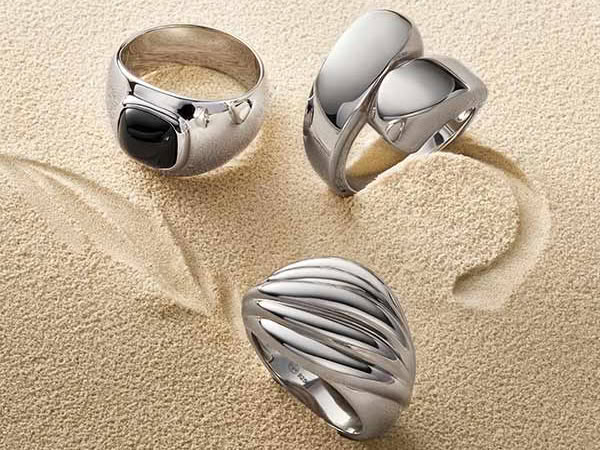
How to clean silver jewelry?
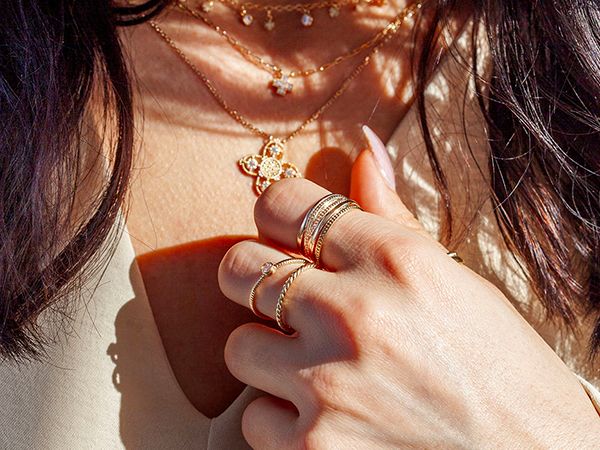
Mixing gold and silver jewelry... How can you successfully accumulate jewelry?